Oracle signed the largest sales contract in history! The secret behind their 44% revenue boost and what it means for AI 🤖

Get Email Alerts and Follow Us:
Oracle’s fourth quarter of 2024 was marked by substantial growth, driven by a significant increase in demand for its cloud services. This period saw the highest sales contract in Oracle’s history, largely due to the need for large language model training and a record level of sales for Oracle Cloud Infrastructure (OCI), autonomous databases, Fusion applications, and NetSuite. Oracle’s Remaining Performance Obligations (RPO) surged to $98 billion, reflecting a 44% year-over-year growth, indicating a strategic shift to multi-year cloud revenue commitments. The company’s US dollar revenue growth rate accelerated to 8%, and its EPS grew at a 10% compounded annual growth rateThe world of finance is replete with complex concepts, but one that stands as a cornerstone for investors seeking to gauge returns is the Compound Annual Growth Rate (CAGR). Often … More.
Oracle secured over 30 AI contracts worth $12 billion in the fourth quarter, with OpenAI selecting Oracle for deep learning workloads. Oracle’s cloud services are expanding with a new multi-cloud partnership with Google. Despite facing a 1% currency headwind, Oracle’s total cloud revenue excluding Cerner was $4.7 billion, up 23%. Including Cerner, the total rose by 20% to $5.3 billion. Oracle’s comprehensive and secure cloud offerings have driven this growth, with total revenues for the quarter reaching $14.3 billion. For the full fiscal year, Oracle’s total company revenue was $53 billion, up 6%, with significant contributions from cloud services.
Unprecedented Growth in Remaining Performance Obligations
Oracle’s Remaining Performance Obligations (RPO) reached $98 billion, a significant increase from $68 billion the previous year, reflecting a 44% year-over-year growth. This surge in RPO is indicative of the strategic shift from one-time non-recurring license revenue to multi-year cloud revenue commitments, which are expected to further accelerate Oracle’s growth rates in revenue, earnings, and cash flowThe cash flow statement provides a detailed overview of the cash inflows and outflows of a company over a specified period of time. It includes cash received from operations, inves… More.
Transformative Cloud Adoption
The pivot to cloud services has been a long-term strategy for Oracle, with the company’s US dollar revenue growth rate accelerating from negative one percent in fiscal year 2020 to eight percent in the past year, excluding Cerner. Over the same period, Oracle’s EPS has grown at a 10% compounded annual growth rateThe world of finance is replete with complex concepts, but one that stands as a cornerstone for investors seeking to gauge returns is the Compound Annual Growth Rate (CAGR). Often … More, while operating cash flowThe cash flow statement provides a detailed overview of the cash inflows and outflows of a company over a specified period of time. It includes cash received from operations, inves… More and free cash flowThe cash flow statement provides a detailed overview of the cash inflows and outflows of a company over a specified period of time. It includes cash received from operations, inves… More have both seen substantial increases.
Major Contracts and Strategic Partnerships
Oracle’s cloud services have become the focal point of customer conversations, as evidenced by several high-profile contracts. Notably, OpenAI selected Oracle to run deep learning and AI workloads on OCI due to its speed and cost-effectiveness. In total, Oracle signed over 30 AI contracts worth over $12 billion in the fourth quarter alone.
Additionally, Oracle continues to expand its cloud applications portfolio, helping companies transform their operations. For instance, a significant enterprise tech company signed a $600 million contract with Oracle to leverage Fusion applications for operational transformation, replacing many competitor products.
Oracle also announced a new multi-cloud partnership with Google, enabling OCI and Google Cloud Network interconnectivity in 10 regions, with Oracle Database services available on Google Cloud by September.
Comprehensive Cloud Offering
Oracle’s cloud offerings stand out due to their comprehensive, highly differentiated, and secure nature. Customers have moved from curiosity to full-scale rollout of Oracle Cloud services. The company’s cloud technologies are not only vertically integrated to work together but also offer flexible deployment models, including public cloud, multi-cloud, sovereign clouds, dedicated cloud, and Oracle Alloy, where partners can offer customized cloud services.
Financial Performance and Metrics
In the fourth quarter, Oracle faced a 1% currency headwind to total revenue and a $0.01 currency headwind to EPS. Despite these challenges, Oracle’s total cloud revenue, excluding Cerner, was $4.7 billion, up 23%. Including Cerner, total cloud revenue rose by 20% to $5.3 billion. SaaS revenue increased by 10% to $3.3 billion, while IaaS revenue grew by 42% to $2 billion.
Total cloud services and license support revenue for the quarter was $10.2 billion, up 10%, driven by strategic cloud applications, Autonomous Database, and OCI. Application subscription revenues reached $4.6 billion, up 6%, and infrastructure subscription revenues were $5.6 billion, up 13%. OCI Gen2 infrastructure cloud services saw a 44% increase, with an annualized revenue of $7.4 billion.
Cloud Infrastructure and Database Services
Oracle’s cloud database services, part of the company’s infrastructure subscription revenues, grew by 26%, achieving an annualized revenue of $2 billion. As on-premise databases migrate to the cloud, Oracle expects these cloud database services to become a significant revenue growth driver alongside OCI and strategic SaaS.
Revenue and Margin Analysis
Oracle’s total revenues for the quarter were $14.3 billion, up 4% including Cerner and 5% excluding Cerner. The gross marginGross margin is a critical financial metric that plays a pivotal role in evaluating a company’s financial health and profitability. It is a percentage that indicates how efficientl… More for cloud services and license support was 77%, with non-GAAP operating income reaching $6.7 billion, a 9% increase from the previous year. The operating marginThe operating margin is a critical financial metric that measures a company’s ability to generate profit through its core operations. It provides valuable insights into a company’s… More was 47%, up from 44%, as Oracle continues to drive efficiencies in its business.
Fiscal Year 2024 Overview
For the full fiscal year, Oracle’s total company revenue was $53 billion, up 6%. Total cloud services and license support revenue, accounting for nearly three-quarters of total revenue, was $39.4 billion, up 11%. Excluding Cerner, total cloud services revenue increased by 26% to $17.2 billion, with SaaS revenue up 13% to $10.4 billion and IaaS and cloud infrastructure revenue up 50% to $6.8 billion.
Non-GAAP EPS for the full year was $5.56, up 9% in USD. Oracle ended the fiscal year with nearly $10.7 billion in cash and marketable securities, a short-term deferred revenue balance of $9.3 billion, and operating cash flowThe cash flow statement provides a detailed overview of the cash inflows and outflows of a company over a specified period of time. It includes cash received from operations, inves… More of $18.7 billion, up 9%. Free cash flowThe cash flow statement provides a detailed overview of the cash inflows and outflows of a company over a specified period of time. It includes cash received from operations, inves… More was $11.8 billion, up 39%.
Outlook for Fiscal Year 2025
Looking ahead, Oracle expects continued strong cloud demand to drive double-digit revenue growth in fiscal year 2025. The company anticipates each successive quarter growing faster than the previous one as OCI capacity increases. Oracle’s momentum is bolstered by a growing pipeline, higher win rates, and expectations of 50% growth in cloud infrastructure services.
Insights
- Oracle’s cloud services saw unprecedented demand, leading to record-breaking sales contracts.
- The company’s strategic shift to multi-year cloud revenue commitments is driving significant growth.
- Oracle secured over 30 AI contracts worth $12 billion in Q4 alone.
- New multi-cloud partnership with Google enhances Oracle’s cloud offerings.
- Oracle’s total revenues for the quarter were $14.3 billion, a 4% increase.
The Essence (80/20)The Origins and Evolution of the 80/20 Principle The Discovery by Vilfredo Pareto In 1897, Italian economist Vilfredo Pareto uncovered a striking pattern in his study of wealth and… More
- Core Topics:
- Cloud Services Growth: Driven by OCI, autonomous databases, Fusion applications, and NetSuite.
- Strategic Shift to Cloud Revenue: Significant increase in RPO to $98 billion, indicating long-term commitments.
- AI and Large Contracts: Over 30 AI contracts worth $12 billion, including a major deal with OpenAI.
- Multi-Cloud Strategy: New partnership with Google for OCI and Google Cloud interconnectivity.
- Detailed Descriptions:
- Oracle’s emphasis on cloud services has resulted in the highest sales contracts in its history.
- The shift from one-time license revenue to multi-year cloud commitments is accelerating growth.
- High-profile AI contracts, such as with OpenAI, highlight the demand for Oracle’s cloud infrastructure.
- The multi-cloud partnership with Google expands Oracle’s reach and interoperability.
Action Plan – What Oracle Will Likely Do
- Enhance Cloud Infrastructure: Continue investing in OCI to maintain competitive edge and meet growing demand.
- Expand AI Capabilities: Leverage AI contracts to develop and integrate advanced AI functionalities in cloud services.
- Strengthen Partnerships: Develop more multi-cloud partnerships to offer flexible deployment models and expand market presence.
- Focus on Long-Term Commitments: Prioritize multi-year cloud revenue contracts to ensure sustained growth.
Blind Spot
- Potential Overlooked Details: The 1% currency headwind and its impact on revenue growth could affect long-term financial projections. Additionally, integrating Cerner’s revenues with Oracle’s could mask underlying performance metrics.
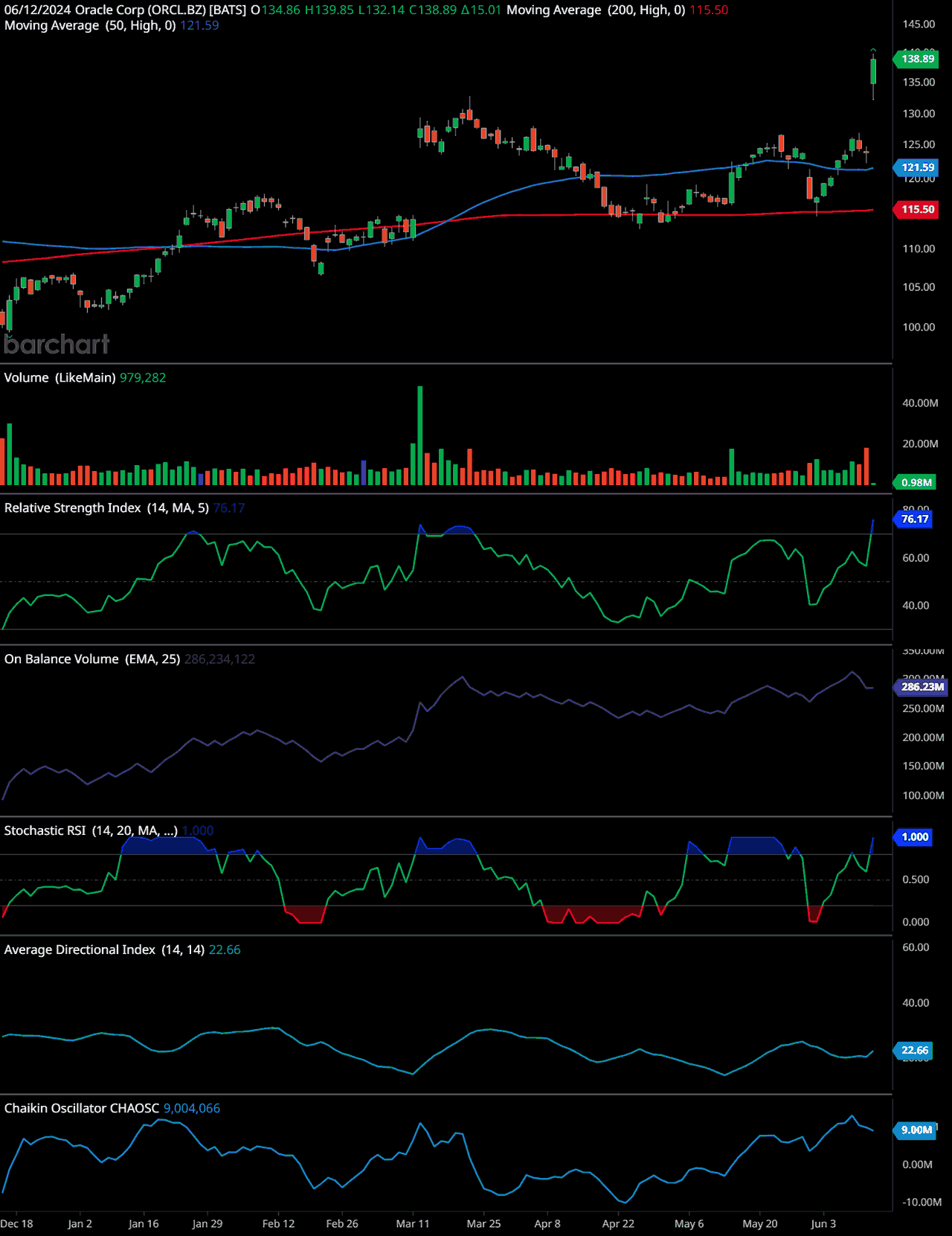
Oracle (ORCL) Technical Analysis
Price Action:
- The stock shows a significant bullish trend with a recent sharp upward movement. The latest price is $138.89, marking a considerable increase from previous levels.
- The stock price has broken above both the 50-day moving average (MA) at $121.59 and the 200-day MA at $115.50, indicating strong bullish momentum.
Volume:
- The trading volume has spiked significantly to 979,282, suggesting high investor interest and supporting the recent price surge.
Relative Strength IndexIn the world of technical analysis, the Relative Strength Index (RSI) stands as a cornerstone tool for traders seeking insights into market momentum. Developed by J. Welles Wilder … More (RSIIn the world of technical analysis, the Relative Strength Index (RSI) stands as a cornerstone tool for traders seeking insights into market momentum. Developed by J. Welles Wilder … More):
- The RSIIn the world of technical analysis, the Relative Strength Index (RSI) stands as a cornerstone tool for traders seeking insights into market momentum. Developed by J. Welles Wilder … More is at 76.17, which is in the overbought territory (above 70). This indicates that the stock might be overbought in the short term and could be due for a correction or consolidation.
On-Balance VolumeThe On Balance Volume indicator (OBV) is a technical analysis tool used to measure the flow of money into and out of a security over a specified period of time. It is a cumulative … More (OBVThe On Balance Volume indicator (OBV) is a technical analysis tool used to measure the flow of money into and out of a security over a specified period of time. It is a cumulative … More):
- The OBVThe On Balance Volume indicator (OBV) is a technical analysis tool used to measure the flow of money into and out of a security over a specified period of time. It is a cumulative … More has been trending upwards, supporting the bullish price action. An increasing OBVThe On Balance Volume indicator (OBV) is a technical analysis tool used to measure the flow of money into and out of a security over a specified period of time. It is a cumulative … More indicates that volume is flowing into the stock, reinforcing the upward price movement.
Stochastic RSIIn the realm of technical analysis, the Stochastic RSI (StochRSI) emerges as a powerful tool for traders seeking to navigate market dynamics with precision. Developed by Tushar S. … More:
- The Stochastic RSIIn the realm of technical analysis, the Stochastic RSI (StochRSI) emerges as a powerful tool for traders seeking to navigate market dynamics with precision. Developed by Tushar S. … More is at 1.000, which is also in the overbought zone. Similar to the RSIIn the world of technical analysis, the Relative Strength Index (RSI) stands as a cornerstone tool for traders seeking insights into market momentum. Developed by J. Welles Wilder … More, this suggests potential for a short-term pullback.
Average Directional IndexThe Average Directional Index (ADX) stands as a cornerstone indicator in the toolkit of technical traders, offering insights into the strength of market trends. Developed by Welles… More (ADXThe Average Directional Index (ADX) stands as a cornerstone indicator in the toolkit of technical traders, offering insights into the strength of market trends. Developed by Welles… More):
- The ADXThe Average Directional Index (ADX) stands as a cornerstone indicator in the toolkit of technical traders, offering insights into the strength of market trends. Developed by Welles… More is at 22.66, which is relatively low. This indicates that the current trend, although bullish, is not very strong yet. However, the recent price action suggests a potential increase in trend strength if the ADXThe Average Directional Index (ADX) stands as a cornerstone indicator in the toolkit of technical traders, offering insights into the strength of market trends. Developed by Welles… More rises.
Chaikin OscillatorNamed after its creator Marc Chaikin, the Chaikin Oscillator stands as a formidable tool in the arsenal of technical analysts. This oscillator is designed to measure the accumulati… More:
- The Chaikin OscillatorNamed after its creator Marc Chaikin, the Chaikin Oscillator stands as a formidable tool in the arsenal of technical analysts. This oscillator is designed to measure the accumulati… More is at 9,004,066, showing a strong positive value. This indicator supports the bullish momentum, suggesting that the buying pressure is currently outweighing selling pressure.
Time-Frame Signals:
- 3-Month Horizon: Hold. Despite the current bullish trend, the RSIIn the world of technical analysis, the Relative Strength Index (RSI) stands as a cornerstone tool for traders seeking insights into market momentum. Developed by J. Welles Wilder … More and Stochastic RSIIn the realm of technical analysis, the Stochastic RSI (StochRSI) emerges as a powerful tool for traders seeking to navigate market dynamics with precision. Developed by Tushar S. … More indicate overbought conditions, suggesting a possible short-term pullback or consolidation.
- 6-Month Horizon: Buy. The overall trend is upward, supported by increasing OBVThe On Balance Volume indicator (OBV) is a technical analysis tool used to measure the flow of money into and out of a security over a specified period of time. It is a cumulative … More and strong volume. A potential short-term correction could provide a better entry point.
- 12-Month Horizon: Buy. The long-term outlook remains positive with the stock breaking above major moving averages, indicating sustained bullish momentum.
In summary, while short-term indicators suggest the stock may be overbought and could see a pullback, the overall trend remains bullish. Long-term investors might consider buying on dips, while short-term traders should be cautious of potential corrections.
Remember, past performance is not an indication of future results. Always conduct your own research and consider consulting with a financial advisor before making any investment decisions. 🧡
Looking Ahead
Oracle’s fourth quarter of 2024 was marked by exceptional performance, driven by strong demand for its cloud services. The company’s strategic shift to multi-year cloud revenue commitments has set the stage for continued growth in revenue, earnings, and cash flowThe cash flow statement provides a detailed overview of the cash inflows and outflows of a company over a specified period of time. It includes cash received from operations, inves… More. With a robust pipeline, significant partnerships, and a comprehensive cloud offering, Oracle is well-positioned for sustained success in the coming years.
Frequently Asked Questions
-
Q1: What marked Oracle’s fourth quarter of 2024 as extraordinary?
A1: Oracle’s fourth quarter of 2024 was marked by a significant surge in large software license contracts and unprecedented demand for Oracle’s cloud services, resulting in the largest sales contract in its history.
-
Q2: How much did Oracle’s Remaining Performance Obligations (RPO) increase?
A2: Oracle’s RPO reached $98 billion, a 44% year-over-year growth from $68 billion the previous year.
-
Q3: What is the significance of the shift from one-time non-recurring license revenue to multi-year cloud revenue commitments?
A3: This strategic shift is expected to further accelerate Oracle’s growth rates in revenue, earnings, and cash flowThe cash flow statement provides a detailed overview of the cash inflows and outflows of a company over a specified period of time. It includes cash received from operations, inves… More.
-
Q4: What was Oracle’s US dollar revenue growth rate in fiscal year 2024 excluding Cerner?
A4: Excluding Cerner, Oracle’s US dollar revenue growth rate was 8% in the past year.
-
Q5: How many AI contracts did Oracle sign in the fourth quarter of 2024?
A5: Oracle signed over 30 AI contracts worth over $12 billion in the fourth quarter of 2024.
-
Q6: What notable partnership did Oracle announce with Google?
A6: Oracle announced a new multi-cloud partnership with Google, enabling OCI and Google Cloud Network interconnectivity in 10 regions, with Oracle Database services available on Google Cloud by September.
-
Q7: What was Oracle’s total cloud revenue excluding Cerner for the fourth quarter?
A7: Excluding Cerner, Oracle’s total cloud revenue for the fourth quarter was $4.7 billion, up 23%.
-
Q8: How much did Oracle’s SaaS and IaaS revenues grow in the fourth quarter?
A8: SaaS revenue increased by 10% to $3.3 billion, while IaaS revenue grew by 42% to $2 billion.
-
Q9: What was Oracle’s total revenues for the fourth quarter of 2024?
A9: Oracle’s total revenues for the fourth quarter were $14.3 billion, up 4% including Cerner and 5% excluding Cerner.
-
Q10: What was Oracle’s operating marginThe operating margin is a critical financial metric that measures a company’s ability to generate profit through its core operations. It provides valuable insights into a company’s… More for the fourth quarter of 2024?
A10: Oracle’s operating marginThe operating margin is a critical financial metric that measures a company’s ability to generate profit through its core operations. It provides valuable insights into a company’s… More was 47%, up from 44% in the previous year.
-
Q11: How much was Oracle’s total company revenue for the full fiscal year 2024?
A11: Oracle’s total company revenue for the full fiscal year 2024 was $53 billion, up 6%.
-
Q12: What was Oracle’s non-GAAP EPS for the full fiscal year 2024?
A12: Oracle’s non-GAAP EPS for the full fiscal year 2024 was $5.56, up 9% in USD.
-
Q13: What are Oracle’s expectations for fiscal year 2025?
A13: Oracle expects continued strong cloud demand to drive double-digit revenue growth in fiscal year 2025, with each successive quarter growing faster than the previous one.
-
Q14: How did Oracle’s cloud database services perform in the fourth quarter?
A14: Oracle’s cloud database services grew by 26%, achieving an annualized revenue of $2 billion.
-
Q15: What was Oracle’s free cash flowThe cash flow statement provides a detailed overview of the cash inflows and outflows of a company over a specified period of time. It includes cash received from operations, inves… More for the full fiscal year 2024?
A15: Oracle’s free cash flowThe cash flow statement provides a detailed overview of the cash inflows and outflows of a company over a specified period of time. It includes cash received from operations, inves… More for the full fiscal year 2024 was $11.8 billion, up 39%.
Get Email Alerts and Follow Us:
We are entirely supported by readers like you. Thank you for your support.
This content is provided for informational purposes only and does not constitute financial, investment, tax or legal advice or a recommendation to buy any security or other financial asset. The content is general in nature and does not reflect any individual’s unique personal circumstances. The above content might not be suitable for your particular circumstances. Before making any financial decisions, you should strongly consider seeking advice from your own financial or investment advisor.
Source link