Powell’s Highly Awaited Speech Today Lifts Likelihood of Resumed Cycle of U.S. Interest Rate Reduction – Currency Thoughts
Powell’s Highly Awaited Speech Today Lifts Likelihood of Resumed Cycle of U.S. Interest Rate Reduction
August 22, 2025
Speaking at the Jackson Hole Monetary Symposium this morning Federal Reserve Chairman Powell acknowledged that the U.S. baseline outlook and balance of risks between higher inflation and lessening employment growth are shifting. Major points that were expressed include
- Broad agreement among policymakers exists that recent and ongoing tariff hikes will lift inflation in the short run.
- Opinion is much more diversified over whether the tariff changes will induce a faster ensuing rate of price inflation.
- The labor market has weakened in recent months more extensively than realized at the time of the last FOMC meeting.
- A risk was acknowledged that a more significant-than-acceptable labor market softness could develop quickly.
- The Fed’s macroeconomic forecasts are being updated as scheduled for the September 16-17th FOMC meeting.
- This upshot of this year’s planned 5-year review of the monetary policy framework reverted to the prior targeting of year-on-year inflation at 2.0%. For the past five years, the objective had been to aim for an average inflation rate of 2.0% over an extended span of time. Under such an interpretation, the extended period over which actual inflation exceeded 2% since 2021 could have imposed a brake on how aggressively policy would be loosened going forward. That implicit constraint has now been lifted.
An important policy element that was not directly addressed is whether over time investors conclude that the modified change in policy forward guidance was influenced heavily by the various efforts of President Trump to influence the Fed’s stance. There is extensive evidence both in U.S. past experience and in the examples of political influence over monetary policy in other countries that such behavior compromises the transmission and effectiveness of monetary policy changes in a negative way. Time will tell if that’s the case again.
Despite the above danger, the immediate financial market reaction to Chairman Powell’s shifted message today was dramatic and as one would expect. The 10-year U.S. Treasury yield dropped 7 basis points and by more than other comparable sovereign debt yields such as in Italy (-5 basis points), France and Spain (-4 bps), or Great Britain and Germany (-3 bps). The 10-year Japanese JGB rose a basis point earlier in the day.
All major U.S. stock market indices rose over 1.0%, especially the Russell 2000. European share prices also got a lift but climbed less sharply. In the Pacific Rim, which closed before Powell speech started at 10:00 EDT, solid market gains in China (1.5%), Japan (1.1%), South Korea (0.9%), and Hong Kong (also 0.9%) were balanced by losses of 1.1% in New Zealand, 0.9% in India, 0.8% in Taiwan, and 6% in Australia and 0.4% in Indonesia.
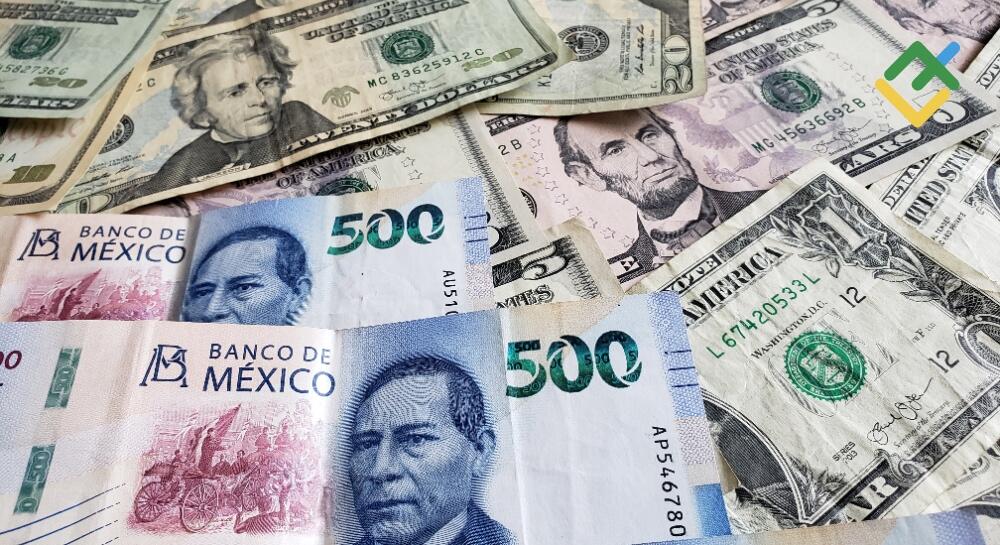
With the scenario of 50 basis points or more easing by yearend back in play, the dollar fell fairly sharply at the end of this week, losing 0.6-0.8% so far on the day against the euro, yen, Swiss franc, Aussie dollar, Mexican peso, and kiwi. The dollar has lost a lesser amount against the Canadian currency but more than 1.0% versus the South Korean won.
Bitcoin’s price got an instant jolt, jumping around 2.5%, and oil and gold each rose about 0.5%.
Data release highlights today included revised German and Mexican GDP from the second quarter, Japanese consumer prices in July, and French business confidence in August.
German growth last quarter was revised from a non-annualized dip of 0.1% reported initially to a slide of 0.3% that reverses 0.3% of positive growth in the first quarter and left GDP in the first half of 2025 just 0.25% above the year-earlier level.
Mexican growth last quarter was revised 0.1 percentage point lower to 0.6% and associated with zero percent on-year growth.
Japanese consumer price inflation lost underlying momentum in July, posting a seasonally adjusted monthly 0.1% uptick in the overall index and also the CPI indices that exclude fresh food and both food and energy. Core inflation slid to 3.1%.
French business confidence in August printed at 95.8, just 0.1 point lower than in July and earning a trend designation of stable. Sentiment has been below the long-term average of 100 since July 2024 but has fluctuated narrowly between 95.0 and 97.4 for the last ten months. In the retail sector, however, confidence deteriorated sharply to 92.4 in August from a reading of 98.5 in the previous month. Another concern involved the trend in employment, which darkened further.
Other news emerging this Friday included Irish wholesale price deflation that moved from a 20-month high of -4.6% in June to -3.5% in July. Slovenian consumer sentiment in August printed at -27, its least negative reading since September 2023. ECB officials will no doubt take notice that negotiated wage growth accelerated to a greater-than-desired 3.95% last quarter. British consumer confidence rose two index points in August to an 8-month high but still well below zero at -17. And Canadian retail sales fell 0.8% last month following a 1.5% monthly rise in June.
Copyright 2025, Larry Greenberg. All rights reserved. No secondary distribution without express permission.
Tags: French business confidence, German GDP, Japanese CPI, Powell speech highlights


 ShareThis
You can leave a response, or trackback from your own site.