Why Do Professional Traders Scale In And Scale Out Of Trades?
Professional traders often have large orders to fill.
While one reason for scaling their trades is to avoid moving the market with a single large order, there are several other strategic benefits as well.
By the end of this article, you’ll understand why scaling in and out is a common practice among professional traders.
Contents
If a trader commits their entire allocation to a single large order, they risk an unfavorable fill or poor pricing due to short-term market fluctuations.
To manage this risk, professionals enter their positions in smaller portions over time.
For example, they might buy one-third of their intended position initially, then add the remaining two-thirds at later intervals.
This approach helps them achieve a more balanced average entry price.
Another reason traders scale in is to manage risk dynamically.
A professional might start with a smaller position, and if the trade begins to move in their favor, they’ll add to it – essentially rewarding trades that confirm their thesis.
On the other hand, if the trade doesn’t work out, their exposure remains small, limiting potential losses.
When it comes to exiting, professional traders often take profits in stages rather than all at once.
They may sell part of their position when a specific profit target is reached, locking in gains, while leaving the remaining portion to run if the trend continues.
This way, they capture profits along the way but still keep some exposure if the trade turns into a bigger winner.
Scaling into and out of equity positions is as straightforward as buying and selling shares.
An options trade involves adding multiple contracts.
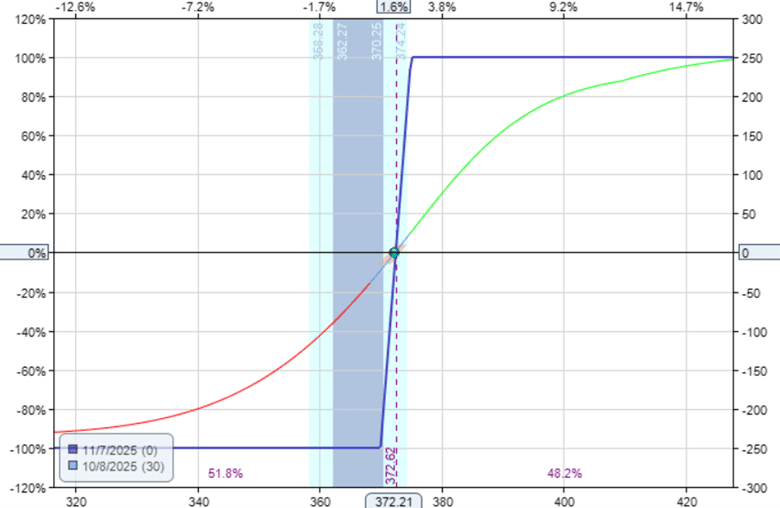
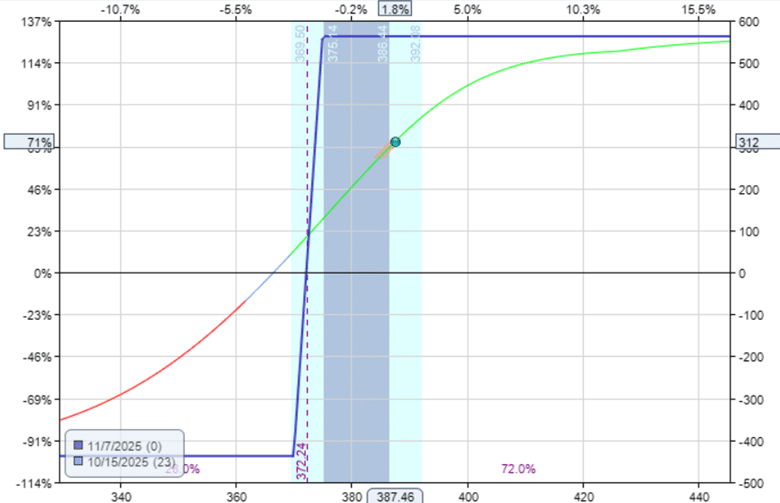
The gold ETF (GLD) is at $372 per share on October 8th, 2025, and an options trader buys a bull call debit spread, expecting continued upward movement.
Date: Oct 8, 2025
Price: GLD @ $372.21
Buy to open one contract Nov 7 GLD $370 call @ $10.23
Sell to open one contract Nov 7 GLD $375 call @ $7.73
Debit: -$250
She paid $250 for the spread.
This is only half of her intended position size.
The next day, GLD dropped in price to $366.
Similarly, the bull call spread of the same strikes costs less.
It’s not a serious drop.
Just a pullback in the price.
Great! Gold and gold call spreads are on sale today.
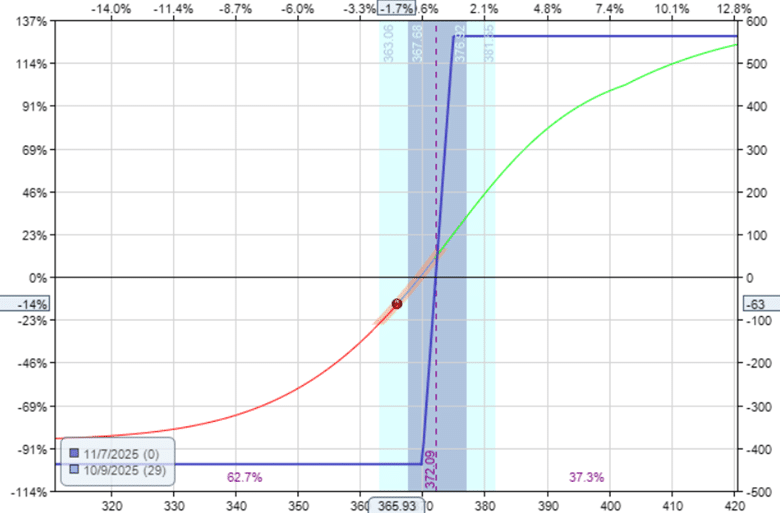
So she adds another contract to her existing position.
Date: Oct 9, 2025
Price: GLD @ $365.93
Buy to open one contract Nov 7 GLD $370 call @ $6.93
Sell to open one contract Nov 7 GLD $375 call @ $5.05
Debit: -$188
The same call spread that she bought yesterday for $250 now costs $188.
Her full position, with two contracts, now looks like this, with a max potential risk in the trade of $438, equal to the sum of the debits from both orders.
A week later, she was able to close the position for a profit of $312 when GLD rose to $387 per share.
She sold to close the two-contract bull call spread position for a credit of $750.
She could have scaled out of the position as well.
But we will demonstrate that in the following example.
This example was to show that by scaling into the position, she was able to buy her bull call spreads for a lower price than if she had entered into her full position on October 8th.
And a lower price means lower trade risk and a higher return on investment.
In terms of dollar value, her profit in the trade is greater than if she had entered the full position on October 8th.
By how much? By $62 more profit.
She saved $62 by buying the second contract at a lower price.
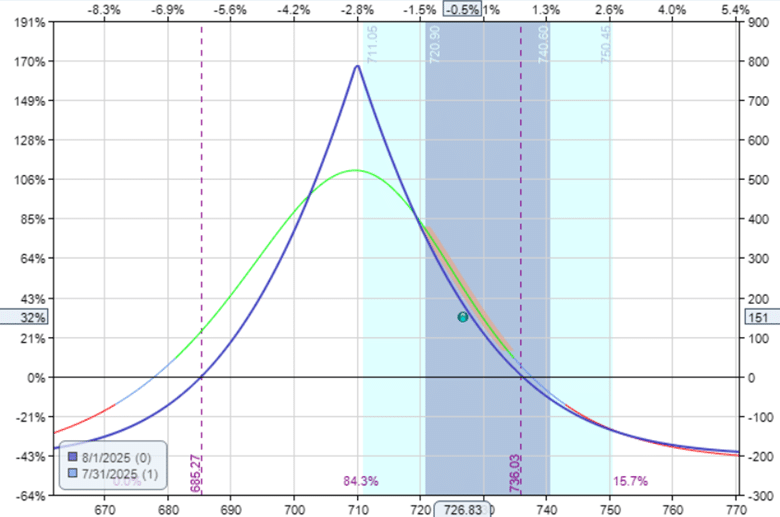
Let’s take an example of scaling out of a calendar spread on the stock Goldman Sachs (GS).
To scale out, there must be at least two contracts to begin with.
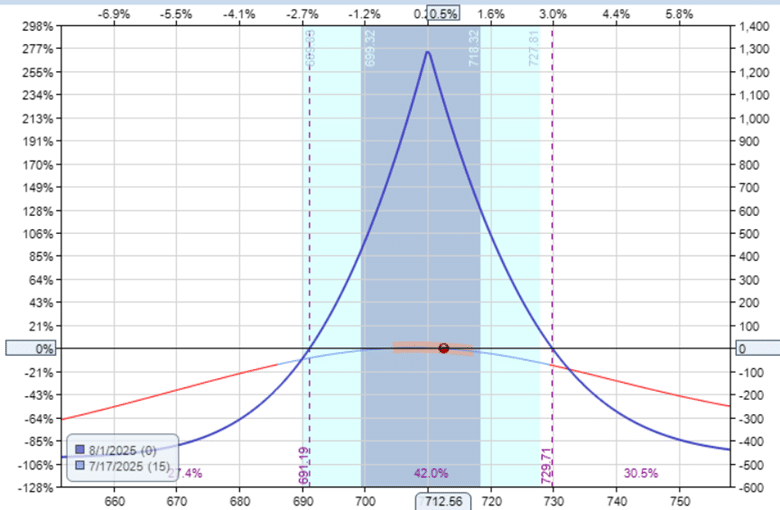
Date: July 17, 2025
Price: GS @ $712.50
Sell to open two contracts of Aug 1st GS $710 put @ $12.08
Buy to open two contracts of Aug 8th GS $710 put @ $14.43
Net debit: -$470
This is a two-contract calendar, with each calendar costing a debit of $235.
Hence, the max risk in the entire trade is $470 (or the total debit paid).
The trade started out with 15 days to expiration.
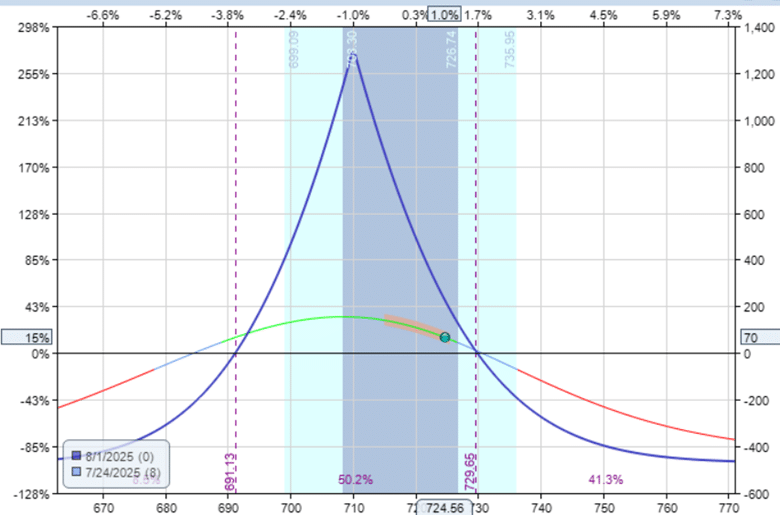
Halfway into the trade with 7 days left till expiration, the price has moved to the edge of the expiration graph profit tent:
Date: July 24th, 2025
Price: GS @ $724.50
P&L in trade: $70
The trade has made a 15% profit, but not at the original 30% target the trader desired.
What to do?
If GS continues to go up in price, it will move out of the profit tent and the entire profit would likely be lost.
If GS goes down in price, the calendar profit will increase and potentially reach the 30% profit target.
The dilemma is:
Should the trader be conservative and take the lower profit now?
Better to secure some guaranteed profit than to risk ending up with nothing at all.
Or should the trader be aggressive and go for the win?
This indeed would be a dilemma if there were only one contract.
Because there are two contracts, the trader decides to close out half of the position.
Buy to close one contract Aug 1st GS $710 put @ $4.38
Sell to close one contract Aug 8th GS $710 put @ $7.08
Credit: $270
The trader essentially took profits on one of the calendars and let the other calendar run.
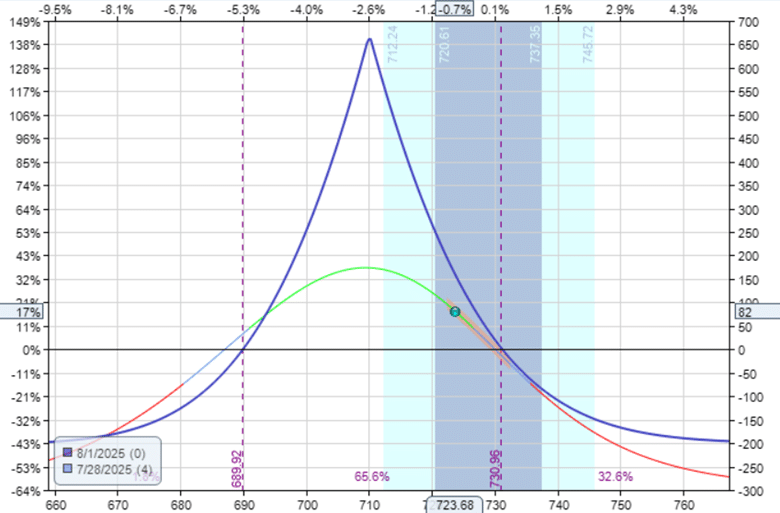
A few days later, with four days remaining until the near-term option expires, the overall trade shows a net profit of $82.
The trader could exit the position now if desired.
But since the trader had already scaled out and locked in a portion of the profits, he is willing to take some risk on this smaller position and hold the trade closer to expiration.
On the day before expiration, the trade hit its 30% profit target, with a net profit of $151.
It is true that in this particular case, the trader would have made even more money if he had not scaled out.
But it could have easily gone the other way, and the trader would have lost more money if he had not scaled out.
Nevertheless, two contracts are better than one (as long as it doesn’t exceed proper position size).
Because it gives you an easy way to resolve your dilemma without needing to commit to one decision or the other, you can have your cake and eat it too (as the saying goes).
Scaling in and out allows professional traders to manage both risk and opportunity, protecting themselves from unfavorable pricing, while positioning for potential upside.
We hope you enjoyed this article on how professional traders scale in and scale out of trades.
If you have any questions, please send an email or leave a comment below.
Trade safe!
Disclaimer: The information above is for educational purposes only and should not be treated as investment advice. The strategy presented would not be suitable for investors who are not familiar with exchange traded options. Any readers interested in this strategy should do their own research and seek advice from a licensed financial adviser.

Source link