Spring forecast: Reeves insists her economic plan ‘even more important’ given Middle East crisis – live updates
UK growth for 2026 cut, but faster growth ahead
Onto growth, and Reeves says the OBR has “adjusted the profile of GDP” so that it grows slightly slower in 2026 and then faster in both 2027 and 2028.
Here are the new forecasts:
-
2026: growth of 1.1%, down from 1.4% growth forecast in November
-
2027: growth of 1.6%, up 1.5% growth forecast in November
-
2028: growth of 1.6%, up 1.5% growth forecast in November
-
2029: growth of 1.5%, as forecast in November
-
2030: growth of 1.5%
Key events
Reeves: borrowing down, headroom up.
On borrowing, Reeves says the UK is set to borrow less than the G7 average, something that the Tories never achieved in any year in 14 years.
[Those 14 years included the austerity years, and the cost of the Covid-19 pandemic].
Today’s forecasts show that public sector net borrowing is set to fall from 4.3% of GDP this year to 3.6% next year, then to 2.9%, 2.5% and to 1.8% in the 2029-30 financial year, she explains.
The chancellor then reveals that her headroom against the stability rule in 2029-30 has increased from £21.7bn to £23.6bn.
Headroom against the investment rule is also higher at £27.1bn.
That means she’s still sticking to her goal of sticking to the fiscal rules. In normal times, that would reassure the financial markets…..
Ddebt is now set to be lower in every year of the forecast compared with the autumn, she adds.
No Labour party speech is complete without a pop at “Liz Truss’s disastrous mini budget”, which crashed the pound three and a half years ago.
Reeves says that 2022 fiscal event was cheered on by the leader of the opposition and by “the honorable member for Clacton” (Nigel Farage), who she calls out for not being present.
Rachel Reeves then pokes the “failed economic dogmas of the past”, such as the “trickle down, trickle out thinking” that she says has produced diminishing returns for working people.
Reeves then explains that she will outline three major choices for the UK economy in two weeks time when she delivers the Mais Lecture in London.
Those choices, she says, are:
-
To go further in strengthening global relationships, break down trade barriers and deepen alliances with European partners
-
To go further in backing innovation and harnessing the power of AI.
-
And to go further in transforming our economic geography so that we can build growth on a broad and stable basis, spread opportunity and unlock opportunity across the country.
Reeves: We can beat the forecasts again
In what may be a hostage to fortune, the chancellor declares that “in the face of global uncertainty, we beat the forecasts last year.”
Reeves insists she has confidence that the government can beat forecasts again, as more of the choices made by the government will come into effect.
She cites discounts on energy costs, trade deals with India, the US and the EU, and reforms to back entrepreneurs, investment in infrastructure and skills, funding for further education and more planning reforms.
In today’s forecasts, unemployment is set to peak later this year and then fall in every year of the forecast period, Reeves says.
UK growth for 2026 cut, but faster growth ahead
Onto growth, and Reeves says the OBR has “adjusted the profile of GDP” so that it grows slightly slower in 2026 and then faster in both 2027 and 2028.
Here are the new forecasts:
-
2026: growth of 1.1%, down from 1.4% growth forecast in November
-
2027: growth of 1.6%, up 1.5% growth forecast in November
-
2028: growth of 1.6%, up 1.5% growth forecast in November
-
2029: growth of 1.5%, as forecast in November
-
2030: growth of 1.5%
Reeves: Inflation expected to fall faster than forecast (except….)
The office for Budget Responsibility expect inflation to come down even faster than it forecast in the autumn, Reeves says.
[Except, these forecasts presumably don’t account for the surge in energy prices this week?].
Reeves reminds MPs that she is cutting energy bills by £150 in April (as announced last year).
In the current global context, with the risk that rising energy prices will put upward pressure on inflation, the action that I have taken is even more crucial to keeping inflation low and stable, and the best way to support family incomes and reduce pressures on the cost of living.
Reeves reminds MPs that there have been six cuts to UK interest rates since the last general election.
[True, but the chances of a 7th soon have tumbled today].
Turning to the OBR’s new forecasts, Reeves says they show that the government’s plan is the right one.
He insists:
Inflation is down, borrowing is down, living standards are up and the economy is growing.
She then criticises the previous government for letting inflation to skyrocket over 11% (after the Ukraine war drove up the cost of living), saying the last parliament was the first one where people were poorer at the end than the beginning.
Reeves: in regular contact with Bank of England governor
Reeves then reassures MPs that she is in “regular contact” with the governor of the Bank of England, with her international counterparts, and with key sectors who are affected by the Middle East crisis – including the maritime sector.
Reeves: Economic plan is “even more important” given Middle East crisis
Rachel Reeves begins by telling MPs that the government has “the right economic plan for the country”, triggering a outburst of noise in the Commons.
The chancellor says this plan is “even more important” in a world that has become “yet more uncertain” in the last few days.
Given the unfolding conflict in Iran and the Middle East, Reeves says it is “incumbent on me” to chart a course through that uncertainty, secure the economy against shocks and protect families from the turbulence beyond our borders.
Reeves begins statement on spring forecast
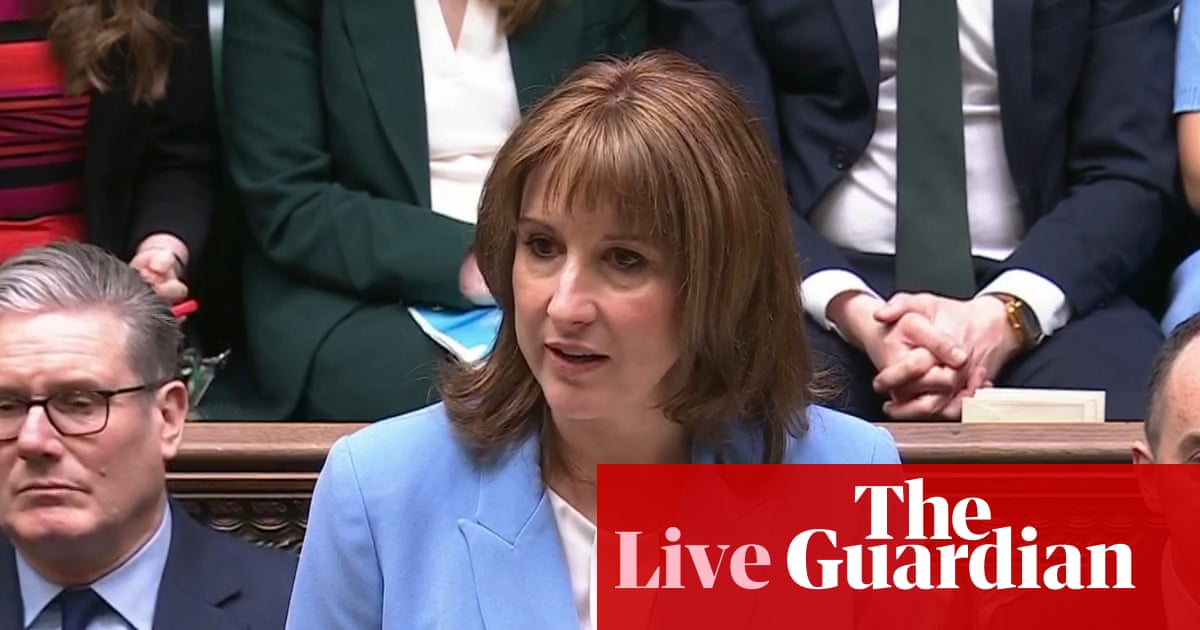
Chancellor Rachel Reeves is now delivering her response to the UK’s spring forecast in parliament, updating MPs on the state of the economy.
This forecast, produced by the Office for Budget Responsibility, will show the latest outlook for growth, inflation and unemployment.
They should also let economists judge whether the UK is on track to hit the chancellor’s fiscal rules.
However, the Middle East crisis – and the surge in oil and gas prices this week – mean such forecasts are probably already out of date even before they’re published (once the chancellor finishes speaking).
Today was meant to be a non-event, as the government has committed to holding just one major fiscal event each year in the autumn; we’re not expecting any major policy changes….
Reeves is giving statement with a backdrop of tumbling financial markets. The UK’s FTSE 100 share index is currently down 2.5%, on track for its worst day since Donald Trump launched his trade war last April.
And disappointingly for the chancellor, the City has slashed its bets on an interest rate cut this month – it’s now just a 22% chance…..
Rachel Reeves, and Sir Keir Starmer, have taken their seats in the House of Commons now, where Foreign Office questions are taking place.
Our Politics Live blog has all the key developments:
Rachel Reeves has now left 11 Downing Street to head to parliament, to deliver her response to the OBR’s Spring Economic Forecast (which will be published after she speaks).