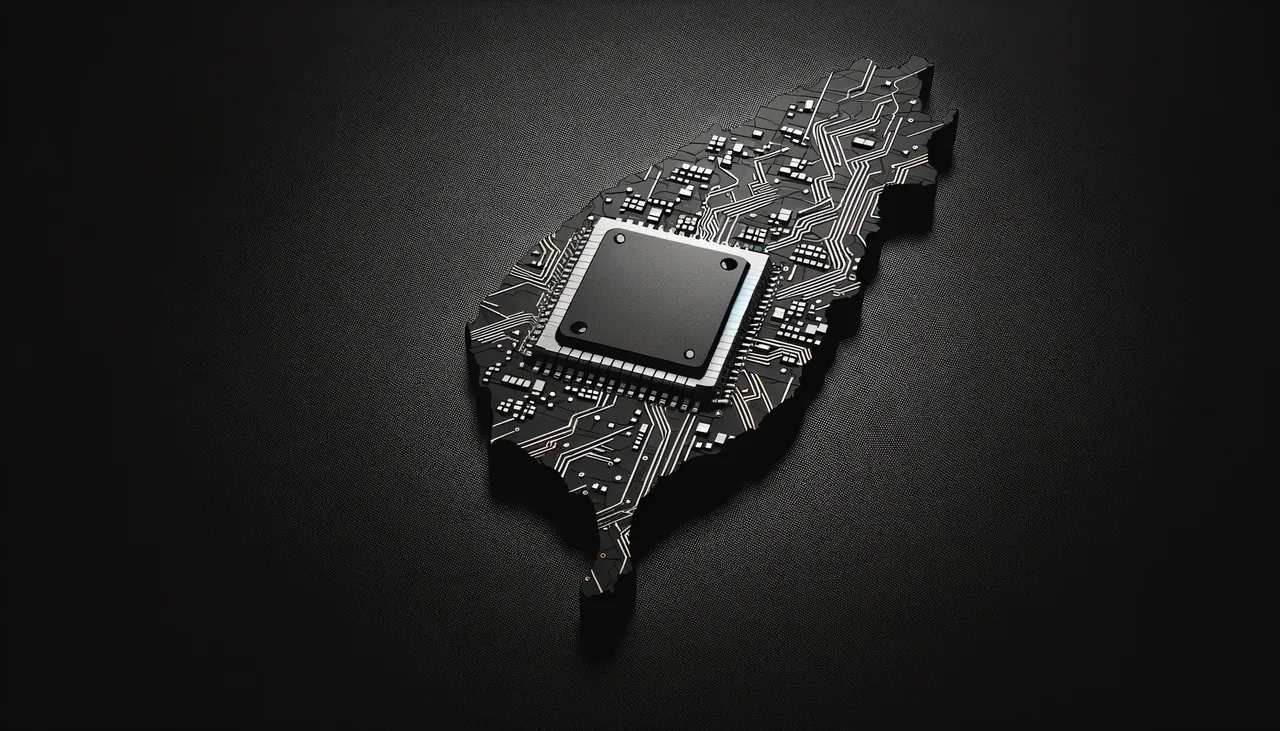
Taiwan’s Presidency Under Siege: What China’s Military Actions Mean for the Semiconductor Industry


Get Email Alerts and Follow Us:
On May 20, Taiwan inaugurated its new president, Lai Ching-te, who faces significant challenges due to escalating tensions with China. Shortly after Lai’s call for peaceful relations, the People’s Liberation Army (PLA) conducted military drills around Taiwan, indicating possible preparations for a blockade or invasion. These maneuvers, although not alarming financial markets, suggest severe potential disruptions, especially to the global semiconductor industry, with Taiwan Semiconductor Manufacturing Co. (TSMC) being a critical player.
Analysts warn that a blockade could drastically impact global economies, reducing GDP by significant margins. Taiwan’s democratic success challenges China’s authoritarian regime, fueling Beijing’s ambitions to control Taiwan. The strategic importance of Taiwan’s semiconductor industry, coupled with technological safeguards, adds complexity to the situation. The new administration’s handling of this geopolitical tension will have profound implications for global stability and economic health.
Lai Ching-te’s presidency began under the shadow of heightened tensions. Despite his call for peaceful relations and mutual respect, the PLA’s maneuvers around Taiwan sent a clear and ominous message. These drills are not mere posturing but could be interpreted as a rehearsal for a potential blockade or invasion.
Evidence suggests that these actions are likely simulations of a blockade. A real blockade could have catastrophic consequences, particularly for the global semiconductor industry. Taiwan Semiconductor Manufacturing Co. (TSMC), the world’s leading chip manufacturer, plays a pivotal role in the global economy. A blockade disrupting TSMC’s operations could cost the global economy approximately $5 trillion.
Economic Impact and Market Response
Despite the gravity of the situation, Taiwan’s financial markets remained relatively unfazed. The benchmark stock index marked its fifth consecutive weekly gain, and TSMC reached a record high. This calm in the markets belies the potential for severe economic disruption should China proceed with a blockade.
The ramifications of such a blockade would be far-reaching. Autos and home electronics, heavily reliant on semiconductor supplies, would face significant production delays and cost increases. Economies with strong ties to these sectors, such as South Korea, Mexico, Southeast Asia, Japan, and the European Union, would suffer disproportionately.
A total cutoff from Taiwan, coupled with Western sanctions on China, could reduce global GDP by about 5%, equivalent to $5 trillion, in the first year. The U.S. GDP could drop by 3.3%, while China’s economy might shrink by 8.9%.
The Geopolitical Stakes
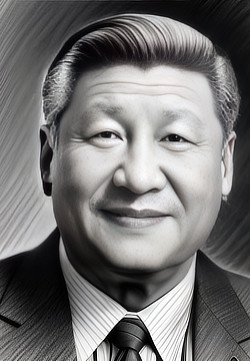
Taiwan’s democratic system and economic success present a direct challenge to the Chinese Communist Party’s narrative of prosperity and stability. Just over 100 miles off China’s coast, Taiwan’s vibrant democracy and high living standards starkly contrast with the mainland’s authoritarian regime. This contrast fuels Beijing’s desire to bring Taiwan under its control, a goal repeatedly emphasized by President Xi Jinping.
The prospect of a military blockade is particularly concerning for Taipei. A blockade, as opposed to a full-scale invasion, poses fewer risks to Chinese forces and might not immediately trigger a war with the United States. Blockade strategies could range from selective interdiction of Taiwan-bound shipping to a comprehensive military blockade cutting off all air and sea traffic.
Technological and Strategic Considerations
The strategic importance of Taiwan’s semiconductor industry cannot be overstated. TSMC’s chips are integral to numerous global industries, and any disruption in supply would have profound economic implications. The world witnessed the impact of supply-chain disruptions during the COVID-19 pandemic, and a Taiwan blockade could lead to similar, if not worse, consequences.
Moreover, technological safeguards exist to mitigate some risks. For instance, ASML Holding NV, the Dutch company that manufactures essential machines for advanced chip production, has the capability to disable these machines remotely. Taiwan’s new technology minister, Wu Cheng-wen, confirmed that TSMC could also remotely shut down its equipment in the event of a conflict, adding another layer of complexity to any potential blockade.
Insights
- PLA’s drills signal serious threats to Taiwan’s sovereignty.
- A blockade could severely disrupt global semiconductor supplies.
- Taiwan’s democracy contrasts sharply with China’s authoritarianism.
- Financial markets remain surprisingly calm despite potential crises.
The Essence (80/20)
- Core Topics: Geopolitical Tensions, Economic Impact, Semiconductor Industry, Democracy vs. Communist Governance.
- Descriptions:
- Geopolitical Tensions: China’s military drills around Taiwan indicate preparation for possible aggressive actions.
- Economic Impact: A blockade on Taiwan could reduce global GDP by $5 trillion, heavily impacting tech-reliant industries.
- Semiconductor Industry: TSMC’s pivotal role in global tech underscores the economic threat of a Chinese blockade.
- Governance Models: Taiwan’s vibrant democracy stands as a stark contrast to China’s communist regime, motivating Beijing’s aggressive stance.
The Action Plan – What Taiwan Should Do
- Strengthen Diplomatic Alliances: Taiwan should bolster ties with democratic nations to secure support against Chinese aggression.
- Enhance Defensive Capabilities: Increase military preparedness and technological defenses to counter potential blockades.
- Economic Diversification: Reduce dependency on semiconductor exports by developing other high-value industries.
- Public Awareness Campaign: Educate global markets and allies on the implications of a blockade to rally international support.
Blind Spot
Potential overreliance on international diplomatic support may overlook the immediate need for robust self-defense mechanisms and economic resilience strategies within Taiwan.
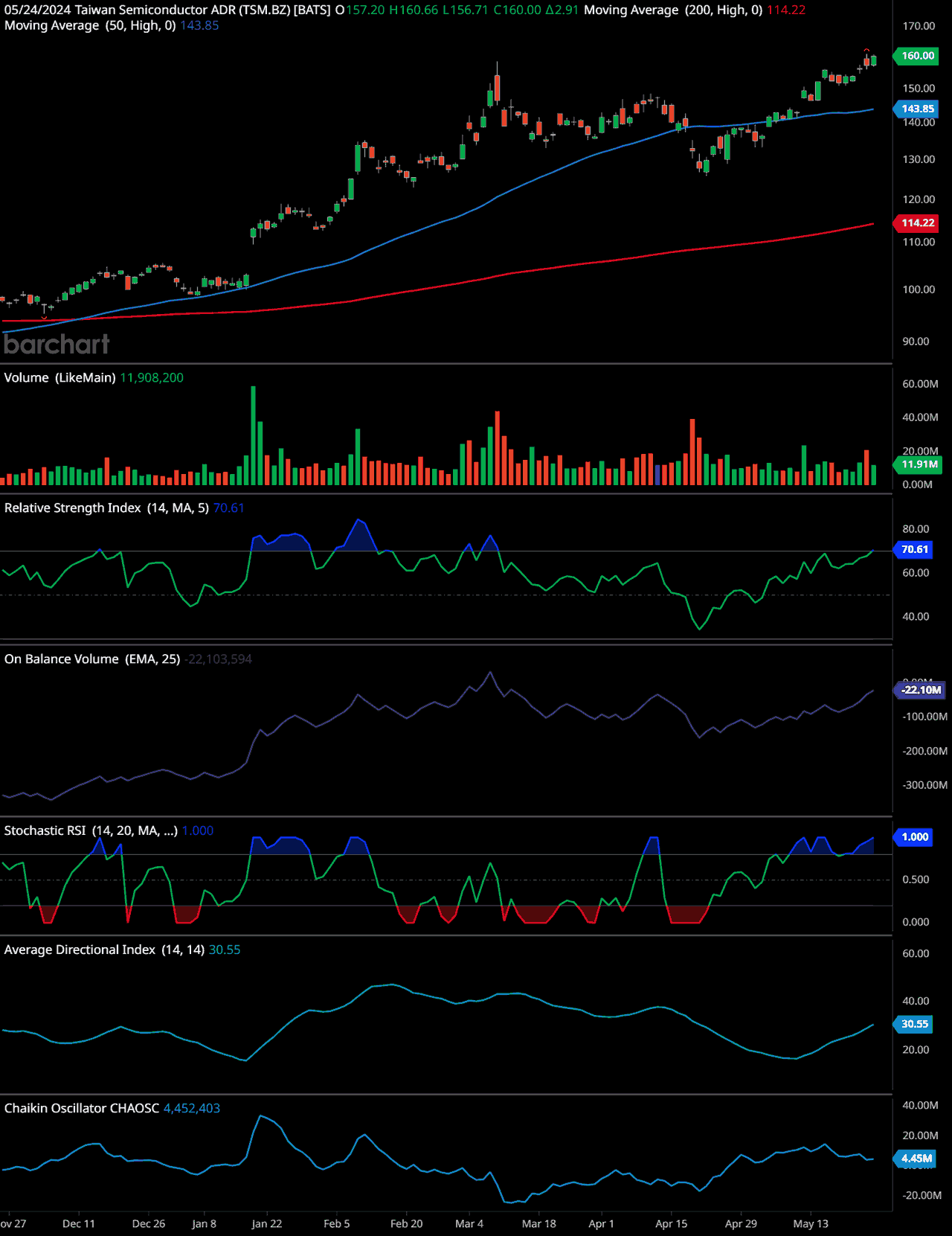
Taiwan Semiconductor (TSM) Technical Analysis
Price Trend and Moving Averages: The stock has shown an overall upward trend. The 50-day moving average (blue line) is at 143.85 USD, and the 200-day moving average (red line) is at 114.22 USD. The stock is currently trading above both moving averages, indicating a bullish trend.
Volume: The volume for the latest trading day is 11,908,200 shares. There has been a notable increase in volume, which often supports the current trend.
Relative Strength IndexIn the world of technical analysis, the Relative Strength Index (RSI) stands as a cornerstone tool for traders seeking insights into market momentum. Developed by J. Welles Wilder … More (RSIIn the world of technical analysis, the Relative Strength Index (RSI) stands as a cornerstone tool for traders seeking insights into market momentum. Developed by J. Welles Wilder … More): The RSIIn the world of technical analysis, the Relative Strength Index (RSI) stands as a cornerstone tool for traders seeking insights into market momentum. Developed by J. Welles Wilder … More is at 70.61, which is in the overbought territory. This suggests that the stock might be overvalued at the moment and could be due for a pullback.
On-Balance VolumeThe On Balance Volume indicator (OBV) is a technical analysis tool used to measure the flow of money into and out of a security over a specified period of time. It is a cumulative … More (OBVThe On Balance Volume indicator (OBV) is a technical analysis tool used to measure the flow of money into and out of a security over a specified period of time. It is a cumulative … More): The OBVThe On Balance Volume indicator (OBV) is a technical analysis tool used to measure the flow of money into and out of a security over a specified period of time. It is a cumulative … More is at 22,103,594. The OBVThe On Balance Volume indicator (OBV) is a technical analysis tool used to measure the flow of money into and out of a security over a specified period of time. It is a cumulative … More is rising, indicating that the buying volume is higher than the selling volume, supporting the upward price trend.
Stochastic RSIIn the realm of technical analysis, the Stochastic RSI (StochRSI) emerges as a powerful tool for traders seeking to navigate market dynamics with precision. Developed by Tushar S. … More: The Stochastic RSIIn the realm of technical analysis, the Stochastic RSI (StochRSI) emerges as a powerful tool for traders seeking to navigate market dynamics with precision. Developed by Tushar S. … More is at 1.000, indicating that the stock is in the overbought condition. This further supports the possibility of a pullback in the near future.
Average Directional IndexThe Average Directional Index (ADX) stands as a cornerstone indicator in the toolkit of technical traders, offering insights into the strength of market trends. Developed by Welles… More (ADXThe Average Directional Index (ADX) stands as a cornerstone indicator in the toolkit of technical traders, offering insights into the strength of market trends. Developed by Welles… More): The ADXThe Average Directional Index (ADX) stands as a cornerstone indicator in the toolkit of technical traders, offering insights into the strength of market trends. Developed by Welles… More is at 30.55. An ADXThe Average Directional Index (ADX) stands as a cornerstone indicator in the toolkit of technical traders, offering insights into the strength of market trends. Developed by Welles… More value above 25 typically indicates a strong trend. Hence, the current upward trend is strong.
Chaikin OscillatorNamed after its creator Marc Chaikin, the Chaikin Oscillator stands as a formidable tool in the arsenal of technical analysts. This oscillator is designed to measure the accumulati… More: The Chaikin OscillatorNamed after its creator Marc Chaikin, the Chaikin Oscillator stands as a formidable tool in the arsenal of technical analysts. This oscillator is designed to measure the accumulati… More is at 4,452,403, which is positive. This indicates that there is buying pressure, supporting the current upward trend.
Time-frame Signals:
- 3 months: Hold. Given the strong upward trend but with overbought signals from RSIIn the world of technical analysis, the Relative Strength Index (RSI) stands as a cornerstone tool for traders seeking insights into market momentum. Developed by J. Welles Wilder … More and Stochastic RSIIn the realm of technical analysis, the Stochastic RSI (StochRSI) emerges as a powerful tool for traders seeking to navigate market dynamics with precision. Developed by Tushar S. … More, a short-term hold is recommended. Watch for any signs of a pullback.
- 6 months: Buy. If the stock corrects from its overbought conditions, it might present a good buying opportunity for the medium term.
- 12 months: Buy. The overall trend remains bullish with support from moving averages and volume indicators. Long-term prospects look favorable assuming market conditions remain stable.
Looking Ahead
The inauguration of President Lai Ching-te marks a new chapter in Taiwan’s history, one that is overshadowed by the looming threat of conflict with China. While financial markets may currently dismiss Beijing’s military drills as routine, the potential for a significant geopolitical crisis is real. A blockade or other aggressive actions by China could disrupt global semiconductor supplies, leading to severe economic consequences worldwide.
As the world watches closely, the situation in the Taiwan Strait underscores the delicate balance between technological advancement and geopolitical stability. The actions taken by China and the responses from Taiwan and its allies will shape not only the future of the region but also the global economic landscape. The new administration in Taiwan faces a formidable challenge, and its ability to navigate this perilous environment will have far-reaching implications for international relations and economic stability.
- Who is the new president of Taiwan?
- On May 20, Taiwan inaugurated its new president, Lai Ching-te, the former vice president.
- How did China respond to Lai Ching-te’s inauguration?
- The People’s Liberation Army (PLA) launched military drills encircling the entire island just days after Lai Ching-te’s inauguration, signaling heightened tensions.
- What is the significance of these military drills by China?
- Experts suggest that these drills could be seen as rehearsals for a potential blockade or invasion, highlighting the seriousness of the threat posed by China.
- What could be the economic impact of a Chinese blockade on Taiwan?
- A blockade could disrupt the operations of Taiwan Semiconductor Manufacturing Co. (TSMC), potentially costing the global economy about $5 trillion and causing significant disruptions in industries reliant on semiconductors.
- How have Taiwan’s financial markets reacted to the situation?
- Despite the potential threats, Taiwan’s financial markets remained relatively unfazed, with the benchmark stock index marking its fifth consecutive weekly gain and TSMC reaching a record high.
- What are the geopolitical stakes of Taiwan’s conflict with China?
- Taiwan’s democratic system and economic success challenge the Chinese Communist Party’s narrative, fueling Beijing’s desire to bring Taiwan under its control. The prospect of a military blockade poses significant risks to the region’s stability.
- What technological safeguards are in place to protect Taiwan’s semiconductor industry?
- Companies like ASML Holding NV and TSMC have measures to remotely disable essential machines and equipment, adding complexity to any potential blockade by China.
Book Recommendations
- “The Hundred-Year Marathon” by Michael Pillsbury
- Description: This book delves into China’s long-term strategic plan to surpass the United States as the world’s dominant power. Pillsbury, an expert on China, provides insights into the political and military strategies employed by China to achieve this goal. Understanding China’s strategic ambitions as outlined in this book helps to contextualize Beijing’s actions towards Taiwan, highlighting the long-term implications of their military maneuvers and economic strategies.
- “Destined for War: Can America and China Escape Thucydides’s Trap?” by Graham Allison
- Description: Allison explores the historical concept of Thucydides’s Trap, where a rising power threatens to displace an existing one, often leading to conflict. The book examines historical cases and applies them to the contemporary U.S.-China relationship. This book provides a framework for understanding the geopolitical tension between China and Taiwan, and by extension, the potential for conflict between China and the U.S., which plays a critical role in Taiwan’s security.
- “The Chip: How Two Americans Invented the Microchip and Launched a Revolution” by T.R. Reid
- Description: Reid chronicles the invention of the microchip and its profound impact on the modern world. The book highlights the technological advancements and economic dependencies created by semiconductor technology. This book helps readers appreciate the critical role of microchips in the global economy and the potential repercussions of a disruption in their supply.
Get Email Alerts and Follow Us:
We are entirely supported by readers like you. Thank you for your support.
This content is provided for informational purposes only and does not constitute financial, investment, tax or legal advice or a recommendation to buy any security or other financial asset. The content is general in nature and does not reflect any individual’s unique personal circumstances. The above content might not be suitable for your particular circumstances. Before making any financial decisions, you should strongly consider seeking advice from your own financial or investment advisor.
Source link