The #1 Gamma Squeeze Trading Strategy: GAMMA PUNCH – Here Is How To Trade It! | Trading Strategy Guides
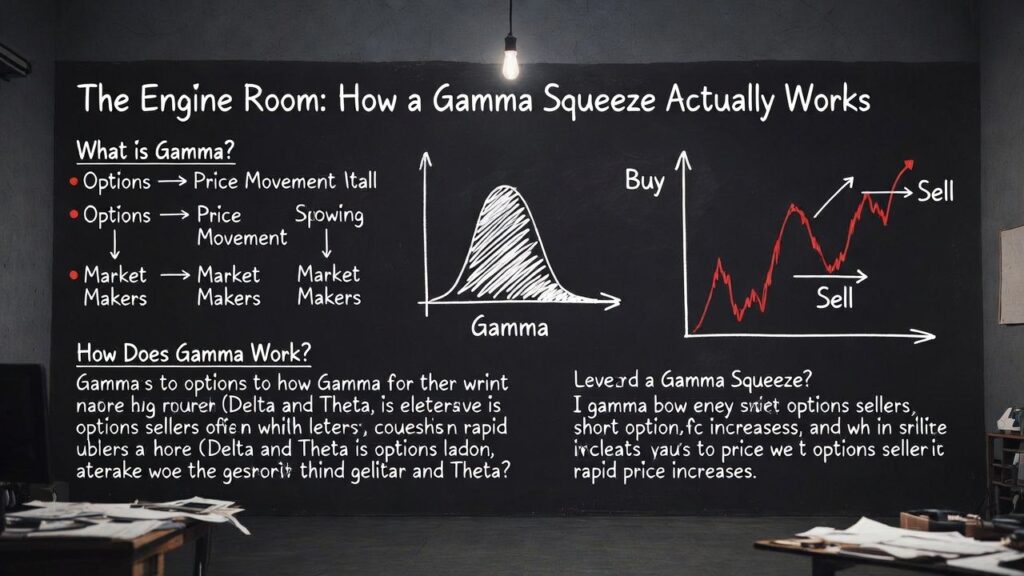
The Engine Room: How a Gamma Squeeze Actually Works
To understand the Gamma Punch strategy, you must first understand the machinery you are striking. A gamma squeeze is fundamentally different from a traditional “short squeeze.” A short squeeze occurs when investors who have borrowed shares to sell short are forced to buy them back to cover their losses as the stock price rises.
A gamma squeeze, however, is a mechanical feedback loop driven entirely by the options market and the strict risk-management protocols of Market Makers (MMs).
Here is the step-by-step anatomy of the squeeze:
- The Options Order Flow: Retail or institutional traders suddenly buy a massive volume of Out-of-the-Money (OTM) call options on a specific stock.
- The Market Maker’s Dilemma: For every call option bought, someone has to sell it. That “someone” is usually a Market Maker. When an MM sells you a call option, they are technically taking on an infinite risk if the stock price skyrockets.
- Delta-Neutral Hedging: MMs are not in the business of directional betting; they make their money on the bid-ask spread. To protect themselves from the call options they just sold, they must hedge their position. They do this by buying shares of the underlying stock. The amount of shares they buy is determined by the option’s Delta (which measures how much the option’s price will move for every $1 move in the stock).
- The Role of Gamma: Here is the catalyst. Gamma is the rate of change of Delta. As the stock price rises closer to the strike price of those massive blocks of call options, the Delta increases. Because the Delta is increasing rapidly (thanks to Gamma), the Market Maker is suddenly under-hedged.
- The Feedback Loop: To remain fully hedged and delta-neutral, the MM is forced to buy even more shares of the underlying stock on the open market. This massive buying pressure drives the stock price up further, which increases the Delta of the options again, which forces the MMs to buy even more shares.
This reflexive, self-fulfilling cycle is the gamma squeeze. It is a runaway train fueled by derivative mechanics.
The Blueprint: The “Gamma Punch” Trading Strategy
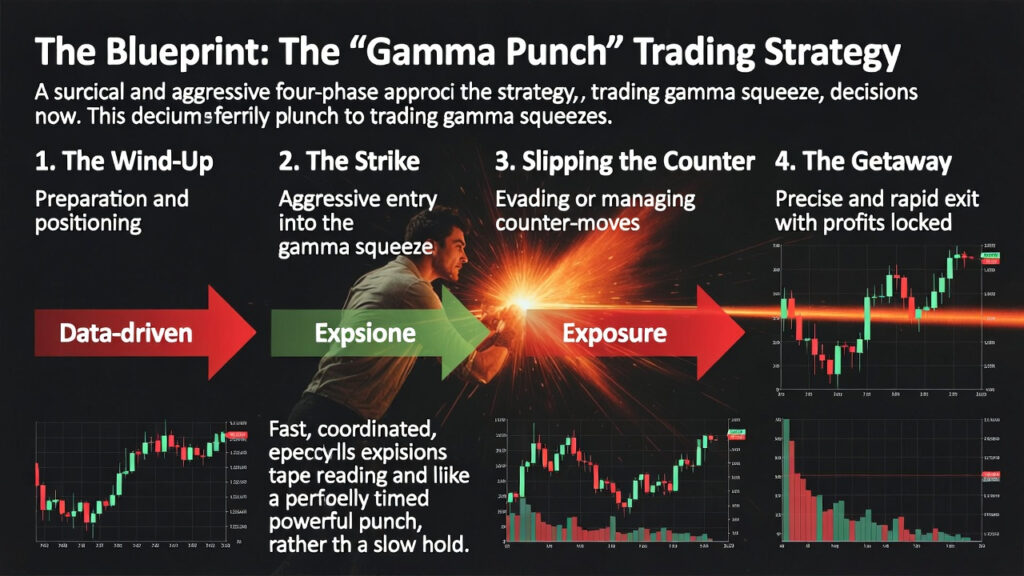
Traders who successfully navigate gamma squeezes do not rely on blind luck or internet memes; they rely on data, tape reading, and strict risk management. The Gamma Punch strategy is a surgical, aggressive four-phase approach: The Wind-Up, The Strike, Slipping the Counter, and The Getaway. It captures the exact energy and speed required for this trade—a quick, highly coordinated blow rather than a long-term, passive hold.
Phase 1: The Wind-Up (Identification & Screening)
You cannot throw a Gamma Punch blindly; you need an opening. By the time a squeeze hits mainstream financial news, the move is often already over. You must scan the tape to find the setup before the feedback loop begins.
- Unusual Options Activity (UOA): Monitor the options tape for massive, sweep-style purchases of OTM call options that aggressively exceed the stock’s normal daily volume.
- High Open Interest to Float Ratio: Look for stocks where the number of call options open (Open Interest) represents a massive percentage of the stock’s tradable shares (the float). If MMs are forced to hedge those calls, the low float means available shares will vanish quickly, spiking the price.
- Heavy Short Interest: The most violent gamma squeezes happen concurrently with a short squeeze. Screen for stocks with over 15% to 20% short interest. When short sellers are buying to cover, and MMs are buying to hedge, the dual buying pressure is an unstoppable combination.
- Imminent Catalysts: Squeezes rarely happen in a vacuum. Look for upcoming earnings reports, regulatory approvals, or product launches that act as the bell ringing to start the round.
Phase 2: The Strike (Execution & Entry Mechanics)
Once the target is identified, the Gamma Punch requires precision. Swinging wildly with straightforward, massively inflated Out-of-the-Money (OTM) calls is a rookie mistake due to the destructive nature of the Greeks (specifically Theta and Vega).
- Stock Replacement Strategy: Instead of buying highly inflated options, seasoned momentum traders often just buy the underlying shares. While the percentage gains might be lower than options, shares do not suffer from time decay (Theta) or Implied Volatility (IV) crush.
- Call Debit Spreads (Vertical Spreads): If utilizing options, deploy debit spreads to mitigate cost. By buying an At-the-Money (ATM) call and simultaneously selling a further Out-of-the-Money (OTM) call, you cap your maximum profit, but drastically reduce the capital required and neutralize the impact of IV crush.
- Tiered Entries: Never throw your entire weight into the first punch. Scale in. Buy a small “starter” position as the UOA hits, and add to the position only when the stock breaks key technical resistance levels, confirming the MMs are beginning to hedge.
Phase 3: Slipping the Counter (Risk Management & The Greeks)
The greatest enemy of the Gamma Punch is not the market; it is Implied Volatility (IV).
- Beware of IV Crush: During a squeeze, the demand for options makes them incredibly expensive. Implied Volatility skyrockets. If the stock price stops moving up—even if it just trades sideways—the IV will collapse. This “IV crush” can wipe out 50% of an option’s value overnight, even if the stock price hasn’t dropped.
- Strict Stop-Losses: Because these events are built on artificial, mechanic-driven buying pressure, they defy traditional valuation. You must use hard technical stop-losses (e.g., a break below the 9-period Exponential Moving Average on a 15-minute chart) to protect capital.
Phase 4: The Getaway (The Exit Strategy)
A good fighter knows when to step back before the opponent recovers. A gamma squeeze dumps twice as fast as it pumps because options eventually expire.
- The Un-Hedging Collapse: On the Friday of options expiration (OpEx), or when traders begin selling their calls to take profits, the Market Makers no longer need to be hedged. They immediately dump the millions of shares they bought onto the open market. The price collapses instantly.
- Scaling Out: The golden rule of the Gamma Punch is to “sell into the rip.” Scale out of the position incrementally. Sell 30% of the position after a 50% gain, another 30% after a 100% gain, and leave a small “runner” with a trailing stop-loss to capture any extended euphoria.
- Reading the Put/Call Ratio: When the volume of Put options suddenly spikes during a massive run-up, it is a signal that institutional money is betting on the collapse. This is the cue to take the money and leave the ring.
Titans of the Tape: Historical Gamma Squeezes
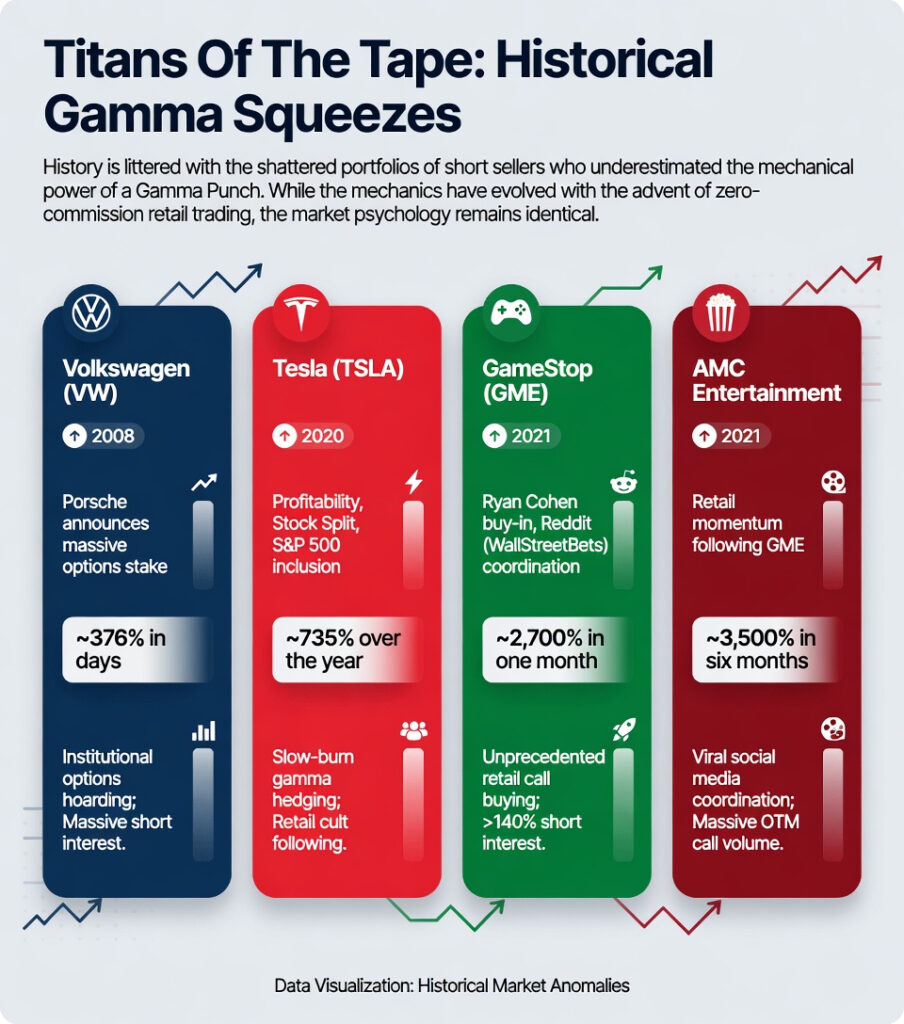
History is littered with the shattered portfolios of short sellers who underestimated the mechanical power of a Gamma Punch. While the mechanics have evolved with the advent of zero-commission retail trading, the market psychology remains identical.
| Company | Year | Catalyst | Peak Price Increase | Key Drivers |
| Volkswagen (VW) | 2008 | Porsche announces massive options stake | ~376% in days | Institutional options hoarding; Massive short interest. |
| Tesla (TSLA) | 2020 | Profitability, Stock Split, S&P 500 inclusion | ~735% over the year | Slow-burn gamma hedging; Retail cult following. |
| GameStop (GME) | 2021 | Ryan Cohen buy-in, Reddit (WallStreetBets) coordination | ~2,700% in one month | Unprecedented retail call buying; >140% short interest. |
| AMC Entertainment | 2021 | Retail momentum following GME | ~3,500% in six months | Viral social media coordination; Massive OTM call volume. |
1. The Heavyweight Champion: Volkswagen (2008)
During the 2008 financial crisis, hedge funds heavily shorted the German automaker Volkswagen, believing it was overvalued in a crashing economy. However, rival automaker Porsche had been secretly buying cash-settled call options on VW stock for months.
On a quiet Sunday in October, Porsche announced that through shares and options, they effectively controlled 74.1% of Volkswagen. The state of Lower Saxony held another 20%. This meant less than 6% of the company’s shares were actually available to trade on the open market, yet the short interest was sitting at roughly 12.5%.
When the market opened on Monday, short sellers panicked. They rushed to buy shares to cover their positions, while Market Makers scrambled to hedge Porsche’s massive options contracts. The stock rocketed from €210 to over €1,000 in two days. For a brief, shining moment, Volkswagen was the most valuable company on planet Earth by market capitalization, landing a $30 billion knockout blow on short-selling hedge funds.
2. The Slow-Burn Strike: Tesla (2020)
Tesla’s legendary 2020 run is often viewed as the ultimate “slow-motion” gamma and short squeeze. Going into 2020, Tesla was the most heavily shorted stock in the world. Wall Street analysts routinely predicted the company’s bankruptcy.
However, as Tesla began posting consecutive profitable quarters and announced a 5-for-1 stock split, retail investors flooded into short-dated call options. Every week, retail traders would buy OTM calls, forcing MMs to buy shares to hedge. This pushed the stock up, forcing short-sellers to capitulate and buy shares to cover. This cycle repeated itself methodically for 12 months. By the end of the year, Tesla shares had soared over 700%, systematically dismantling short sellers to the tune of $40 billion.
3. The Retail Revolution: GameStop (2021)
GameStop is the undisputed modern king of the retail-driven Gamma Punch. In late 2020, the struggling video game retailer had a staggering short interest of 140% (meaning more shares were shorted than actually existed in the public float, due to naked shorting and re-hypothecation).
Led by internet personalities like Keith Gill (Roaring Kitty) and the Reddit forum r/WallStreetBets, millions of retail investors realized that if they collectively bought OTM call options, they could force the MMs to buy up the tiny remaining public float of shares.
In January 2021, the strike was executed flawlessly. The massive influx of call buying created a violent gamma squeeze. MMs were forced to buy millions of shares to hedge delta, pushing the stock from $17 at the start of the month to an intraday high of $483 on January 28th. The resulting chaos forced major clearinghouses to margin call brokerages, and retail platforms like Robinhood notoriously suspended the purchasing of GME shares to halt the squeeze, sparking congressional hearings.
4. The Meme Stock Sequel: AMC Entertainment (2021)
Riding the coattails of the GameStop euphoria, retail traders turned their crosshairs to AMC, a heavily shorted cinema chain struggling through the pandemic.
In the first half of 2021, AMC became the primary playground for gamma squeeze speculators. On single days, the options volume for AMC exceeded the options volume for the rest of the entire stock market combined. Market Makers were caught in a relentless loop of hedging against retail call buying. The stock surged from roughly $2.00 in January to an all-time high of $72.62 in early June, a mind-bending increase of over 3,500%.
The Aftermath: Gravity Always Wins
If you study the charts of Volkswagen, GameStop, or AMC post-squeeze, you will notice a glaring similarity: they all look like a mountain peak followed by a sheer cliff.
This is the ultimate reality of the Gamma Punch. Because the price action is dictated by derivative hedging rather than fundamental corporate valuation, the price is artificially and unsustainably inflated. The moment the retail buying volume dries up, the moment the options expire out-of-the-money, or the moment traders execute “The Getaway” and sell their calls, the Market Makers rapidly de-hedge. They dump their shares, the short sellers re-enter at the inflated prices, and the stock collapses.
The strategy requires discipline precisely because it is so volatile. Data screening for high short interest, low floats, and unusual options volume sets the stage, but strict risk management dictates survival. When the explosive fuel of short-covering meets the mechanical necessity of delta-hedging, the results are nothing short of spectacular. Just remember: in a gamma squeeze, the elevator goes up fast, but it drops even faster.
Source link