The Price of Risk: An Equity Risk Premium Monologue!
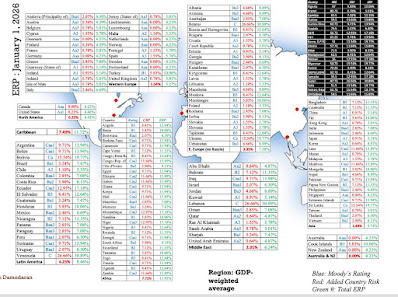
I start my valuation classes with a question of whether valuation is an art or a science, and I argue that it is neither; it does not have the precision that characterizes a science and unlike an art, it does come with principles that constrain you on what you can and cannot do. I describe valuation as a craft, where you learn as you value companies, and in the process, there are times where you question how it is practiced, and try to find ways to do it better. I have learned my share of lessons in the four decades that I have practiced valuation, and I have often abandoned standard practices, in the hope of developing better ones. There is no input in valuation where I have found myself questioning existing practices more than in estimating the price of risk in equity markets, i.e., the equity risk premium, and I have wrestled with ways of coming up with alternatives. That endeavor was pushed into high gear by the 2008 market crisis, when I started to pay more attention to how markets price risk, what causes that price of risk to change over time and the limitations in the ways that we estimate that price of risk in financial analysis.
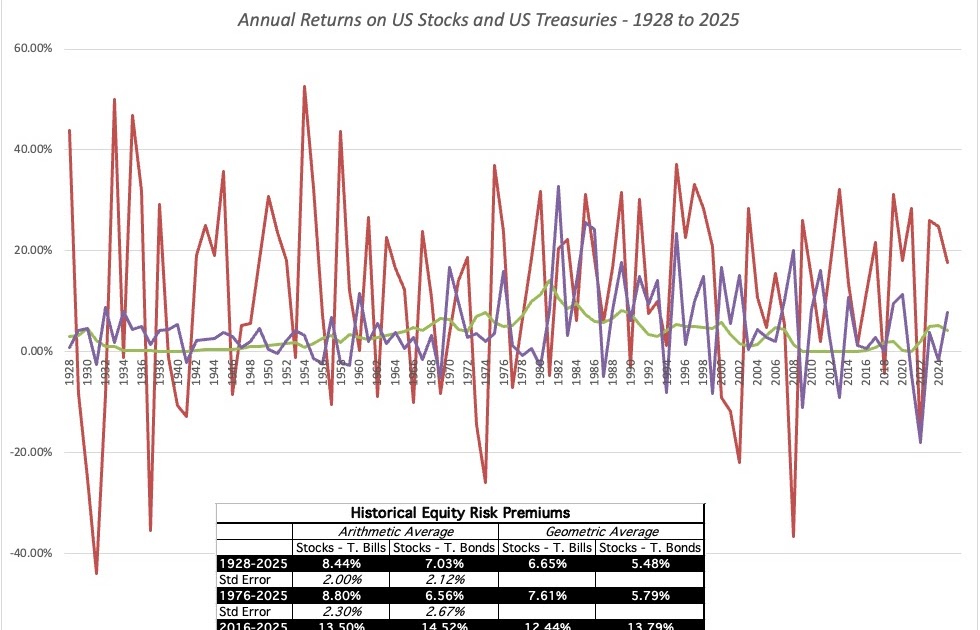
Leading into 2008, I had long been skeptical about how we approached the estimation of equity risk premiums, essential ingredients in hurdle rates in corporate finance and discount rates in valuation. It was (and still remains) standard practice to look at historical data, almost entirely from the US, on what stocks had earned over treasuries, and use that historical equity risk premium as the best estimate of the equity risk premium for the future, That approach would have yielded an equity risk premiums of between 5.5% to 14.5%, at the start of 2026, depending on the time period used, the way we compute averages and what we use as the riskfree rate.
These historical equity risk premiums are not only backward-looking and very noisy (see the standard errors), but they allow bias to easily creep in, through the choice of equity risk premiums, with bullish (bearish) analysts picking lower (higher) numbers. Disconcertingly, they also move in the wrong direction, falling during crises (as historical returns get updates) and rising during good times.
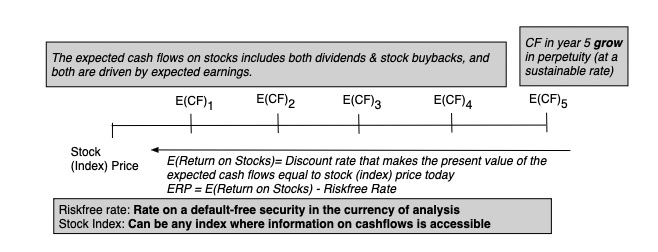
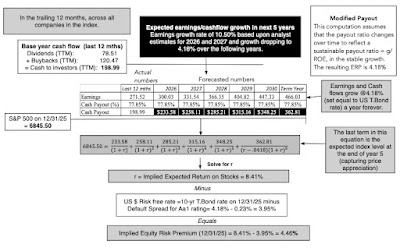
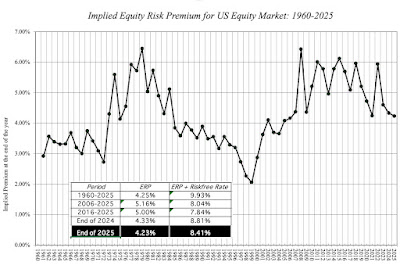
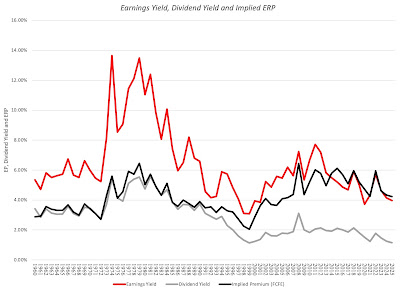
That approach yields forward-looking equity risk premiums, and while there is estimation error in the expected earnings growth and payout numbers, it yields vastly more precise estimates that are also model-agnostic. Using this approach, the equity risk premium at the start of 2026 was 4.23% (over the US treasury bond rate):

ERP Estimation during Crises
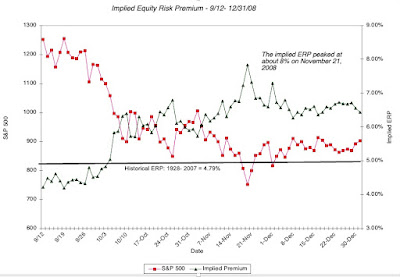
Unlike historical equity risk premiums, these implied premiums are sensitive to market gauges of fear and greed, and change, as those change. In fact, I computed the ERP, by day, during the 2008 market crisis, and you can see the shifts during that 14-week period below:

Note that the crisis started with the equity risk premiums at 4.2% on September 12, 2008m but almost doubled over the next two months, as stocks went into free fall. To me, these implied equity risk premiums made far more intuitive sense, rising as market fears about banks and the economy rose.
Equity Risk Premiums – Lessons Learned
The process of estimating implied equity risk premiums on a continuing basis is driven less by intellectual curiosity and more by my need for these numbers, when I value companies. That process has taught me three lessons about equity risk premiums, and I have responded by altering my practices.
1. The equity risk premium is a dynamic and shifting number, and a good estimate of the premium should reflect this volatility. Using an equity risk premium that is different from the implied equity risk premium makes every valuation a joint judgment on what you think about the company and what you think about the market. Put simply, sticking with a 4% equity risk premium during a crisis, when the implied risk premium has surged to 6% will lead you to find most companies to be undervalued, almost entirely because you think that the market is undervalued (not the company). In my view, a company valuation should be market-neutral, and the only way you can get there is by using a current implied equity premium.

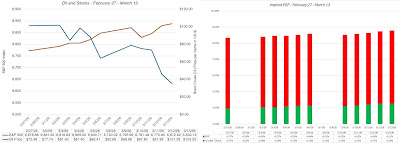
My conclusion, at the start of 2026, was that while stocks were richly priced using almost every conventional metric (high PE ratios, low dividend yields), the implied equity risk premium was in line with what US stocks have generated over the last 65 years. That said, I did note that 2025 was a tumultuous year, with tariffs making the news and the post-war dollar-centric global economic system starting to fray, and argued that the market seems to be too sanguine about catastrophic risk. Almost on cue, two weeks ago, bombs started falling in the Middle East, and US equities and bonds have been struggling to price in the effects of higher oil prices. In keeping with my practice of estimating equity risk daily, during troubled times, I did compute the implied ERP for the S&P 500 every day, during the last two weeks (Feb 27- March 13):

Oil is up to over a hundred dollars a barrel and the S&P 500 is down, but so far, the market is not behaving as if it is in crisis mode. The equity risk premium, which started March at 4.37% has risen, but only to 4.51%, over the two weeks. In fact, it is the ten-year US treasury bond that has had the bigger surge, up from 3.97% at close of trading, on February 27, to 4.28% at close of trading, on March 13, indicating inflation fears are trumping other market concerns right now. All of this could change next week or the week after, and I will continue to track the equity risk premiums, by day, until the market settles in.
Equity Risk Premiums – The 2026 Edition
If you do get a chance to download the paper, I should warn you ahead of time that it long (153 pages), unexciting and entirely directed at practitioners. It is modular, though, and it is broadly broken down into the following sections:
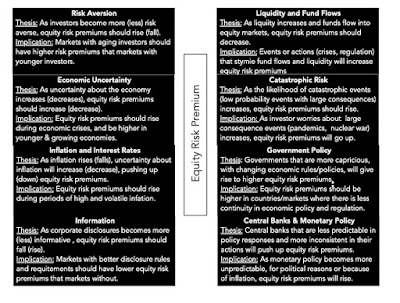
1. The Determinants of Equity Risk Premiums: Given that equity risk premiums represent the price of risk in the market, it should come as no surprise that almost everything that happens in the market, political or economic, affect its level. The picture below summarizes the determinants, and you can find more details in the paper:

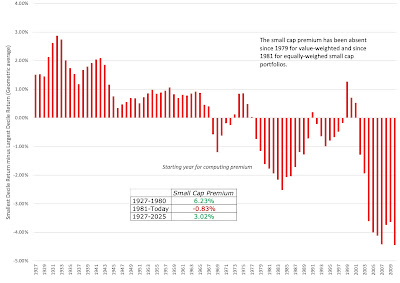
2. Historical Equity Risk Premiums (and spin offs): I spend a section of the paper discussing historical equity risk premiums, examining the statistical properties that make it a faulty approach, and why a belief in mean reversion has made it the status quo. While most of the historical equity risk premiums that you see reported in practice come from the US and are based upon the Ibbotson data going back to 1926, I also look at historical data that goes back further (to 1871) as well as historical premiums in the rest of the world. The historical data on returns in the US has also been mined by services to extract premiums that have been earned by subsets of stocks, and since these premiums often get used by practitioners, I look at the efficacy of these premiums. I specifically look at the small cap premium, a widely used add on in valuation, and not that not only has it been noisy over the entire time period (1926-2025), but that it has disappeared since 1981:

The fact that the small cap premium endures in practice is a testimonial to how once bad practices become embedded in valuation, they never leave.

4. Implied Equity Risk Premiums and Alternatives: In this section, I start with a description of an intrinsic value model for the market, and use that model to illustrate what you would need to assume for the dividends yield or earnings yield to become reasonable proxies for the equity risk premiums; for the latter, for instance, you have to assume either that there is no earnings growth or that if there is growth, it is value neutral. I then use the full version of the model, allowing for higher growth and cash payout that includes buybacks, to derive my implied equity risk premium estimates. I also look at how my implied equity risk premium estimates relate to other risk proxies (default spreads on bonds, VIX etc.) and how they change over time, as the riskfree rate changes.

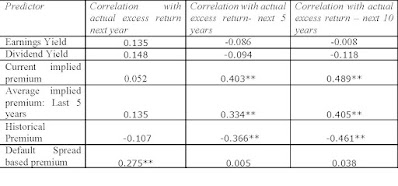
5. Efficacy of ERP Estimates: The test of whether an equity risk premium estimate is a good one is in the data, since equity risk premiums measure expectations of what investors hope to earn on equities in future periods. In the last section of the paper, I examine the predictive efficacy of alternative measures of equity risk premiums, by looking at their correlation with actual stock market returns in the next year, the next five years and the next ten years:

Source link