Tighten The Options Collar – Make Money Even When The Stock Goes Down

To be clear, the options collar strategy is a bullish strategy.
We want the stock to go up.
Many times, though, the stock doesn’t behave the way we want.
This example illustrates how Microsoft (one of the Magnificent Seven stocks) experienced a decline.
Yet with proper adjustment of the collar options strategy, the investor was still able to profit.
Contents
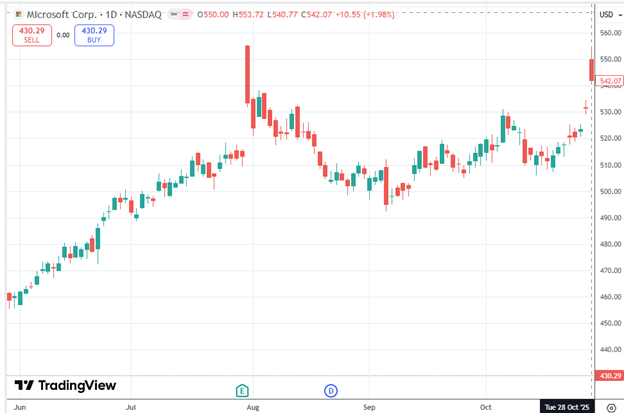
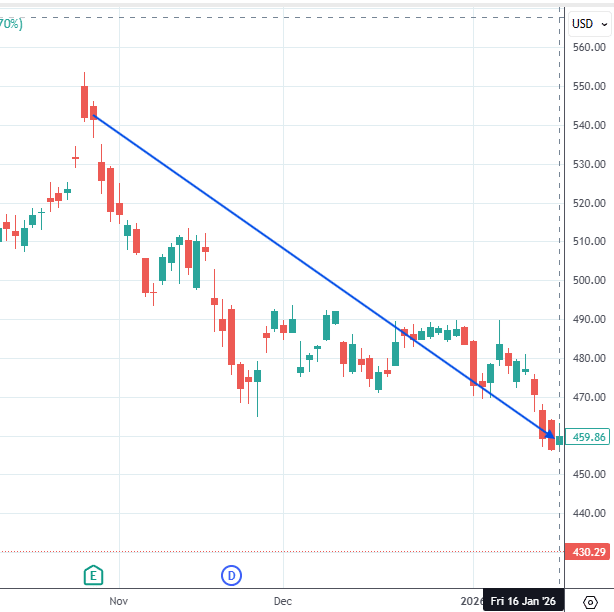
The story starts on October 28th, 2025, when Microsoft (MSFT) was at $545.
By the end of the story, MSFT was at $460, a 15% decline.
On October 28th, an investor owned 100 shares of Microsoft and was happy because it had recently risen to $545.53 per share.
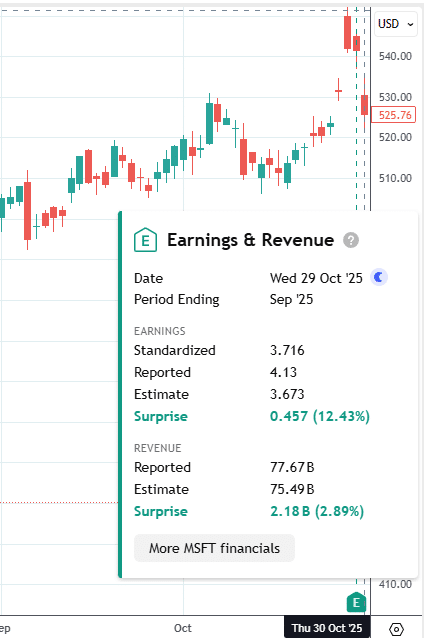
As a diligent investor, he is aware that Microsoft reports earnings the next day after the market closes.
He holds a $54,553 investment in Microsoft and is concerned that Microsoft might decline on a weak earnings report.
Or it might even drop on a good earnings report – you never know.
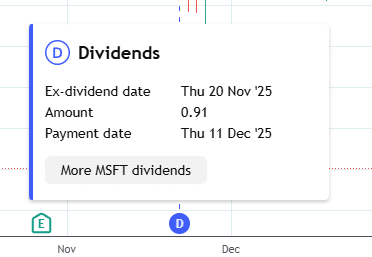
He doesn’t want to sell his shares because he wants to receive the $ 0.91-per-share dividend.
That would be an extra $91 in his pockets on the payment date of December 11th.
Source: TradingView with earnings and dividends display enabled
To receive this dividend, he must be holding the stock on the “record date” of November 21st (one day after the ex-dividend date of November 20th).
For those who want to buy the stock solely for the dividend, they must buy it one business day before the ex-dividend date, as it takes two business days to settle and become a “shareholder of record” on the record date.
In any case, this savvy investor decided to hold on to the 100 shares and implement an options collar to protect his investment.
He buys one put option contract at a strike price of $540.
This contract will allow him to sell 100 MSFT shares at $540 at any time before or on the expiration date.
The contract he purchased expires on January 16th, 2026 (approximately 80 days forward).
He buys this contract for a debit of $2038.
To help finance this, he sells one contract of a $ 555 strike call option above the current stock price.
This call option expires on the same day as the put option on January 16th.
He receives $2295 from the sale.
This is more than enough to cover the cost of the put option.
The net credit from selling the call and buying the put is $257.
The sale of the call option obligates him to sell his 100 MSFT shares at $555 per share upon the other party’s request.
If MSFT is above $555 per share at expiration, the other party will likely request it.
That is fine by the investor because his stock would have appreciated if it had gone up to $555.
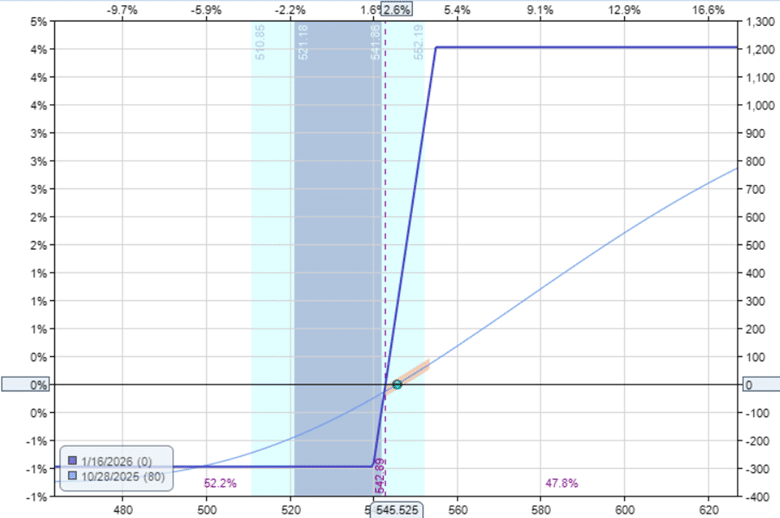
A better way to understand this is to model it in a payoff graph.
Here is the payoff diagram for 100 shares of MSFT, together with a put option at $540 and a call option at $555.
The investor would make money if the stock goes up.
Because of the put option’s protection, the maximum the investor would lose is approximately $300, according to the graph.
Even without the payoff graph, we can calculate the maximum loss if MSFT were to drop to $460 at expiration, for example.
In that case, the investor’s put option enables him to sell his 100 shares at $540.
So he would have $54,000 plus the net credit of $257 from the sale and purchase of the call and put options.
He ends up with $54,257.
Recall that he began with an initial investment of $54,553.
Thus, this would be a loss of $296, as shown in the payoff graph.
That does not include the $91 dividend.
Accordingly, the maximum loss would be $205.
He can sleep fine regardless of Microsoft’s earnings.
October 30th is the day after the earnings report.
Microsoft earnings report beat expectations.
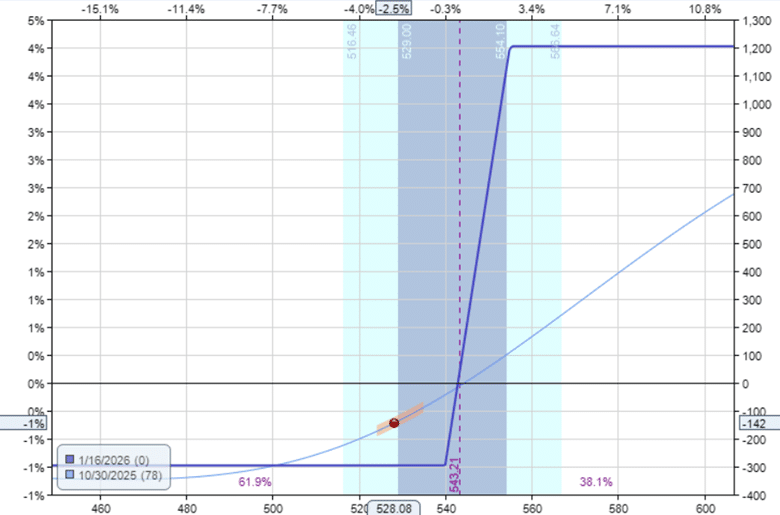
Yet, the stock dropped to $528.
The investor’s position is down $142.
If he hadn’t implemented the options collar, he would have lost $1753.
When a stock goes down, the short call option makes money.
In this case, the call option, which was sold for $2295, can now be bought back at $1330 – a profit of $965
The investor buys back the $555-strike call option and then sells another call option at the $545 strike price with the same expiration.
This can be done in one transaction:
Date: October 30, 2025
Price: MSFT @ $528
Buy to close one contract Jan 16 MSFT $555 call @ $13.30
Sell to open one contract Jan 16 MSFT $545 call @ $17.03
Net credit: $373
The investor had “rolled the call down”.
Instead of the call option at a $555 strike price, it is now at $545.
Because this strike is above the current stock price and the put option’s strike price, the position retains upside potential to profit if MSFT rises.
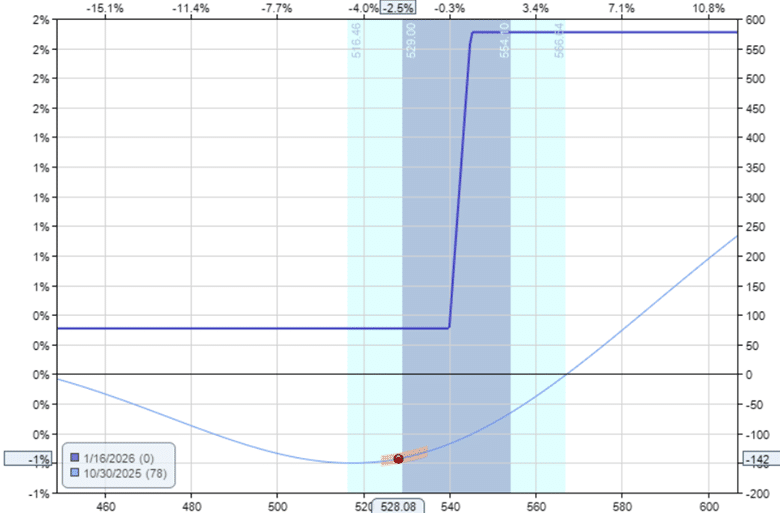
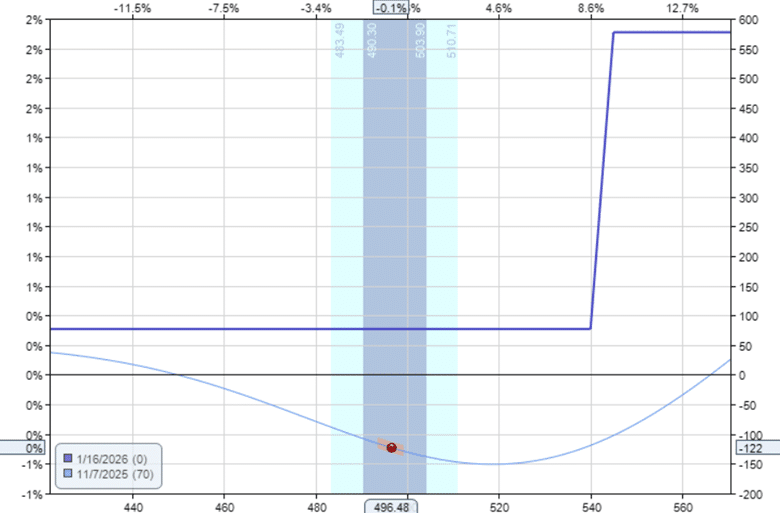
The resulting payoff graph looks like this…
The collar had been tightened (compare the pre- and post-tightening graphs).
The distance between the strike prices of the call and put options had narrowed.
More interestingly, the expiration payoff graph (the dark blue line) is completely above the zero-profit line.
Although this position is currently at a loss of -$142, it will be profitable at expiration regardless of MSFT’s price.
It is possible because the investor had collected more credit than the position’s maximum loss.
He had collected $373 from rolling the call option down.
The max loss previously was only $296.
Let’s not even count the dividend.
He had collected $77 more than the maximum loss.
That’s why the payoff graph shows a minimum profit of $77 at expiration.
You can also conduct a thought experiment to determine what would happen if MSFT is below $540 at expiration.
You would see that the investor would profit $77 if you do all the math.
After:
$54000 + $257 + $373 = $54,630
After versus Before:
$54,630 – $54,553 = $77
For readers whose heads are already spinning, they can leave the position as-is until expiration, being satisfied that the collar completely protected the position from the stock’s decline (and even made a small profit).
Microsoft continues to decline in price.
On November 7th, it is now down to $496 per share.
Because of the collar, the investor’s position is no longer losing money.
It is down only -$122.
The strike price of a call option caps profits if MSFT exceeds the strike price.
Is MSFT ever going to go up to the call strike of $545 before expiration?
The $545 level was MSFT’s prior to the earnings announcement.
The investor didn’t think it would.
He decided to roll the call option down one more time, from a strike price of $545 to $540, and collect an additional $97 credit.
Date: Nov 7, 2025
Price: MSFT @ $496.48
Buy to close one contract Jan 16 MSFT $545 call @ $6.33
Sell to open one contract Jan 16 MSFT $540 call @ $7.30
Net credit: $97
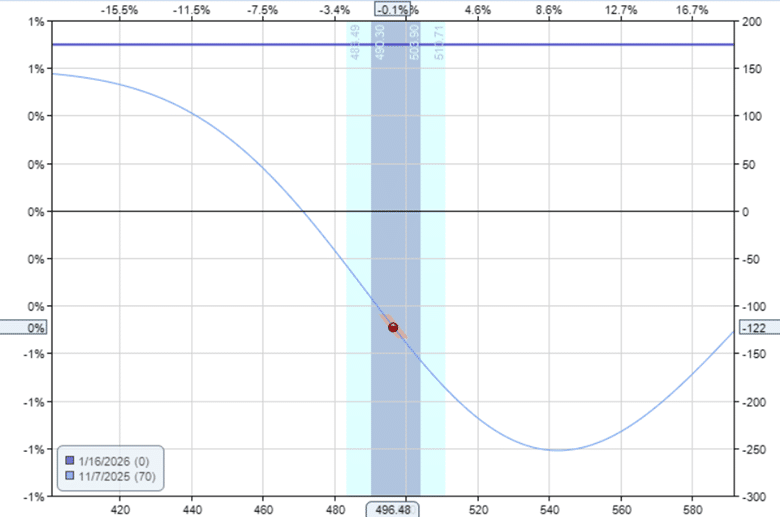
The resulting expiration payoff graph appears nearly flat at a profit level of $174.
No matter what happens to the MSFT price, the profit on this trade will be $174 at expiration – no more and no less.
This is because the put and call strikes are both at $540.
In all cases, the stock will be sold at expiration.
If MSFT is below $540, the call option becomes worthless, and the long put option would sell the shares at $540 per share.
If MSFT is above $540, the put option becomes worthless, and the short call would obligate the seller to sell the shares at $540 per share.
This is a completely directionally agnostic position.
It literally doesn’t matter if MSFT goes up or down.
Hold until expiration for the maximum profit of $174.
Tally what the investor makes at expiration:
Sale of 100 shares at $540 per share: $54,000
Credit for initiating the collar: $257
Credit for rolling the call down: $373
Credit for rolling the call down again: $97
Total: $54,727
Recall that the investor started with an investment of $54,553 in MSFT stock.
$54,727 – $54,553 = $174
So the investor has $174 more money than he started – even though the stock declined 15%…
The reader should not assume that it is always possible to profit from collars when the stock declines.
This example is only to illustrate that it is possible to make money given the right circumstances and adjustments.
In general, this is easier to accomplish when starting with a lower maximum risk and when the collar has a later expiration.
When the stock drops, the investor has the opportunity to roll down the call for a credit.
Keep accumulating credits to reduce the risk.
However, keep the strike price of the call option above the strike price of the put option to have upside potential.
However, if the stock is performing poorly and the upside is low, the investor may roll the call strike down to the put strike.
It is not advisable to roll the call strikes below the put strike.
Otherwise, it will become a bearish position and introduce upside risk.
We hope you enjoyed this article on tightening the options collar.
If you have any questions, please send an email or leave a comment below.
Trade safe!
Disclaimer: The information above is for educational purposes only and should not be treated as investment advice. The strategy presented would not be suitable for investors who are not familiar with exchange traded options. Any readers interested in this strategy should do their own research and seek advice from a licensed financial adviser.

Source link