Tracking Smart Money Options Flow With Quant Data
Smart money refers to the money invested or traded by big institutional investors and banks.
While it is a colloquial term, there is some truth to its origins.
It is generally accepted that these big players have better research, faster access to information, advanced tools, and deeper market insight than the average retail investor.
Therefore, if the retail investor can see what smart money is doing, they can ride on its coattails by following its moves.
Smart money is not dumb; that’s why they use various tactics to hide their moves, mainly to prevent their big orders from unfavorably affecting the prices they are trying to bid.
They split a large order into multiple smaller trades – sometimes sent to only one exchange and sometimes sent to multiple exchanges.
This is where Quant Data and other options flow software come in.
They use proprietary algorithms to try to figure out the smart money’s move.
Contents
Quant Data will piece together these smaller orders and conjecture what the smart money’s big order is.
That big consolidated order is known as a “split” (if the pieces are sent to the same exchange) or a “sweep” (if sent to multiple exchanges).
In the main Quant Data dashboard, the splits, sweeps, and blocks are clearly labelled.
Source: YouTube
A block is a large order of over 10,000 shares.
Each row will tell you whether the order is a call or a put and whether it is closer to the bid or the ask, as labelled with “B” or “A”.
The bid price is the price that buyers are willing to pay.
The ask price is the price that sellers are willing to sell.
Because buyers want to buy low and sellers want to sell high, the bid price is always less than the ask price.
Knowing whether the order was filled closer to the bid or the ask will indicate whether it was a bullish or bearish trade.
For example, call option orders with executed prices on the ask side are bullish because they suggest the buyer wants the call options so much that they are willing to pay the sellers’ asking price.
Similarly, put options executed near the ask price are likely put options being bought and hence are bearish.
If you see a call order in the dashboard printed on the bid side, that indicates that the order is likely selling calls, suggesting a bearish thesis.
Similarly, put orders on the bid side suggest that put options are being sold (bullish).
Sometimes you will see an order labelled “AA” (above ask).
This indicates extreme urgency to get the order filled.
So a call order labelled AA is very bullish because the buyer is willing to pay above the ask, or pay more than what the sellers are asking.
A put order labelled as BB (below bid) suggests extreme bullishness because the order is willing to sell the put at a very low price.
As options traders, we know that selling of puts is bullish.
We are either selling to collect a premium, expecting the price to go up (or at least not down below the strike price).
Or we already have a put option (bearish), and we need to get rid of it because the underlying’s price is going up.
The full Quant Data dashboard is not shown in the above screenshot.
Still, with each row, there is a potential indication on the left margin that an order is particularly “unusual”, which may be an order of extreme urgency or aggressiveness that is worth taking a look at.
Different software has its own definition of determining this based on various factors such as size, bid/ask aggregation, time to expiration, volume, etc.
Quant Data will also indicate orders that are “golden sweeps”.
These are large sweep orders with a premium of over one million.
Dark pools are off-exchange, private trading systems where large institutions can buy or sell without immediately revealing their orders to the public market.
Quant Data can aggregate reported Dark Pool prints by strike price over a time period of your choosing.
Therefore, if you see a high volume of activity clustered around certain price levels, these levels can help identify potential support and resistance zones.
Options have a strike price and an expiration date.
The options heat map has the strike price along the horizontal x-axis and the expiration date on the vertical y-axis.
This creates a grid of cells. If you hover over a cell, it will show the premium, volume, and open interest for that strike and expiration.
This cell is colored by the amount of net premium for that strike and expiration.
If net premiums are mostly calls, it will be green shading.
If it’s primarily red, it will be red.
Quant Data can see all the options transactions flowing through the exchanges in real time.
Because options contain a large amount of information, they can sometimes provide clues about the potential short-term price movement of the underlying asset in the short term (hence, more suitable for day traders)
Quant Data provides several tools that make this information easier to understand visually.
Many intraday traders may already be familiar with some of these tools.
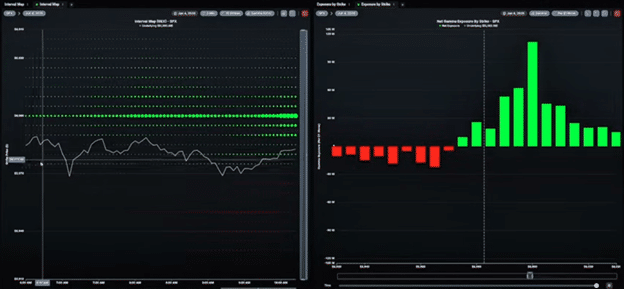
Below are the GEX chart by strike on the right and the interval map on the left – both highlighting potential price levels the underlying may gravitate toward.
Source: YouTube
Quant Data also includes the Max Pain tool (not shown).
You can learn more details about these tools at Quant Data’s YouTube channel.
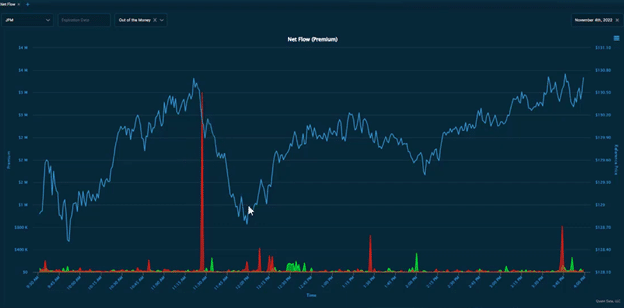
Another example shows how their Net Flow tool provided insights into a potential downward reversal right after we saw a surge in out-of-the-money put options.
See that red spike…
Source: YouTube
If you are too busy monitoring all these intraday tools and your charts, you can turn on the voice alerts for Quant Alerts.
This alerts you to potential trades based on proprietary algorithms that analyze millions of data points and trigger different alert types based on various criteria.
Quant Data is a real-time market analytics platform that helps traders interpret institutional activity and options flow.
It aggregates and visualizes these data so that they are more comprehensible and actionable, should the trader want to follow the moves of the smart money.
We hope you enjoyed this article on tracking smart money options flow with Quant Data.
If you have any questions, please send an email or leave a comment below.
Trade safe!
Disclaimer: The information above is for educational purposes only and should not be treated as investment advice. The strategy presented would not be suitable for investors who are not familiar with exchange traded options. Any readers interested in this strategy should do their own research and seek advice from a licensed financial adviser.
Source link