Trading or Gambling? The Battle Over Prediction Markets Heats Up | BitcoinChaser
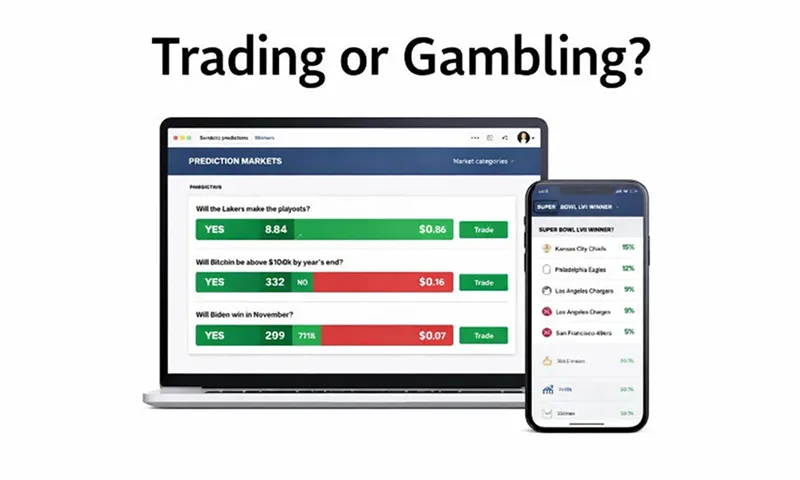
Prediction markets have moved from niche financial products to headline news, especially after the Super Bowl pushed trading volumes into the billions. Regulators are now clashing over a question that sounds simple but has massive consequences:
Are these platforms offering financial contracts — or unlicensed gambling?
The answer could reshape the future of event betting in America, and it may determine if prediction markets become a nationwide alternative to sportsbooks or get boxed into state-by-state restrictions.
What are prediction markets?
Prediction markets let users buy and sell contracts tied to real-world outcomes. Most sports-linked offerings are binary-style contracts that settle based on a single result.
At a basic level:
- A “Yes” position pays out if the event happens
- A “No” position pays out if it does not
- Prices move as sentiment and liquidity change
- Traders can often exit before settlement
That last point matters. In many setups, users are not forced to “hold to the final whistle.” They can sell early if the market moves in their favour, which makes the product feel closer to trading than traditional wagering.
Another key difference is the platform role. Instead of acting like a bookmaker setting odds, these platforms typically operate more like marketplaces. Participants trade against each other, while the platform earns revenue through fees or spreads.
That structural distinction is the foundation of the legal argument.
Why states are pushing back
State regulators tend to focus less on product structure and more on the practical outcome: people are staking money on sports results.
Their objections usually fall into a few buckets:
- Unlicensed wagering activity bypassing state gambling frameworks
- Consumer protection and responsible gambling rules
- Age-gating inconsistencies compared with sportsbook standards
- Integrity oversight concerns (monitoring, reporting, suspicious activity)
Arizona has issued cease-and-desist letters aimed at companies offering sports-linked event contracts, including Kalshi, Crypto.com, and Robinhood. Nevada has pursued legal action seeking to block certain offerings, arguing they amount to illegal gambling without state licensing.
From the state’s view, the argument is essentially: if it looks like sports betting and walks like sports betting, it falls under state gaming law.
The CFTC’s position
The Commodity Futures Trading Commission takes the opposite stance: these are derivatives, not bets.
The CFTC’s framing is that event contracts can qualify as commodity derivatives and therefore sit under federal jurisdiction. In that view, states should not be able to treat them as gambling products simply because the underlying event happens to be a sports match.
The disagreement is clean but explosive:
- States: This is sports betting under state law
- CFTC: This is federally regulated trading under derivatives law
That jurisdictional clash is now playing out through lawsuits, enforcement actions, and competing interpretations of authority.
The Super Bowl volume that changed the conversation
The Super Bowl didn’t create prediction markets, but it arguably forced the issue into the open. The numbers suddenly made it impossible to ignore the category.
Recent reporting indicates:
- Kalshi saw over $1 billion in total Super Bowl-related volume
- Around $871 million in notional volume was reported leading up to and on game day
- Roughly $500 million in trading occurred on Super Bowl Sunday alone
- Legal sportsbooks were estimated to handle about $1.76 billion in wagers
Prediction markets are no longer “tiny compared to sportsbooks” for major events. They’re starting to look like a serious parallel lane, especially when the product is packaged inside apps that already have mainstream distribution.
Why this feels like a sportsbook alternative
Even when the mechanics differ, the user experience can feel extremely similar:
- Pick an outcome
- Put money behind it
- Profit if you’re right
Where supporters draw the line is in tradability and pricing. Markets adjust in real time, and users can manage positions like a trade rather than a one-time bet. There is no classic fixed-odds bookmaker margin in the same way, even if spreads and fees still create a cost of participation.
Critics respond that none of this changes what most users are there to do: speculate on sports outcomes for profit. That is why the “intent vs structure” argument keeps coming up. Courts may ultimately decide that one matters more than the other.
What happens next
This won’t be settled quickly because multiple institutions have incentives to fight for control.
What to watch next:
- Court rulings on state enforcement actions (especially where states are trying to block offerings)
- Further statements or rulemaking from the CFTC clarifying its approach to event contracts
- Whether Congress steps in to draw a hard line on jurisdiction
- •Whether more states follow Arizona’s enforcement playbook
If the federal position holds, prediction markets could scale nationally with a single regulatory framework. If states succeed, platforms may face a patchwork of restrictions, licensing battles, and limited access depending on where a user lives.
Why it matters for crypto
Prediction markets naturally overlap with crypto culture because crypto users already understand markets, risk, and tradable positions. For a lot of traders, “event contracts” don’t feel like a new category — they feel like another instrument.
The big implication is distribution. If prediction markets remain federally framed, they could become a scalable alternative to sportsbooks across many states without the same licensing maze. If states win, access could tighten, and the category may be forced into slower, compliance-heavy expansion.
Either way, this is now a real regulatory fight over a product doing real volume. The resolution won’t just define prediction markets — it could reset the boundary between financial trading and gambling in the U.S.
Bitcoinchaser features many types of Bonuses
Bitcoinchaser features a variety of crypto casino bonuses, including: