One Example – Five Options Strategies


In this example, we show how transitioning from one options strategy to another can be helpful.
We will examine the hypothetical investor’s thought process and how risk mitigation is central to his considerations.
On October 31, 2025, Microsoft (MSFT) was trading at $517.54.
The investor is interested in buying the stock for the intermediate to long term.
The investor knows that Microsoft’s ex-dividend date is upcoming on Thursday, November 20th, 2025.
That means if he wants to collect the $ 0.91-per-share dividend, he needs to buy the stock on or before November 19th, which he plans to do.
Contents
If he is going to buy the stock anyway, why not sell a put option and hope to get assigned the stock?
At least, he would collect an extra premium from selling the option.
And that’s what he does:
Date: Oct 31, 2025
Price: MSFT @ $517.54
Sell to open one contract Nov 14 MSFT $515 put @ $7.90
Net Credit: $790
The put option expires before November 20th, so that he can obtain the stock by then.
He sells a put option with a strike price of $515, slightly below the stock’s current price.
If MSFT falls below $515, he will buy the stock at $515 per share, which he is more than happy to do.
If MSFT is above $515 at expiration, he would keep the $790 in premium he just collected.
And he would buy the stock outright at market price.
He wants to own 100 shares of MSFT, so he reserves $51,500 in his account for this purpose.
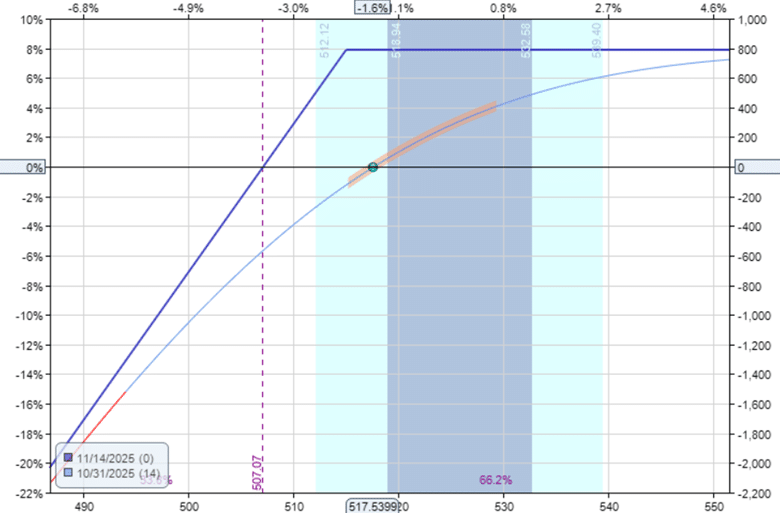
This strategy of selling a put option with cash reserves on hand to potentially own it is known as the “cash secured short put” option strategy, and the payoff graph looks as follows:
That was the plan.
Until things took an unexpected turn.
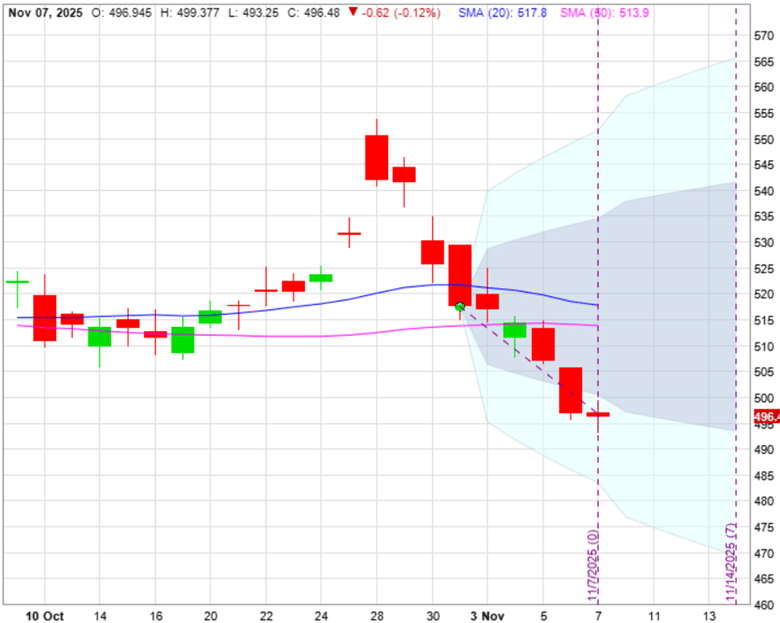
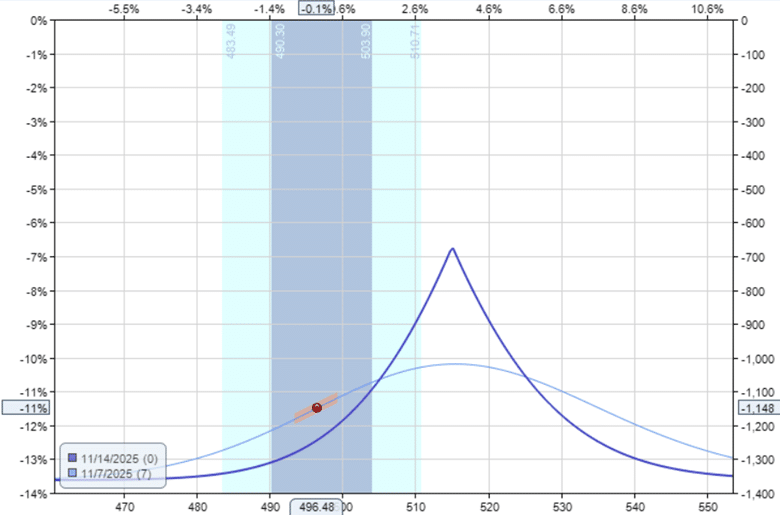
Just one week later, MSFT dropped below its 50-day moving average and moved down by more than one standard deviation from its expected move.
The investor doesn’t know all these technicals.
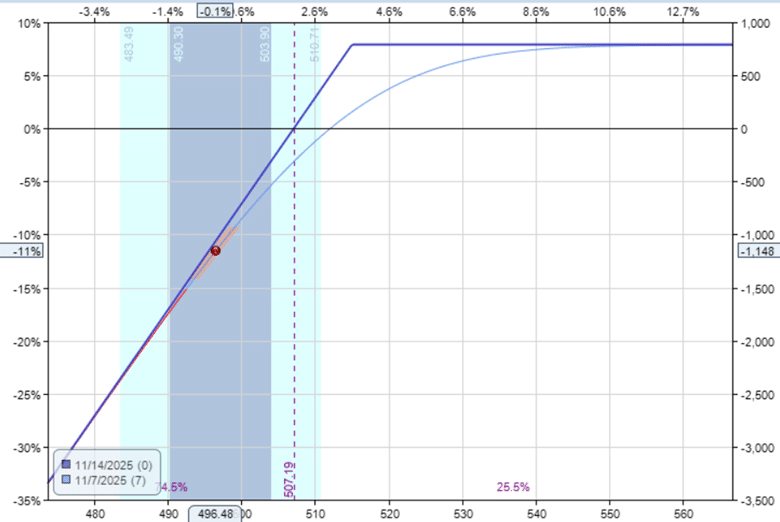
All he sees is that MSFT is trading at $496 per share, and he is obligated to buy 100 shares at $515 per share if its price does not return to $515 within seven days before expiration.
That is a 19-point difference from $496 to $515.
And buying 100 shares would be like taking a $ 1,900 loss.
Even after collecting the $790 premium, there would still be a $ 1,110 loss.
His account is showing a -$1148 loss at the moment…
What seemed like a good idea to collect some premium no longer seems like a good idea now.
Previously, he thought he would be happy to buy MSFT at $515, but now he would rather buy it at the market price of $496.
He is accepting that he will likely be assigned 100 shares of MSFT stock (at an unfavorable price of $515).
Needless to say, he is getting nervous until he came up with another seemingly good idea.
He thought, why not buy a put option that guarantees he can sell back his 100 shares at $515.
He will buy a put option with a strike price of $515.
Date: Nov 7, 2025
Price: MSFT @ 496.48
Buy to open one contract Nov 21 MSFT $515 put @ $21.50
Net Debit: -$2150
He made sure the November 21 expiration date was on or after the ex-dividend date so he could collect the dividend.
Now he has one short put at $515, expiring on Nov 14th, and one long put at $515, expiring on Nov 21st.
In effect, he has an options calendar spread.
Because of the large loss taken from the cash-secured put, even if the calendar made a maximum profit, it would not have recovered the loss from the short put sale.
But he doesn’t know all that.
All he cares about is that if he has to buy MSFT at $515, he wants the right to sell it back at $515 later.
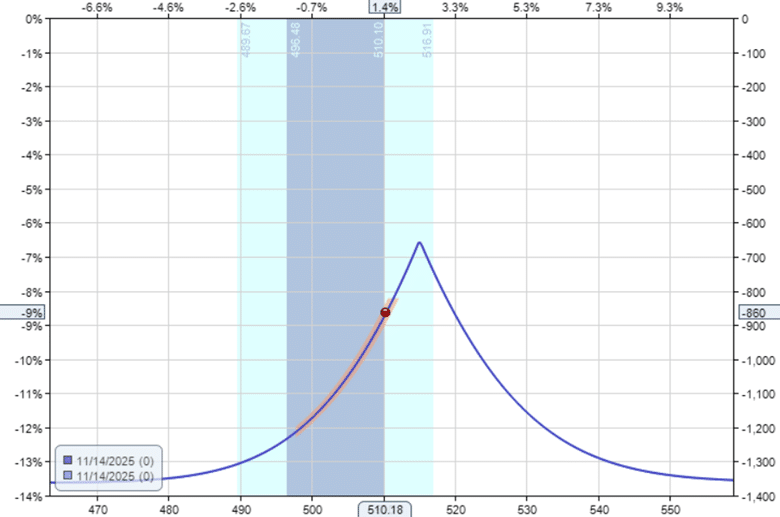
On November 14th, when the short put option expires, MSFT closed at $510.18.
It is actually near the calendar’s peak profit.
Not looking at the analytical software, the investor does not know all that either.
All he knows on Monday morning is that he has been assigned 100 shares of MSFT at $515 per share.
Date: Nov 14, 2025, at the close
Price: MSFT @ $510.18
Buy 100 shares of MSFT at $515
Net Debit: -$51,500
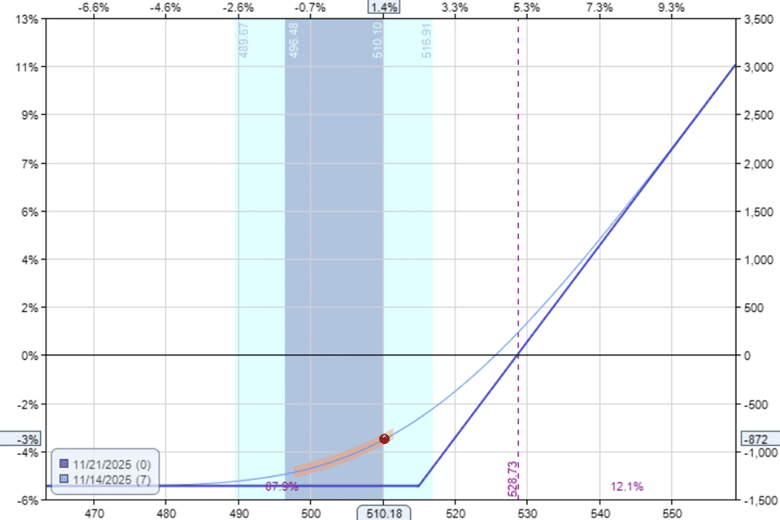
Now he has 100 shares of MSFT and one long put option protecting that stock at a strike price of $515.
The option expires in 7 days on November 21st.
Even though the short put had expired, he kept the long put because it limits his total risk to $1360.
When this protective put is paired with 100 shares of stock, some people loosely termed the trade “stock with a married put”.
While the investor is happy that he has a protective put to limit his losses if MSFT continues to go down, he realized that he had paid a large amount of money to buy this put option (costing $2150).
He decides to sell a call option at the $520 strike to collect a bit of premium.
Date: Nov 17, 2025
Price: MSFT @ $507.85
Sell to open one contract $Nov 21 MSFT $520 call @ $2.14
Net credit: $214
When a call option is sold while owning 100 shares of the stock, it is called a “covered call”.
In this case, a call option is sold while holding 100 shares of stock and a long protective put.
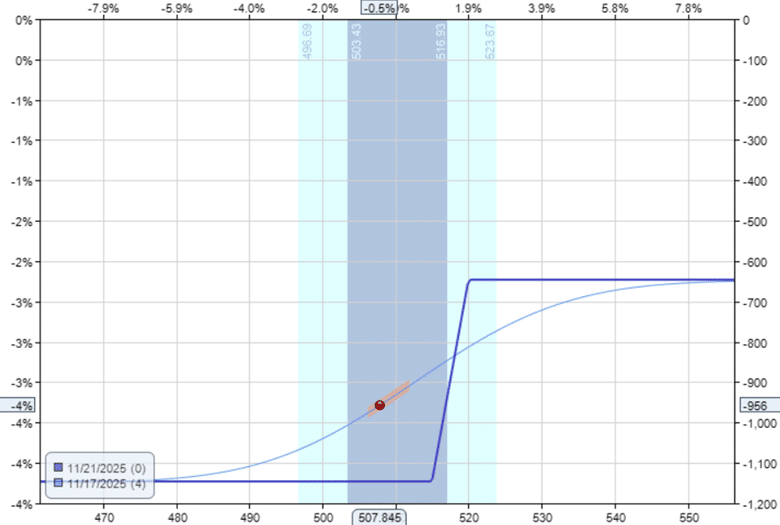
This is called a collar, and its risk graph looks like this…
Make sure that the strike of the short call is above the long put strike.
This allows the trade to profit if the stock price rises.
Selling this call option also reduced the maximum downside risk.
Previously, the max risk was at about $1360.
The maximum risk on the collar is now about $ 1,145.
The max risk was reduced by the amount of credit received from the sale of the call option.
The next day, on November 18, the stock dropped instead of going up as the investor hoped.
At this point, he is just trying to reduce his max risk.
He sells a bear call credit spread to collect additional credit and reduce maximum risk in the trade.
Date: November 18, 2025
Price: MSFT @ $493.93
Sell to open one Nov 21 MSFT $520 call @ $0.54
Buy to open one Nov 21 MSFT $525 call @ $0.28
Net credit: $26
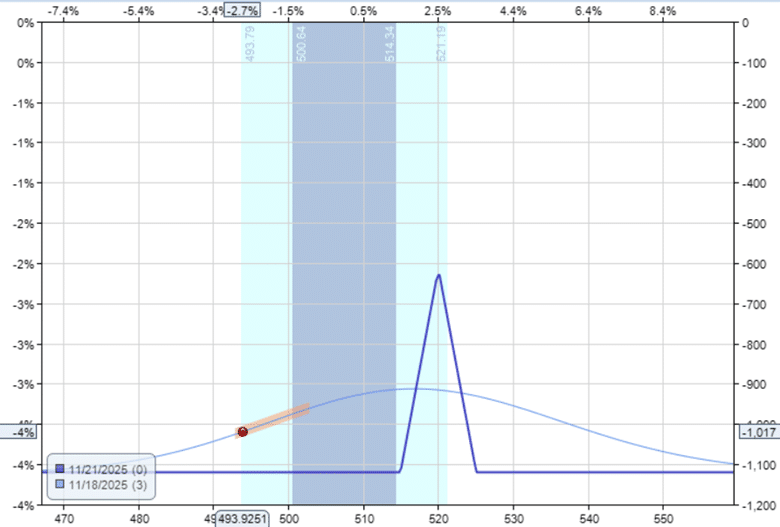
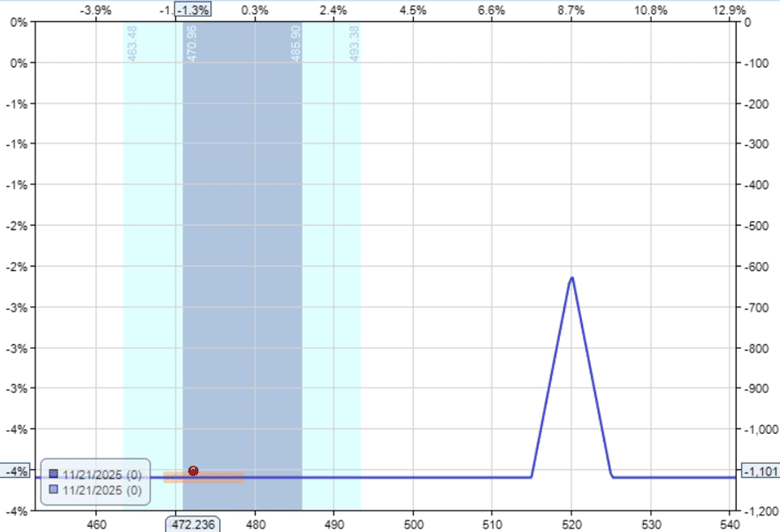
The resulting graph looks like a butterfly and behaves like a butterfly…
But it is not a butterfly because the lowest leg, which would have been a long call, had been replaced by long stock and long put.
Options synthetics:
Long call = Long stock plus long put
This equivalence is an example of options synthetics—a topic the investor knows nothing about.
All he knows is that if he collects a $26 collect, he will reduce the downside risk by $26.
And if the spread width of the bear call spread does not exceed the spread width of the collar, his upside risk will not exceed his downside risk.
And so that’s what he does, and the overall max risk in the trade is down to $1120.
On expiration, November 21st, MSFT closed at $472.23.
This is down 45 points from when the story started – a 8.7% drop.
All call options expired worthless.
The put option was used to sell his 100 MSFT shares at $515 per share.
The investor now has no stock and no options, but his account is $1,029 lower than when he started.
The math:
Sell cash-secured put: $790
Buy long put for calendar: -$2150
Assigned 100 shares: -$51,500
Collected dividend: $91
Sell call option for collar: $214
Sell bear call spread: $26
Use put to sell back shares: $51,500
Net P&L: -$1029
The analytics software shows a larger loss due to bid-ask spread fluctuations and because it did not account for the $91 in dividends collected.
It had been a good idea (to own Microsoft stock and collect a dividend), and he had made reasonable decisions.
But he just lost too much money on the cash-secured put and was unable to recover the loss.
If he had not used his options knowledge to limit his losses, his losses would have been much higher, at $3,487.
The math:
Sell cash-secured put: $790
Assigned 100 shares: -$51,500
Shares now worth: $47,223
Net P&L: -$3487
While in this example, the investor was not looking at technicals and risk graphs, at least he understood the fundamentals of buying and selling puts and calls.
He used this knowledge to help protect his stock investment and to collect premiums to pay for that protection.
As options traders, we need to look at price technicals and risk graphs, and, in addition, have enough strategies in our toolbox so we can pull out the right one when needed.
We hope you enjoyed this article on transitioning from one options strategy to another.
If you have any questions, please send an email or leave a comment below.
Trade safe!
Disclaimer: The information above is for educational purposes only and should not be treated as investment advice. The strategy presented would not be suitable for investors who are not familiar with exchange traded options. Any readers interested in this strategy should do their own research and seek advice from a licensed financial adviser.

Source link