US Dollar Index finds support with Fed’s Kashkari saying rates to remain steady for longer
- The US Dollar is tying up with gains on Tuesday, snapping the DXY’s losing streak.
- Fed officials still see US rates unchanged under tariff and trade uncertainty.
- The US Dollar Index heads above 99.00 in search of the 100.00 figure.
The US Dollar Index (DXY), which tracks the performance of the Greenback’s value against six major currencies, is tying up some minor gains, trading around 99.30 at the time of writing this Tuesday. The Greenback started edging higher at the end of Asian trading hours, after the Japanese Ministry of Finance (MoF) commented that its bond issuance plan might see some tweaking, with lower volumes. This made Japanese yields collapse and saw the Japanese Yen (JPY) devalue against the Greenback, with a domino effect in favor of the US Dollar against several major currencies.
Meanwhile the Federal Reserve (Fed) has come out with comments from Minneapolis Fed Chairman Neel Kashkari, who commented that rates will remain steady until tariff clarity takes place. Fed’s Kashkari also pointed out that there are no quick wins in trade talks, and that these talks can take months or years to be concluded.
While markets are hopeful about a US-EU trade deal in the upcoming days, this week will start with US data due this Tuesday, after the Memorial Day public holiday, which kept markets closed. Traders can look ahead to the US Durable Goods Orders for April and the Dallas Federal Reserve (Fed) Manufacturing Business Index for May, which is a good leading indicator to see how the manufacturing sector is holding up after the introduction of tariffs.
Daily digest market movers: Durable Goods less severe
- The US Durable Goods Orders for April have been released. The headline figure saw Orders shrink by only -6.3%, against the feared -7.9%, coming from a revised down 7.6% with the previous reading at 9.2% in March. US Durable Goods Orders without Transportation jumped by 0.2%, beating the expected contraction by -0.1% and up from the revised -0.2% (initial reading 0%) in March.
- At 14:00 GMT, the US Consumer Confidence for May will be released, with no forecast available and the previous figure at 86.0.
- At 14:30 GMT, the Dallas Fed Manufacturing Business Index for May is due. No forecast available, with the previous number falling sharply by -35.8.
- Equities are seeing some small gains across the board in Asia and Europe. US futures are advancing much more aggressively, with all three major indices up over 1.50% ahead of the US trading session.
- The CME FedWatch tool shows the chances of an interest rate cut by the Federal Reserve in June’s meeting are only at a low 2.1%. Further ahead, the July 30 meeting sees odds for rates being lower than current levels at 24.4%.
- The US 10-year yield comes in at 4.47% at the time of writing, another leg lower from the 4.62% peak performance seen last Thursday.
US Dollar Index Technical Analysis: Small sigh of relief
The US Dollar Index is due for some recovery after a long stretch of devaluation, and that narrative is picking up this Tuesday after very early signs were seen on Monday. Expect to see the DXY swing back higher and look for firm resistance. That could trigger a firm rejection at higher levels and push the DXY beyond the low of May, causing more devaluation for the Greenback and losses for the DXY.
On the upside, the 100.22 level, which held the DXY back in September-October, is the first resistance, followed by the broken ascending trend line near 100.80. Further up, the 55-day Simple Moving Average (SMA) at 101.32 is the next level to watch out for, followed by 101.90, a pivotal level throughout December 2023 and a base for the inverted Head-and-Shoulders (H&S) formation during the summer of 2024. In case US Dollar bulls push the DXY even higher, the 103.18 pivotal level will come into play.
Should the DXY see some renewed selling pressure, a nosedive move could materialize towards the year-to-date low of 97.91 and the pivotal level of 97.73. Further below, a relatively thin technical support comes in at 96.94 before looking at the lower levels of this new price range. These would be at 95.25 and 94.56, meaning fresh lows not seen since 2022.
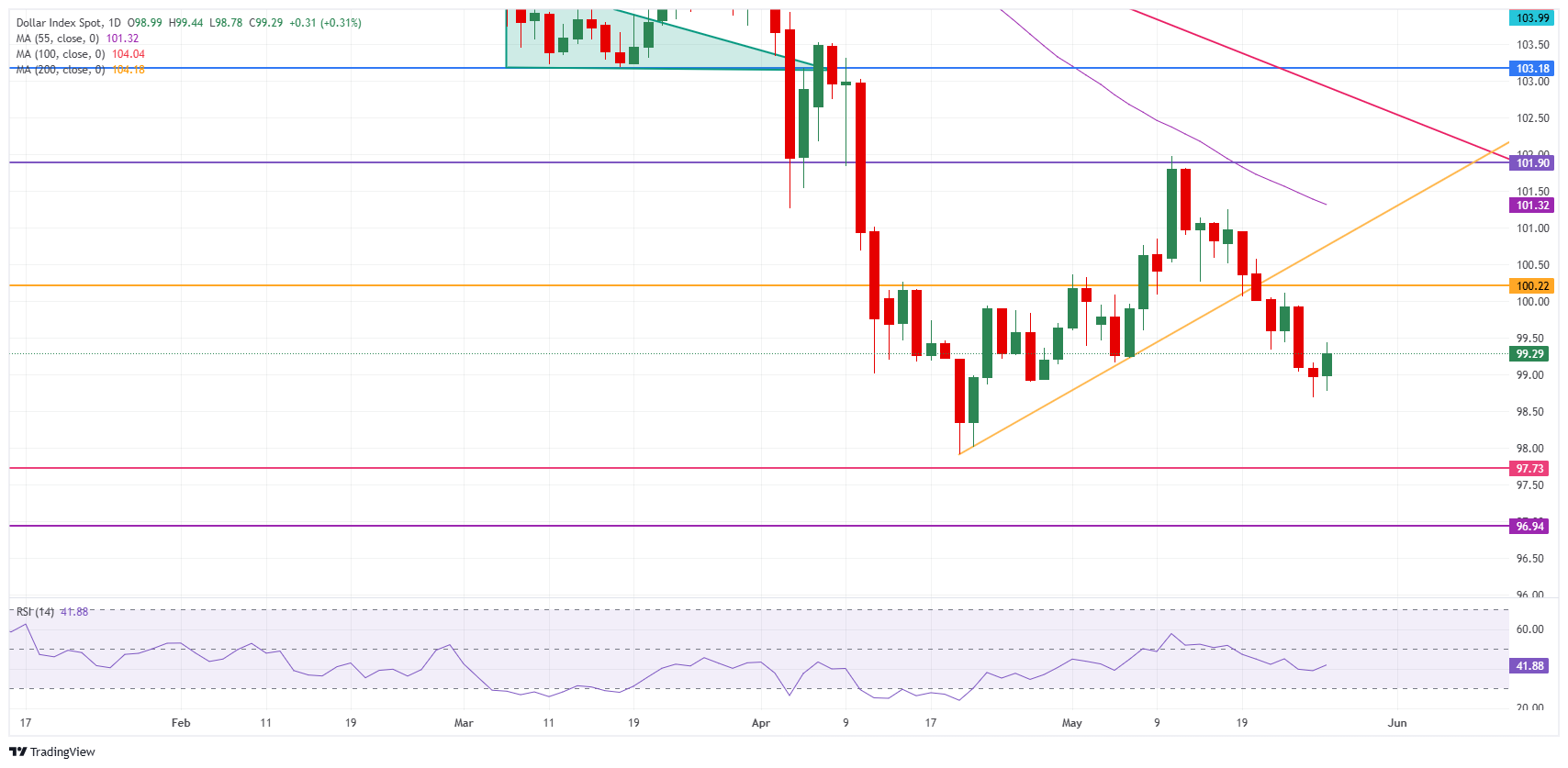
US Dollar Index: Daily Chart
Inflation FAQs
Inflation measures the rise in the price of a representative basket of goods and services. Headline inflation is usually expressed as a percentage change on a month-on-month (MoM) and year-on-year (YoY) basis. Core inflation excludes more volatile elements such as food and fuel which can fluctuate because of geopolitical and seasonal factors. Core inflation is the figure economists focus on and is the level targeted by central banks, which are mandated to keep inflation at a manageable level, usually around 2%.
The Consumer Price Index (CPI) measures the change in prices of a basket of goods and services over a period of time. It is usually expressed as a percentage change on a month-on-month (MoM) and year-on-year (YoY) basis. Core CPI is the figure targeted by central banks as it excludes volatile food and fuel inputs. When Core CPI rises above 2% it usually results in higher interest rates and vice versa when it falls below 2%. Since higher interest rates are positive for a currency, higher inflation usually results in a stronger currency. The opposite is true when inflation falls.
Although it may seem counter-intuitive, high inflation in a country pushes up the value of its currency and vice versa for lower inflation. This is because the central bank will normally raise interest rates to combat the higher inflation, which attract more global capital inflows from investors looking for a lucrative place to park their money.
Formerly, Gold was the asset investors turned to in times of high inflation because it preserved its value, and whilst investors will often still buy Gold for its safe-haven properties in times of extreme market turmoil, this is not the case most of the time. This is because when inflation is high, central banks will put up interest rates to combat it.
Higher interest rates are negative for Gold because they increase the opportunity-cost of holding Gold vis-a-vis an interest-bearing asset or placing the money in a cash deposit account. On the flipside, lower inflation tends to be positive for Gold as it brings interest rates down, making the bright metal a more viable investment alternative.