Stop Losses – when to use?
Hello and Welcome, bomz_21
IMHO, the simple answer, especially for a beginner, is
Thou shalt honour thy stop loss and and keep it Holy, lest thy capital disappear in the bottomless pit and be eternally lost.
Take a look at the reasons why you bought a share in a company:
You did your research, found a company that you thought was a reasonable investment at this time and price, and you were prepared to pay, say, $1 a share.
Q: Why did you buy? A: To let your capital grow faster than under the mattress or in a bank account (almost the same interest, these days.)
Roll forward in time, and you’re likely to be confronted with either of two scenarios.
1. The share price does rise as expected, and your capital grows in value. Let it ride.
2. The share price stagnates and turns down, and you’re becoming poorer by the day.
Will you sit idly and let that happen? Or do you take action to keep your wealth as close to today’s (high) level as possible?
Where I sit, the answer is simple: Sell at today’s price before tomorrow’s price is even less.
So much for the need to “Keep the Stop-Loss Holy”.
The only variation is now the “How”.
You mentioned a tick below your buy price. In the life of a company’s share, what is significant about your buy price? Answer: Nothing! The Market moves a share price this way or that solely depending on market forces that you may be able to observe after they have happened, but where you don’t feature. (Exceptions, such as Warren Buffet or James Packer, don’t include beginners or small retail traders.)
Therefore, it is an unreasonable approach – IMHO – to take any notice of my buy price when determining when it’s time to sell.
see http://rettmer.com.au/TrinityHome/Trinity/Musings.htm#onshareprices
In setting a (trailing) stop level, the only “personal” factor is your risk tolerance, meaning the percentage you’re prepared to hand back to the Market before taking back your capital. Do remember that your capital is the total value of your share parcel based on the most recent trade. Again, it does not depend on the price you paid, but solely on the price the last buyer was prepared to pay had you been sitting in the sellers’ queue.
In order to determine a sale price, I wrote an algorithm for a “trailing stop”. It simply calculates the stop at a level when the share price has dropped by more than an average swing from the most recent High. (The algo is written in Pascal language, which won’t help you much in standard charting packages.)
If the software you use has a “Keltner Channel”, you might start studying that one, It’s based on the same idea, but because of its age misses some of the adaptability and flexibility that a fast computer allowed me to incorporate.
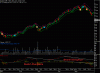
PS for galumay: Every trailing stop algo should always contain the reversal signal. Mine shows buy (up) arrows and sell (down) arrows, and even if I stopped out and then find the uptrend resumes, it will quickly give me the “Buy Back” arrow. See example below: