January 2026 DDD
That includes acquisitions, private equity takeovers, IPOs, and SPACs. The “acquisition in disguise,” (à la Inflection, Adept, Character, and Groq) won’t be as necessary anymore, which will be welcome news for venture capitalists burned in the Biden-era crackdown.
While some of that antitrust regime continued under Trump, his administration will begin to loosen regulations to support the tech industry, which has already returned the favor to Trump.
We’ve seen major breakthroughs in quantum computing over the last couple of years, and big tech CEOs have signaled the technology is becoming more like a medium-term ambition, rather than the “moonshot” technology it was for decades.
Dario Gil, undersecretary for science at the US Department of Energy, has already signaled that this is a presidential priority. In 2026, we’ll see an executive order aimed directly at quantum computing. The goal will be to beef up the national supply chain by removing any bottlenecks to progress. The Chinese are putting billions into the technology and the United States is at risk of losing its advantage.
Quantum will become part of Trump’s Genesis Mission, aimed at using AI to advance science, because scientists ultimately need the kind of data generated by quantum computers to fully utilize AI in science.
AI will be a major talking point in the midterms, where Republicans and Democrats agree more than they won’t. The China threat will be central to the conversation, and some Democrats will make AI safety, data center sprawl, and AI-related energy prices central to their campaigns. They’ll get a lot of media attention, and raise quite a bit of money — but fewer votes. This is still a country whose voters remain broadly optimistic about technology — and whose hyperscalers (and allies) will dump tens of millions of dollars into winning elections.
As data center NIMBYism roils the US and becomes a political issue, tech companies will start investing in the curb appeal of facilities,making them more design-forward, replacing the traditional square-white-box look of data centers. The spaces won’t be reserved for server equipment alone, but sections of new builds will incorporate places for residents to gather, like community gardens, playgrounds, restaurants, and stores. The addition of community spaces will attempt to ease negative sentiment towards data centers, though facilities handling the most important information will remain secluded from the public. The physical security of such facilities will become a point of innovation to account for additional foot traffic near the technology, though cybersecurity remains the biggest threat. Simultaneously, we will see a PR push for data centers revolving around the economic value they bring to localities as a way to thwart political backlash.
Reminiscent of the chip shortage that plagued many industries, from autos to consumer electronics, the AI-driven memory shortage will become a huge issue in 2026, prompting a renewed push to diversify supply chains to avoid economic disruptions and national security risks.
The AI industry has significantly boosted demand for memory in data centers and chips, which is causing price hikes in consumer products. Higher prices will create even more anti-AI sentiment, which could slow the rollout.
Autonomous driving will have a big year, which could be a good thing or a bad thing. On the one hand, Waymo is expanding nationwide, and Tesla is a breakthrough or two away from actual self-driving cars that can scale almost anywhere. On the other hand, it’s inevitable that as self-driving cars become more prevalent, there will likely be an accident involving a human, not just a pet. It’s unclear whether self-driving cars are established enough to survive such an incident. A single accident was enough to stop Uber’s autonomous driving ambitions, and Cruise barely exists because of a separate incident.
| Amazon $AMZN is currently exhibiting a Squeeze Score of 96 and an even tighter Long-Term Score of 96.9. Here’s what the chart looks like: |
| |
Amazon has been coiling in a tight range against its pre-tariff selloff highs. Volatility on the Strazza Indicator is compressed near one-year lows just as the stock sets up in one of our favorite patterns – the VWAP Pinch. If offensive rotation returns to consumer stocks, this bellwether should be one of the first to move. |
|
|
|
|
|
AI-driven scientific innovation accelerated, yielding real-world benefits from robotics to health care.
1. Diagnoses for Alzheimer’s and related diseases are on the road to becoming faster and cheaper with AI.
4. Weather forecasting is more powerful: Researchers are combiningAI with physics-based climate models to predict extreme weather that may happen every 1,000 years — “gray swan” events.
|
The U.S. quietly made historic progress this year on some of its deadliest and most difficult problems — from murder and overdoses to traffic fatalities and mental health:
|
Americans are getting healthier as researchers make major medical advances:
|
Major live TV events saw a notable ratings bump this year — underscoring how much audiences crave communal, real-time experiences even as their daily viewing habits fragment, Axios Media Trends author Sara Fischer writes.
- Why it matters: The pandemic shift to streaming drove historic low TV ratings for live events that have started to rebound.
- NBC’s 99th Macy’s Thanksgiving Day Parade reached 34.3 million viewers across NBC and Peacock, a record combined audience.
- Nearly 45 million people watched the three Thanksgiving Day NFL games on average, according to Nielsen, shattering last year’s record of 34.5 million viewers.
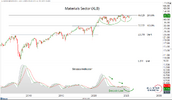
| The Materials Sector $XLB is currently exhibiting a Long-Term Squeeze Score of 94.5. Here’s what the chart looks like: |
| |
The large cap Materials space, largely dominated by chemicals rather than this year’s high-flying metals, is currently sitting at a decade-low volatility reading on the monthly Strazza Indicator. When this group breaks out, it tends to happen fast, and with a structural setup of this magnitude, a powerful move should not be surprising. We have traded around the mineral and materials theme all year. We were early in precious metals, banking big winners in silver and silver miners. Later, we rotated into industrial metals, agriculture and coal. Now we are looking ahead to what could become the next major group investors decide to bid up. |
Donald Trump’s maximum pressure strategy on Venezuela is finally starting to impact Venezuela’s oil production, with state oil company PDVSA beginning to shut down wells in the Orinoco Belt amidst swelling inventories and ongoing tanker seizures.
– Venezuela’s oil production has been continuously growing in 2025, with the November average of 1.165 million b/d representing a 20% year-over-year increase.
– According to Bloomberg, PDVSA plans to reduce output in the Orinoco Belt by at least 25% to 500,000 b/d, which could shave some 15% off Venezuela’s total liquids production.
– Venezuela will curb production at its heaviest wells first, with extra-heavy Junin becoming the first basin to be slashed, keeping lighter fields that require less diluents operational for as long as possible.
– Despite ongoing VLCC seizures, flows of diluents to Venezuela have not fully stopped, with Russian suppliers delivering four tankers of naphtha in December to date, however storing the upgraded bituminous crude is becoming a deal-breaker for PDVSA.
Market Movers
– Australia’s top energy producer Woodside Energy (ASX:WDS) signed a 9-year term LNG supply deal starting from 2030 to deliver around 5.8 billion m3 of liquefied gas from its Louisiana LNG project.
– US oil major Chevron (NYSE:CVX) has reported first oil from its South N’dola project offshore Angola, aiming to produce 25,000 b/d of crude and 50 MMCf/d of natural gas once the field reaches peak output.
– Russia’s government has extended its deadline to sell ExxonMobil’s (NYSE:XOM) 30% stake in the Sakhalin-I project by another year, potentially indicating Moscow’s readiness to re-integrate the US oil major into Sakhalin’s new shareholding structure after the Russia-Ukraine conflict ends.
Tuesday, December 30, 2025
In the relatively uneventful period between Christmas and New Year, Russia-Ukraine peace talks were the main geopolitical driver. Ukraine’s alleged targeting of Putin’s residence and Moscow’s pledge to change its negotiating strategy brought yet another wave of disappointment to those eyeing a resolution to the four-year-long conflict, capping ICE Brent at $62 per barrel. An all-out-war in Yemen could provide a new geopolitical risk to oil, however the physical impact thereof remains questionable.
Saudi Arabia Mulls Extending Price Cuts. Saudi Arabia’s national oil firm Saudi Aramco (TADAWUL:2222) is expected to cut its formula prices for February-loading cargoes going to Asia by up to 30 cents per barrel, slashing prices further despite dipping to a 5-year low last month.
China Launches 2026 Crude Import Season. China’s Commerce Ministry has issued its first batch of crude oil import quotas for 2026, allocating 206 million metric tonnes or 4.14 million b/d to qualified refineries, putting the overall allocation some 8% higher than a year ago as new private refiners boost runs.
India Seeks Billions from Key Upstream Players. The government of India is seekingmore than $30 billion in compensation from a consortium comprising Reliance Industries and BP (NYSE:BP), claiming they failed to produce promised volumes from two deepwater fields, D1 and D3.
Kazakhstan Curbs Output on CPC Damage. Oil production in Kazakhstan dropped by 6% month-on-month in December to 1.93 million b/d, following a November 29 drone attack on the CPC terminal on Russia’s Black Sea Coast, with curbs mostly coming from the Chevron-operated Tengiz field.
Nigeria Eyes Asset Divestments to Boost Coffers. Nigeria’s state oil company NNPC is reportedly planning to sell stakes in some of its oil and gas assets, offering potential bidders to disclose their interest by January 10 despite ongoing protests from the African country’s powerful trade unions.
Russia Extends Gasoline and Diesel Export Ban. Russia’s government has extended its temporary ban on gasoline exports until 28 February 2026 as a precautionary measure vis-à-vis Ukrainian drone strikes, having already halved exports of the transportation fuel to 50,000 b/d in 2025.
Ghana Restarts Its Key Refinery After 5-Year Hiatus. Ghana’s state-owned 45,000 b/d Tema refinery has resumed operations this week after a 5-year hiatus as a means to combat soaring imports of petroleum products from Nigeria’s 650,000 b/d Dangote refinery that sent 30,000 b/d of fuel in 2025.
LNG Canada Still Not Flowing the Way It Should. Canada’s first LNG export plant, Shell-operated (LON:SHEL) LNG Canada, struggles to make good on initial promises as there has been no cargo loading LNG in Kitimat in three weeks despite the operator claiming both liquefaction trains were up and running.
Beijing to Limit Copper and Alumina Smelting Capacities. China’s ‘anti-involution’ campaign to combat overcapacity will extend into the country’s copper and alumina industries as Beijing vowed to tighten oversight over the metal industry, with both copper and alumina hitting all-time highs in 2025.
Petrobras’ Strike Might Spin Out of Control. Brazil’s Superior Labour Court has mandated that staffing levels remain at a minimum of 80% across all Petrobras (NYSE BR) facilities as the Brazilian state oil firm’s largest trade union rejected its latest proposal to end the ongoing three-week strike.
Syria Starts Exploration Campaign for More Gas. Syria’s Petroleum Company announced that the war-torn country will resume exploration drilling to boost domestic gas production in Q1 2026, planning to drill four wells around the capital city of Damascus.
US Exporters Boost Pre-Christmas Exports. Delayed weekly data from the US Energy Information Administration show that American exports of petroleum products soared to a new all-time high of 7.8 million b/d in the week ending December 19, taking the usual year-end destocking to a new level.
Market Expects Lithium Slump in Early 2026. China’s passenger car association expects demand for lithium batteries to slump by at least 30% as Beijing’s tax incentives for EV purchases are gradually phased out, capping lithium’s stellar 35% rally in December as lithium carbonate rose to $16,850/mt.
- Apple ponies up. Breaking its aversion to big M&A, Apple buys an AI search engine or model lab — think Mistral or Perplexity — to catch up in the tech and talent war it can’t afford to be losing.
- A new $1 trillion asset manager. Blackstone has held the mantle for too long. KKR is still a few years away, so this newcomer will be formed by acquisition. Here’s one combination you can cross off, and one to watch.
- Bitcoin at $120,000: Trump makes crypto the base of a US sovereign wealth fund. Nothing sends asset prices higher than a forced buyer.
- FREE SPACE: New Fed chair
- A predictions-market scandal will make Nobelgate look small and bring new regulation down on online betting.
- A European digital tax. France, Italy, and Spain already have one, and splitting €38 billion in revenue could help deficit-strapped and debt-shy governments pay for defense buildouts.
- SEO death spiral. Human-directed web traffic falls by 25% as agents come of age, sparking a sharp drop in e-commerce stocks.
- Tariff refunds. Either checks sent directly to Americans as a popularity play before the midterms, or payments to retailers after the Supreme Court finds some of the levees unconstitutional.
- Robinhood buys a bank. It becomes the latest fintech to embrace the “if you can’t beat ‘em, join ’em” ethos.
- NASCAR takes outside money. With the antitrust lawsuit settled, sports eating finance, and red-state culture ascendant, the lane is wide open.
- A major labor action over AI. Thousands of workers in telecom, healthcare, and manufacturing walk off the job, demanding ‘human-in-the-loop’ contracts that block AI from doing mission-critical tasks.
- Alphabet becomes the world’s most valuable company. Custom TPU chips, the Gemini 3 rollout, and a big Waymo expansion drive its market cap past a cooling Nvidia and Apple.
- Saudi Arabia starts serving. Allowing booze will lure Westerners who prefer the libertinism of Dubai, boosting the kingdom’s ambitions to win the “regional headquarters” race.
- China bans Teslas. Beijing enacts a total ban on Tesla sales, citing the recently passed cybersecurity law and “national security risks” posed by the cars’ cameras.
- Sam Bankman-Fried gets pardoned after a media campaign reframing his 25-year sentence as a partisan hit job.
- The iShares 20-Year Treasury Bond ETF ($TLT) has struggled since the start of the decade, falling roughly 51% from its March 2020 highs.
- David notes that little has changed structurally, with $TLT on track to close the year flat, marking one of its calmest years since the ETF’s inception.
- Bond market volatility ($MOVE) currently remains at multi-year lows, and this quiet backdrop has coincided with one of the strongest equity runs in history.
Full:https://www.theatlantic.com/ideas/2…opy-link&utm_medium=social&utm_campaign=share
Full:https://www.wired.com/story/the-us-must-stop-underestimating-drone-warfare/
jog on
duc
Source link