What is a trading terminal, and how does it work?
In the fast-growing financial markets of India, technology has brought a revolution in the way trade is placed by retail and institutional investors. At the centre of this change lies the trading terminal, a software system that offers direct access to the market, real-time data, advanced charting, and lightning-fast order execution.
The advent of online trading platforms has democratised access to the stock markets as millions of Indians are now able to invest in the equity, derivatives, and commodities markets with the help of various tools that were previously only available to large financial institutions.
Whether an experienced professional or a beginner taking their first tentative steps in the world of investing, having an understanding of what a trading terminal is and how to utilise it helps to better navigate the modern financial landscape. Let’s explore this in detail.
Understanding the trading terminal
A trading terminal is an online interface that allows traders and investors to place buy and sell orders, track market trends, and manage their investment portfolios. In the earlier days, stock trading in India used to take place on phone calls by brokers or at the exchange rings physically. However, with the advent of the internet came trading terminals, which have made these processes much easier for market participants, giving them the ability to trade and access real-time market data at the click of a few buttons.
Brokers offer these trading terminals to the market participants to provide seamless and efficient transactions. Thus, trading terminals are the connecting link between the market participants and the stock markets and supply them with the tools and information necessary for them to make informed trading decisions.
Behind these user-friendly interfaces of today’s terminals is a complex architecture that connects them directly with exchange servers. This ensures that the data a trader sees on their screen (whether it’s the bid-ask spread or the Last Traded Price (LTP)) has close to zero latency, which is important for executing profitable trades in a highly volatile environment.
The evolution of trading systems in India
To know the true worth of modern trading terminals, it’s important to know just how far we’ve come. The journey of trading in India has undergone 3 major phases:
The open outcry era
Before the mid-90s, the Bombay Stock Exchange (BSE) was an open-outcry exchange. Traders physically gathered in the trading ring, shouting their orders and using hand signals to buy and sell shares. It was chaotic, prone to human error, and completely inaccessible to the retail investor sitting at home.
The desktop terminal era
With the establishment of the National Stock Exchange (NSE) and the introduction of electronic screen-based trading, the first iterations of trading terminals were designed. These were heavy, downloadable, desktop software programs. While revolutionary for that time, they were PC-intensive, required constant manual updates of the software, and were largely restricted to particular desks.
The web and mobile era
Today, this landscape is dominated by lightweight and highly responsive web-based terminals and mobile applications. Due to improvements in cloud computing and the use of the latest version of the programming language, modern traders don’t need to download the software anymore. They can access advanced tools directly from their web browsers, providing high flexibility to their trading experience.
How does a trading terminal work?
When a market participant decides to buy a stock and uses a trading terminal for this purpose, there is a smooth, high-speed process that takes place in the background to facilitate this. The process includes:
- Order entry: The trader selects a stock, they pick the product type (CNC for long-term delivery or MIS for intraday trading) with it, and then place a buy order on the trading terminal.
- Validation: The trading terminal instantly verifies the linked trading account to make sure that there are sufficient funds or margin to execute the order.
- Routing to the exchange: After being validated, the brokers route the order to the exchange. The National Stock Exchange (NSE) makes use of the NEAT system, whilst the Bombay Stock Exchange (BSE) uses the BOLT architecture to find matching orders.
- Matching and execution: Once the exchange finds a matching buy order with a corresponding sell order, it then executes the trade based on price and time priority.
- Confirmation: After a trade is executed, a confirmation is sent back to the trading terminal within fractions of a second that the trade is executed, and the portfolio is updated depending on the trade executed.
Key features of a trading terminal
Modern trading terminals provide the trader with various features to make trading easy for them. Some of those are:
- Real-time access: They provide access to real-time market data, including pricing information, bid-ask spreads, and market depth, which is essential for making informed decisions.
- Order execution capabilities: They are the means of execution of different types of trades.
- Analytical tools: Offers integrated access to live charts, historical data analysis, and technical indicators to help traders identify trends and entry/exit points.
- Portfolio overview and management: Allows market players to track the performance of their portfolio and also access the daily P&L (Profit and Loss) and margin utilisation.
- Risk management tools: Modern terminals offer features like trailing stop-losses, bracket orders, and cover orders, which automatically manage a trade’s downside risk without requiring the trader to constantly monitor the screen.
Enter the next generation with Dhan’s DEXT T3
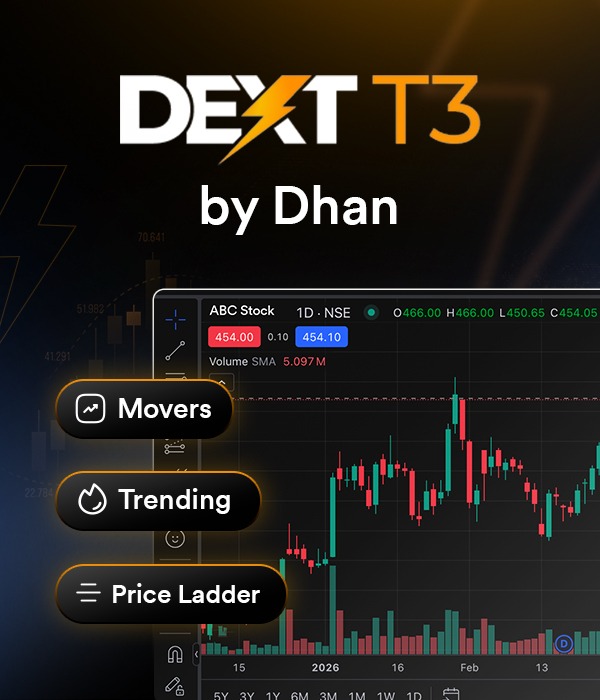
As the Indian markets have matured, the needs of the modern trader have evolved. Standard web platforms are excellent for investors, but active day traders, scalpers, and Options traders require a system built purely for speed, customisation, and offering advanced features. Recognising this gap, Dhan introduced the DEXT T3 (Dhan Exchange Trading Terminal), a web-based trading terminal built specifically for the super traders.
The DEXT T3 trading terminal bridges the gap between heavy legacy desktop software and lightweight web browsers. Here is what makes the DEXT T3 a game-changer in the Indian broking industry:
Customisable workspaces
Unlike traditional platforms, DEXT T3 allows traders to build their customisable screens. Traders can drag and drop widgets, resize panels, and create multiple personalised workspaces. Whether they want a screen dedicated solely to their portfolio, or a complex setup with an option Chain, order book, and live charts side-by-side, DEXT T3 adapts according to their workflow.
Multi-monitor support
Professional traders rarely use a single screen. DEXT T3 is designed to spread across multiple monitors so that traders can track global indices on one screen while executing Nifty options on another without any lag.
Fast execution with keyboard shortcuts
For Scalpers, every millisecond counts. DEXT T3 offers them high speed by integrating comprehensive keyboard navigation. Traders can open order windows, change tabs, and execute or cancel orders instantaneously using hotkeys, completely bypassing their need for a mouse.
Advanced F&O capabilities
With its development targeted at derivatives traders, the DEXT T3 terminal includes an integrated, real-time Option Chain. Traders can view Option Greeks (Delta, Theta, Gamma, Vega), track implied volatility, and place multi-leg option orders from the chain itself.
Advanced charting integration
DEXT T3 offers a seamless integration with TradingView, which traders can use to execute trades directly from the charts. Traders can have multiple chart layouts on the screen at once, use hundreds of technical indicators, and visualise their open positions without leaving the charting window.
Who should use an advanced terminal like DEXT T3?
While the need for a basic investing app is enough for long-term mutual fund or stock investors, advanced trading terminals are for active market participants. Traders should consider upgrading their setup to an advanced trading terminal similar to DEXT T3 if they fall into any of these categories:
- Intraday traders & scalpers: Traders who make buy and sell decisions within minutes or seconds make extensive use of keyboard shortcuts, instantaneous order execution, and real-time market depth. A split-second delay in a simple app can mean the difference between a profitable scalp and a loss.
- Derivatives (F&O) traders: To trade efficiently in options, vast amounts of data have to be processed at the same time. Traders need to keep track of the underlying index, specific strike price premium, India VIX, and option greeks simultaneously. Terminals with customisable layouts and advanced option chains are necessary for their success in the F&O segment.
- Algorithmic traders: Advanced trading terminals offer webhook integrations or API access, enabling tech-savvy traders to connect their custom algorithms directly to the broker’s execution engine.
The bottom line
A trading terminal is a tool that is essential for market participants, as it allows them to obtain real-time data, analytics, and efficient order execution. These tools meet a wide variety of trading requirements and preferences.
Understanding their features, knowing how to efficiently utilise them, and also the advanced functionalities that they offer are some of the most crucial steps for exploring the dynamic world of the Indian financial market. With the introduction of modern trading terminals, the barrier between retail traders and the tools used by institutional traders has been completely erased. The trading terminals help a trader to be better in their analysis and discipline.