What is the “Square Root of Time Rule” & How Does it Impact Option Expiration Date Selection?

You’re selling 4, 1-month covered call contracts for the $100.00 strike and generating $1000.00 in premium. Pretty good, right? But wait a minute … if I sell 4, 6-month $100.00 strikes, I can make $2,500.00. Seems like a no-brainer to get $2500.00 up front. Before you say yes or no, let’s review the Square Root of Time Rule and then analyze a real-life example with AAPL.
What is the Square Root of Time Rule?
This states that an options price (and volatility) is roughly proportional to the square root of it time-to-expiration. For example, an at-the-money option with 4x the amount of time-to-expiration compared to another, will generate only double the price (not 4x) … the square root of 4 = 2. This implies that in order to compare “apples-to-apples”, we must annualize our returns, so all choices are playing on the same field.
Real-life example with Apple Inc. (Nasdaq: AAPL)
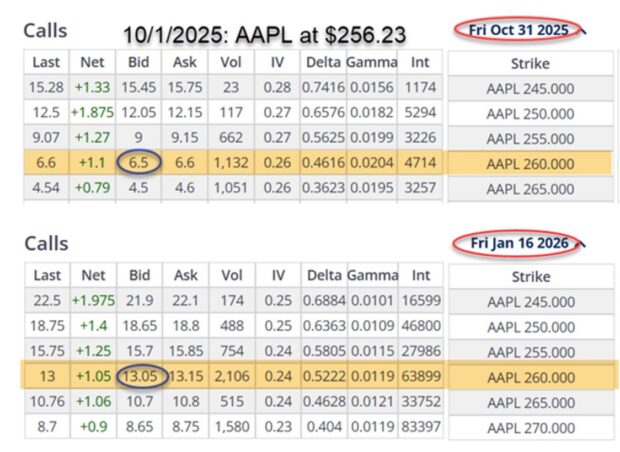
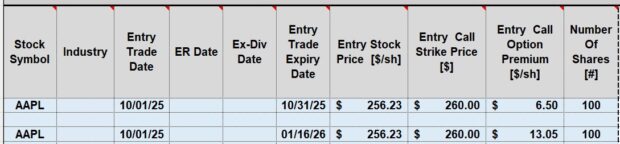
- 10/1/2025: AAPL trading at $256.23
- 10/1/2025: The (1-month) 10/31/2025 $260.00 call has a bid price of $6.50
- 10/1/2025: The (3 1/2-month) 1/16/2026 $260.00 call has a bid price of $13.05
- Using the Square Root of Time Rule, (Square root of 3.5) we would expect a premium of 1.87 x that of the monthly ($6.50) or $12.16. $13.05 is pretty close
AAPL option-chains
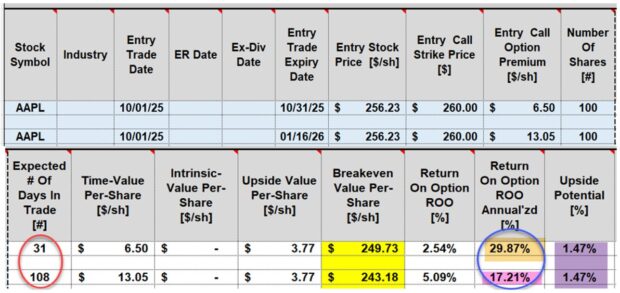
Using the BCI Trade Management Calculator (TMC) to compare annualized returns
- Red circle: calculates the days-to-expiration (DTE) of 31 and 108 days
- Purple field: The same amount of upside potential (1.47%)
- Blue circle: The shorter-dated option has an annualized return of 29.87% (brown cell); while the longer-dated option shows an annualized return of 17.21% (pink cell)
Discussion
The Square Root of Time Rule is instructive in that it demonstrates that shorter-dated options generally return greater annualized returns compared to longer-dated options. So, put on your sunglasses and avoid the shiny objects of higher premium dollar amounts. It’s all about annualization.
The Blue Collar Investor’s Guide to:
Exit Strategies for Covered Call Writing and Selling Cash-Secured Puts
This book will detail how to enter, manage and calculate trade adjustments for all market conditions. After we select the underlying security and sell the corresponding option, we immediately move into position management mode. There are over 20 exit strategies defined, as well and when and how to implement these plans.
Free training resources
Your generous testimonials
Over the years, the BCI community has been incredibly gracious by sending our BCI team email testimonials sharing stories as to what our educational content has meant to their families. Moving forward, we have decided to publish several of these testimonials in our blog articles. We will never use a last name unless given permission:
Hi Alan,
I have been watching your videos on YouTube about Covered Call writing, and I recently purchased your book – the Complete Encyclopedia of Covered Call Writing. Thanks for posting the content and for sharing your methods so nicely in your books. After watching so many hours of your videos, I feel as though you are an old friend! Glad to get a chance to connect.
Thanks again for making all the wonderful content accessible to novice investors like me. Really appreciate it.
Thanks
Nikhil
New video: What is a Delta-Neutral Portfolio?
Upcoming events
1. Palm Beach Traders Club (do you live near Palm Beach Gardens Florida?)
March 10, 2026
6:30 PM – 8 Pm ET
Private Investment Club / guests are welcome (free)
Wine-tasting event follows for those interested.
2. Long Island Stock Investors Meetup Group: Part II
Thursday March12, 2026
7:30 PM ET – 9:00 PM ET
Ultra-Low-Risk Approaches to Covered Call Writing & Selling Cash-Secured Puts
Introducing Our Latest Products, Creating New Investment Opportunities
3. Hollywood Florida Money Show
April 10, 2026
11:40 AM – 12:25 PM
The Put-Call-Put (PCP) or Wheel Strategy
Using Both Covered Call Writing and Put-Selling to Generate Monthly Cash Flow
Selling stock options is a proven way to lower our cost-basis and beat the market on a consistent basis. Two such low-risk strategies are covered call writing and selling cash-secured puts. This presentation will detail how to incorporate both strategies into one multi-tiered option-selling strategy where we either generate cash-flow or buy a stock at a discount. I refer to this as the Put-Call-Put (PCP) Strategy, also referred to as the wheel strategy.
The basics and pros and cons of low-risk option-selling strategies will be discussed as well as an analysis of a real-life example and introduction into the BCI Trade Management Calculator (TMC). This seminar is appropriate for those who look to generate modest, but consistent, returns which will enable us to potentially beat the market on a consistent basis while focusing on capital preservation.
4. Young Investor’s Club at The University of Central Florida
April 16, 2026
Private student investment club.
5. Sarasota Investment Group
Portfolio Overwriting: A Form of Covered Call Writing
Wednesday April 22, 2026
Details to follow.
6. BCI Educational Webinar #10: The Put-Call-Put (PCP) or “Wheel Strategy”
Thursday May 14, 2026, at 8 PM ET
Using both covered call writing & cash-secured puts in a multi-tiered option selling strategy. A 68-day real-life example taken from one of Alan’s portfolios will be analyzed.
BONUS: Barry will share a real-life credit spread trade using our BCI Conservative Credit Spread Management System.
Discount coupons and a live Q&A session will follow the presentation.
7. American Association of Individual Investors: NYC Chapter
June 10, 2026, at 6 PM – 8 PM ET
More information to come.
8. Orlando Money Show
October 5 – 7, 2026
Details to follow.
Source link