
The Thin Red Line – Fat Tail Daily
In March last year, the talk of Silicon Valley wasn’t OpenAI or Anthropic.
It was a Chinese startup called Manus.
It was called the first true ‘Agentic AI’ — the AI co-worker rather than a chatbot.
Its demo had gone viral overnight. Access codes were invitation-only and trading online for thousands. Less than 1% of those who requested access could get in.
I had to see for myself.
After a busy few evenings and a pompous letter angling for my inclusion as part of ‘tech journalism’, I eventually managed to gain access through a Silicon Valley contact.
What I used was the first piece of software that genuinely felt like a coworker rather than a chatbot.
Source: Manus
I asked it to find me a good Melbourne apartment for under $1 million.
It opened a browser, scraped Domain, filtered listings by school catchments, built a comparison spreadsheet, and then drafted enquiry emails to the agents.
30 minutes, start to finish. A few postcodes were hallucinated. But it actually finished the job.
This was my first real taste of agentic AI. Something between a tool and an employee.
That distinction matters.
ChatGPT is conversational. You ask, it answers. An agent does work. It plans a sequence of steps, opens tools, executes, and recovers from errors.
Earlier AI threatened tasks. Agents threaten jobs.
Manus’s commercial trajectory backed that hype. By December 2025, the company claimed US$100 million in annual recurring revenue — the fastest run-up in startup history.
Backers included Chinese tech giants, Tencent and VC majors HongShan.
Then Meta turned up with US$2 billion.
The Workaround That Worked (Until It Didn’t)
Manus had an awkward problem. The product was Chinese-built. The capital was American. And in late 2024, the US Treasury banned American funds from investing directly in Chinese AI.
So Manus did what a growing list of Chinese startups have done in the past.
It moved.
The Singapore office became its headquarters. The Beijing team was cut to a skeleton crew, and its major website started blocking Chinese IP addresses.
The parent re-incorporated, and by December, it was a Singapore company on paper.
The technique had a name in Silicon Valley: Singapore-washing.
It was a well-oiled machine in Singapore.
After the Meta deal, staff were integrated into Meta’s Singapore offices within weeks.
They didn’t ask Beijing for permission.
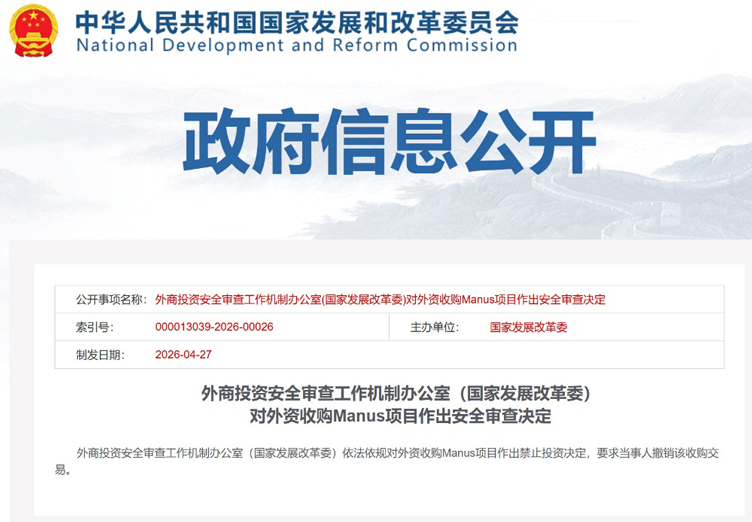
But on Monday this week, China dropped the hammer.
China’s Office of Foreign Investment Security Review issued a prohibition on the deal.
Soon after, China’s National Development and Reform Commission ordered the deal unwound.
Source: CCP | National Development and Reform Commission
Now, co-founders Xiao Hong and Ji Yichao have been barred from leaving the country.
Beijing has set a deadline measured in weeks and reportedly demands that any data or technology already transferred to Meta be stripped out.
Meta says it’s preparing to comply.
The Look-Through Doctrine
The official CCP rationale is national security. The real logic is more interesting.
Chinese regulators have had enough with Singapore-washing. A registered address of a holding company is no longer enough.
They’re claiming jurisdiction over technology built by Chinese teams, on Chinese infrastructure, with Chinese data, regardless of where the parent later moves.
Lawyers are calling it the look-through doctrine. It applies to founders, R&D location, training data, original capital and user base.
If enough of those answers come back as ‘China’, the deal needs Beijing’s blessing.
It is functionally a Chinese version of CFIUS — the US committee that vets foreign acquisitions on national security grounds.
Until now, China lacked one.
The Big Split
For over a year, the US has been blocking American capital from flowing into Chinese AI. Now China has closed the other door.
Chinese founders cannot offshore their way to a Western exit. American venture firms cannot backdoor into Chinese frontier research.
The result is a clean split. Two ecosystems, two capital pools, two regulatory regimes.
A few things follow for markets and your investments.
First, Hong Kong is now likely to become the default exit for Chinese Tech.
Manycore Tech [HKG:0068], a 3D-rendering firm rebranded as a ‘spatial intelligence’ company, listed in Hong Kong this month.
Its price doubled on the first day of trading. That’s no fluke.
Second, the Chinese tech stack will increasingly bypass US silicon.
Beijing has reportedly told domestic firms to avoid Nvidia hardware where possible. State banks have launched a 1 trillion-yuan technology fund to underwrite domestic alternatives.
Third, and most relevant for the ASX, Australia’s ambiguous trade posture gets harder to fudge.
In the future, these mountains of data centres, semiconductors, research partnerships and critical minerals will increasingly be tied to one ecosystem or the other.
Does Australia go East or West? Seems like a simple answer.
But then will our businesses be trapped in expensive US AI ecosystems while the global south embeds in a cheaper Chinese AI and chip stack?
Does that become a moral choice more than an economic one for end-users of AI?
The bigger question may be who wins the agentic race.
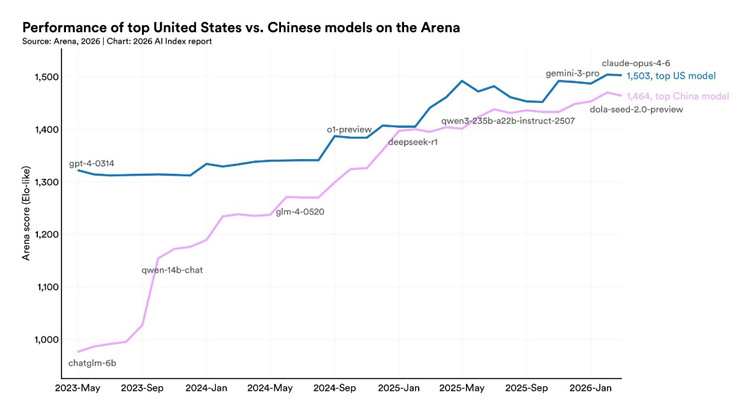
Western models still lead in raw capability. Chinese models lead in deployment and cost, particularly in video and consumer applications.
When we look at the top end of the most powerful AI models publicly released, you can see that China is closing the gap. Often at a fraction of the cost.
Source: Arena | 2026 AI Index Report
[Click to open in a new window]
But while these graphs appear to be close, it’s unlikely China will surpass anytime soon.
Many Chinese models are well known to ‘distil’ their models from the latest US ones. A fancy way to say they are quick to copy the latest US changes — effectively waterskiing behind the huge R&D spend by US labs.
Manus itself was built on top of Anthropic’s Claude, a workaround that the new reality makes hard to repeat.
The New Red Line
The US$2 billion offer by Meta was always more than a price to China.
It was a provocation that Beijing answered.
Every Chinese AI founder in Singapore watched their exit strategy die this week.
The next ones will likely be looking towards Hong Kong — keep an ear out.
For investors, the takeaway is simpler than the geopolitics.
The era of a single global AI market, where capital, talent and customers flowed freely between Beijing and Palo Alto, ended this week.
Now it’s two ecosystems. Two stacks. Two lists of winners and losers.
Shop accordingly.
Source link



![Liontown Resources [ASX:LTR] Shares Rally on Production Progress - Fat Tail Daily](https://dcgreferral.com/wp-content/uploads/2024/08/1722928826_Liontown-Resources-ASXLTR-Shares-Rally-on-Production-Progress-Fat-768x437.png)