Don’t Sleep on ‘Boring’ Tech – Fat Tail Daily
Last week, I suggested that the most exciting technological revolution of all time will paradoxically favour boring companies.
And that the best investments may prove to exist in some of the most overlooked places.
I’ve got three of those ‘boring’ companies for your watchlist, and a chart worth a second look.
Ironically, it was the most mundane experience that got me going this morning.
Heading to the office, buying a coffee, I was struck with inspiration.
We implement AI in coffee making, I’ll call it the ‘coffee machine’.
Perhaps…the future collapse of coffee-making is imminent.
Get the word out!
Sound ridiculous? It is.
And I’m not suggesting we’re watching the advent of humanoid baristas that are just as jaded as most of today’s service industry folk.
It’s more a metaphor for how small incremental improvements in existing software companies (which have sold off heavily the last 6 months) are where AI may truly work its magic for your investments.
I think fear is mispricing some of the AI market’s most promising use cases.
We need to keep our heads straight.
Because market fear will walk you right past good opportunities.
Let’s look at a few companies that fit our archetype.
Some very boring companies, SiteMinder [ASX:SDR], WiseTech [ASX:WTC] with CargoWise (a subsidiary of WTC), or TechnologyOne [ASX:TNE] come to mind.
The Boring Businesses
These are the ones that solve a single problem.
A simple problem fixed so well that an industry leans on it.
SiteMinder streamlines hotel logistics and connects hotels to booking channels. It’s a booking engine.
Travellers interface with a chat assistant, and SiteMinder makes hotels discoverable and bookable.
Its AI reads the hotel’s own data and the wider market to recommend pricing, then runs the booking process in the background.
The SiteMinder platform serves 50,000 hotels and 250 million room nights, driving its service to generate over $85 billion in revenue for its hotel customers each year.
The service is so efficient that it finances its own implementation.
Bookings under the service see returns that outstrip subscription costs in some cases. One property reporting a 15–20% lift in direct bookings.
The SiteMinder network — 50,000 hotels wired to hundreds of booking channels — owns its problem so completely it can’t be dislodged.
CargoWise by WiseTech is not putting freight workers out of a job. It’s not changing how freight is shipped.
The platform tunes the small variables — fuel, weight, days in storage — until a route is as cheap and tight as it gets.
Its AI classifies customs entries, screens shipments for compliance and runs routine workflows on its own. Leaving people to handle only the exceptions lifts the productivity of skilled operators.
It’s used by around 16,500 customers and licensed across 195 countries, and the AI has made it the default for freight management.
CargoWise’s defensibility lies in its network: 24 of the top 25 forwarders already run on its platform. It becomes the default.
As a consumer, you and I won’t notice that AI has been implemented for freight delivery. But you may notice it’s a few dollars cheaper and always on time.
It’s possible that the AI era most likely won’t revolutionise your day-to-day life; but instead, it’ll really smooth out some of the rough edges.
That brings us to our last example of a company I see integrating AI to make sense of tangled back-end processes.
TechnologyOne sells to governments, education, health and community services. It’s not a flashy front end. It manages the back-office grind.
Through plain language, not a 20-step multi-windowed process, a worker can approve or reject invoices, leave requests, check budget availability or track an invoice. Just by asking.
The dull, mandatory and error-intolerant work the public service demands.
The company serves 73 UK councils with revenue growing by 50% a year. This is an AI structural shift that is driving procurement by TechnologyOne, not a passing trend.
The regulatory position matters for this type of system integration.
Nobody is vibe-coding their way into running the council’s finance systems.
These are second-wave companies.
They don’t get killed by AI, but in fact are able to take more of the market from it.
So, at least consider the possibility that the market is mispricing companies with proven applications and market share.
And as a result, our biggest opportunities are in the ‘dullest’ corners of the ASX.
And what’s that I see on the chart I promised you?
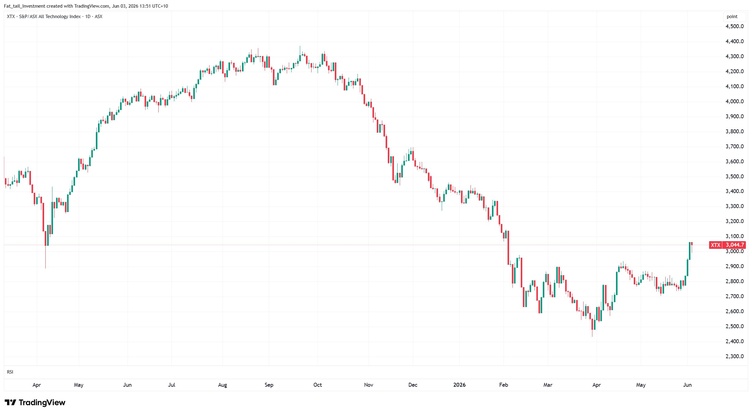
Ah yes, the ASX All Technology Index [ASX:XTX] just edged up in the last two weeks:
Source: Market Index
[Click to open in a new window]
Wisetech and TechnologyOne are big names in that index…
Next week I’ll keep digging.