
5 Business Improvement Techniques You Need to Know



When it comes to staying ahead in the fast-paced world of business, every company must continuously evolve. If you’re not focusing on business improvement techniques, you risk being left behind. That’s why business improvement isn’t just an option—it’s a necessity. Whether you’re in manufacturing, tech, or service, improving business processes is key to ensuring growth, customer satisfaction, and competitive advantage.
Business improvement techniques are structured methodologies used to enhance efficiency, elevate quality, foster innovation, and drive sustainable growth. These techniques apply a structured approach to identifying, analyzing, and executing strategies to enhance multiple dimensions of a business. The core goals of business improvement techniques are to optimize efficiency, elevate quality, and foster innovation, all with the aim to enhance multiple dimensions of your organization.
So, how can businesses transform their operations for maximum efficiency? Let’s dive into 5 game-changing business improvement techniques you need to know to take your company to the next level.
Introduction to Business Improvement
In today’s competitive landscape, business improvement techniques provide the foundation for operational efficiency and long-term success. Embracing a structured approach to business improvement initiatives ensures that progress is systematic and measurable, rather than left to chance. At the heart of these improvement techniques is process optimization, which involves identifying inefficiencies within your workflows and streamlining them to reduce costs and boost output.
But process optimization is just one piece of the puzzle. Employee training is another critical factor, as it equips your team with the skills needed to adapt and excel. Analyzing customer feedback allows you to identify areas where your products or services can better meet client needs, directly impacting customer satisfaction. Technology integration—such as automating repetitive tasks or leveraging digital tools—can further enhance accuracy and free up valuable resources. Finally, performance measurement using key performance indicators (KPIs) helps you track progress and pinpoint areas for further improvement.
By adopting these business improvement techniques, companies can achieve sustainable growth, improve customer satisfaction, and gain a competitive edge. The journey involves identifying inefficiencies, setting clear goals, and continuously refining your approach to stay ahead in the market.
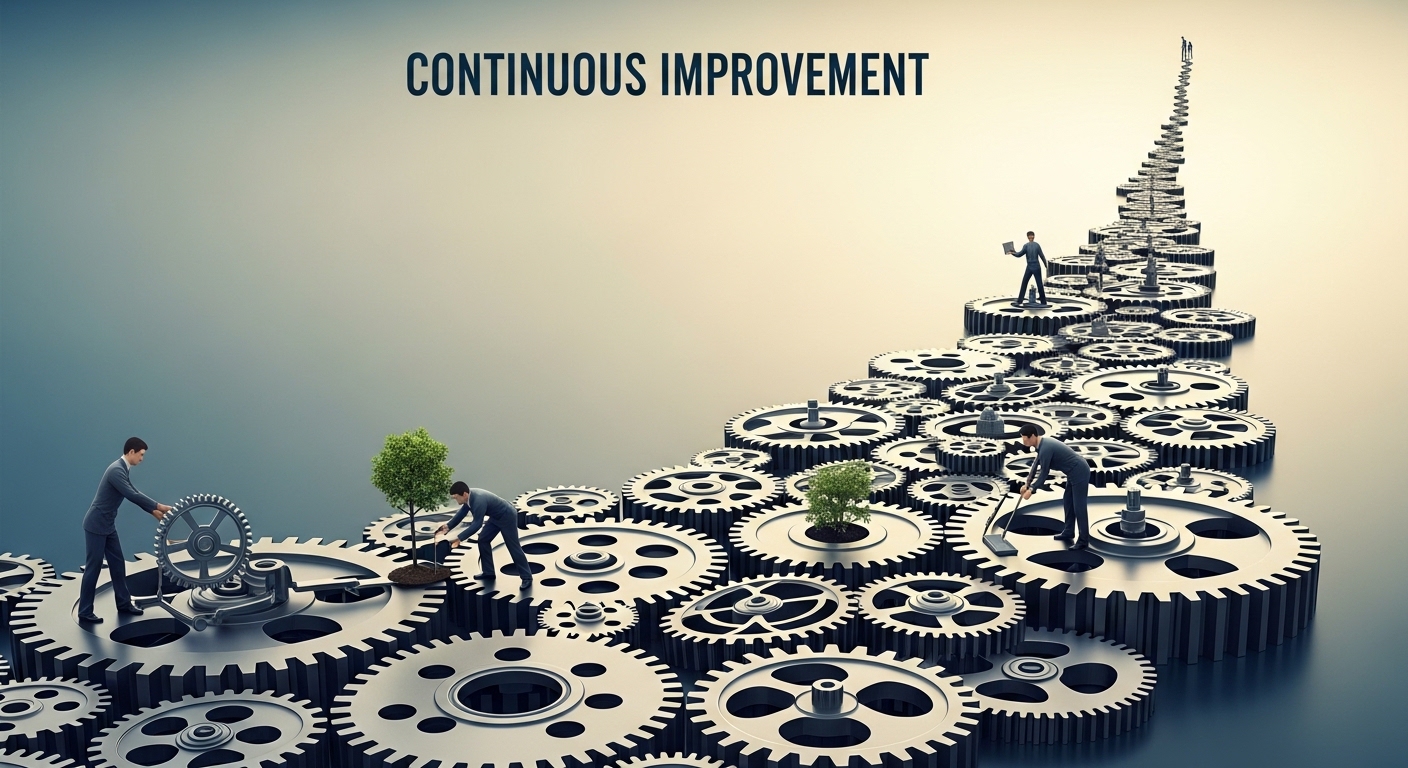
1. Continuous Improvement: The Key to Long-Term Success
Let’s start with continuous improvement, because if you’re not consistently improving, you’re stagnant. And let’s face it, no one wants to be stuck in a rut. Continuous improvement involves regularly assessing and enhancing your business processes. It’s all about small, incremental changes that add up over time to make a big impact. This could mean improving employee performance, streamlining operations, or finding ways to eliminate waste.
This technique ties into the concept of process improvement, which focuses on optimizing business processes to make them more efficient and cost-effective. By focusing on continuous, data-driven decision making, companies can adjust their operations in real-time to meet customer demand and forecast future trends. Employee involvement is also critical here, as your team members have first-hand knowledge of where inefficiencies exist. Encourage them to be part of the solution, and you’ll create a culture of continuous improvement that drives real results.
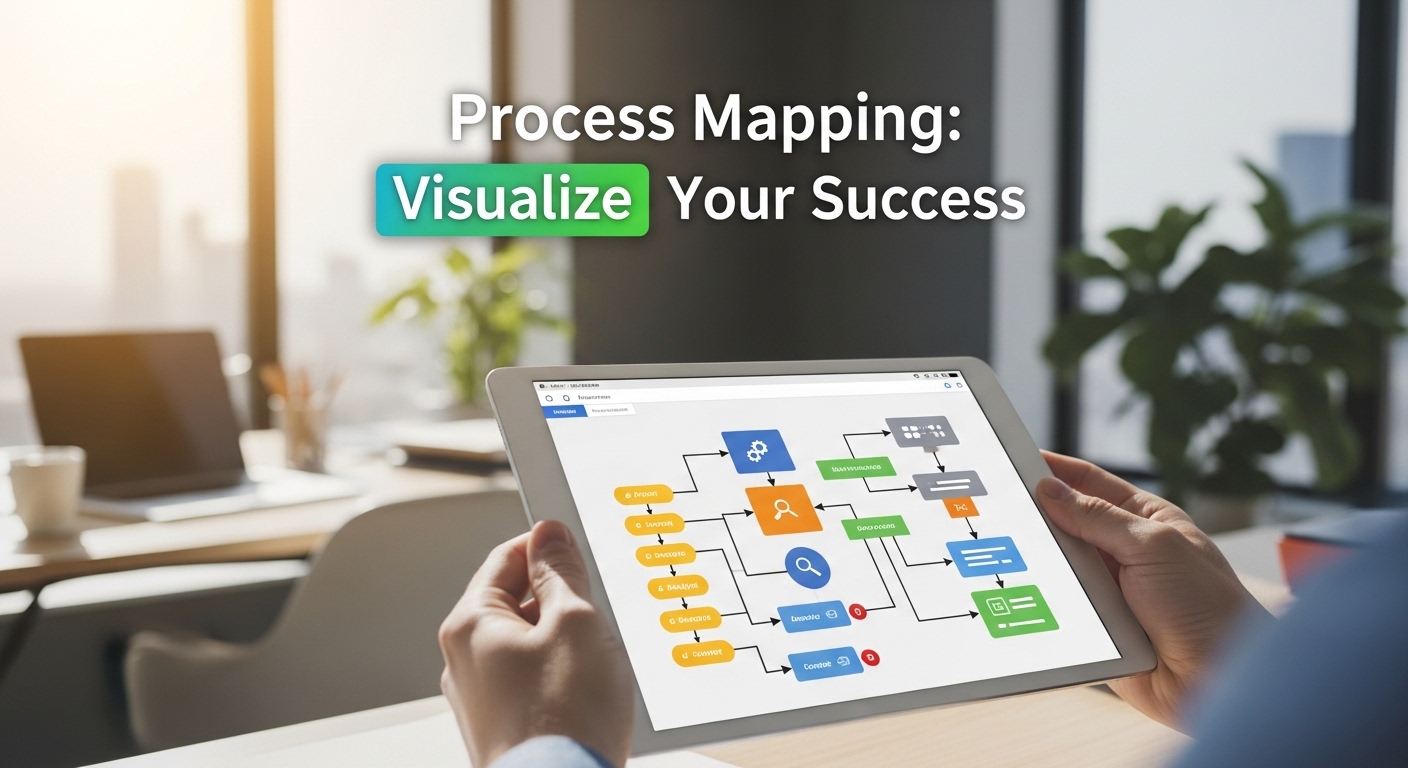
2. Process Mapping: Visualize Your Success
Have you ever tried to improve something without understanding exactly how it works? That’s like trying to drive somewhere without a map—good luck with that! Process mapping is an effective tool for identifying bottlenecks and inefficiencies in your operations. By visually mapping out business processes, you can identify areas that need improvement, ensuring that streamlining operations becomes a reality. Business process improvement is a methodology that relies on process analysis and mapping to identify operational bottlenecks and drive organizational efficiency.
Value stream mapping (VSM) is a popular approach here. This technique helps businesses identify the steps in a process that add value and the steps that don’t. By eliminating non-value-adding steps, companies can save time, reduce costs, and enhance customer satisfaction. The more you understand how a process functions, the better equipped you’ll be to optimize it for success.
To implement business improvement techniques effectively, businesses need to consider critical components such as process analysis and mapping.
3. Total Quality Management (TQM): Never Settle for Less
Total Quality Management (TQM) is all about fostering a culture where quality is the priority in every aspect of the business. This involves everyone from the CEO to the entry-level employees. Quality control should not be an afterthought, but a core principle guiding every decision, from product design to customer service.
TQM emphasizes continuous learning, data analytics, and employee involvement. It uses a data-driven approach to assess business performance, track key performance indicators, and monitor process performance to ensure operational excellence. In essence, this improvement strategy is about developing solutions that lead to the highest quality output and increased customer satisfaction.
4. Lean Business Principles: Eliminate Waste, Optimize Efficiency
If you’re not focused on eliminating waste, you’re wasting money—plain and simple. That’s where lean principles come into play. This technique is centered around optimizing business processes by removing inefficiencies that don’t add value. It’s about doing more with less: minimizing waste, reducing repetitive tasks, and streamlining processes. Optimizing efficiency involves identifying and eliminating waste, whether it’s wasted time, materials, effort, or resources.
Lean is not just for manufacturing—it can be applied across industries, from service businesses to software development. A good example of lean in action is automating repetitive tasks. Lean Thinking focuses on eliminating waste and maximizing value, and Lean principles help optimize processes and drive optimizing efficiency across the organization. By using technology to take over the menial stuff, your team can focus on higher-value activities, which ultimately leads to improvement efforts that boost overall performance and operational efficiency.
5. Business Process Management (BPM): Get Your Processes Under Control
In order to improve business performance, you need to be able to control your business processes. Business Process Management (BPM) involves the design, modeling, and optimization of business processes to align them with your strategic objectives. This structured approach makes sure that every process functions in the most efficient way possible. BPM is often used to plan, manage, and track improvement projects as part of large-scale transformations and continuous improvement initiatives.
With BPM, you can identify inefficiencies, monitor process performance, and ensure that business improvement efforts align with company goals. The data-driven decision-making aspect of BPM allows you to track your processes in real-time, making adjustments as needed. Establishing clear metrics for measuring performance is essential for tracking progress and evaluating the impact of improvement initiatives. By implementing BPM, businesses are better equipped to make informed decisions that lead to achieving sustainable growth.
6. Customer Experience and Business Performance
Customer experience is at the core of business performance, and the right business improvement techniques can make all the difference. By leveraging data analytics and process mapping, organizations can identify bottlenecks in their customer-facing processes and develop targeted improvement initiatives. This data-driven decision making enables businesses to streamline operations, automate repetitive tasks, and respond more quickly to customer needs.
Implementing total quality management (TQM) principles ensures that every product or service consistently meets or exceeds customer expectations. Business process management (BPM) further supports this by optimizing internal processes, reducing waste, and aligning operations with strategic objectives. When you focus on customer satisfaction and use tools like process mapping and data analytics, you not only improve the customer experience but also drive business performance and profitability.
Ultimately, increased customer satisfaction leads to greater loyalty and positive word-of-mouth, fueling growth. By making customer experience a priority in your business improvement efforts, you set the stage for lasting success.
READ ALSO: Fundamentals in Marketing Explained Without Fluff
7. How to Get Started with Business Improvement Techniques
So, you’re probably thinking, “How do I start implementing these techniques?” Well, the key to success is starting small and scaling up. Here’s how to get started:
- Identify areas for improvement: Start by analyzing your current business processes. Use process mapping to identify inefficiencies and areas that could benefit from improvement. Incorporate visual tools such as flowcharts or fishbone diagrams to analyze root causes and brainstorm solutions.
- Set clear goals: Whether it’s improving customer satisfaction, reducing waste, or increasing profits, setting measurable goals is essential. Track progress using key performance indicators (KPIs).
- Leverage technology: Use software tools to help automate repetitive tasks, track performance metrics, and manage your business processes more efficiently. Minimize errors in data entry by using error-proofing software and accurate data management systems.
- Engage your employees: Your team plays a critical role in business improvement. Encourage collaboration and employee involvement in the process.
- Measure success and iterate: Regularly assess your progress and make adjustments. A continuous improvement mindset means you never stop evolving.
Effective business improvement initiatives require accurate data management systems to guide the improvement process.
8. Overcoming Challenges to Business Improvement
Every business improvement journey comes with its own set of challenges, but a structured approach and a culture of continuous improvement can help you overcome them. One of the biggest hurdles is identifying inefficiencies and pinpointing areas for improvement. Tools like value stream mapping (VSM) and process mapping allow you to visualize how a process functions, making it easier to identify bottlenecks and opportunities for streamlining operations.
Implementing improvements often requires collaboration across departments. Cross-functional teams and effective project management are essential for developing creative solutions and ensuring that changes are executed smoothly. Leveraging technology, such as robotic process automation, can help automate routine tasks and minimize human error, while data analytics provides valuable insights to guide your improvement efforts.
Applying total quality management (TQM) principles and focusing on operational excellence will help you minimize waste and optimize efficiency. By fostering a culture of continuous improvement and using a structured approach, your business can overcome obstacles, implement effective improvement techniques, and achieve higher quality and customer satisfaction.
READ ALSO: Business Intelligence Advisors Explained Simply
9. Best Practices for Business Improvement
To get the most out of your business improvement efforts, it’s important to follow proven best practices. Start by using data analytics to identify areas for improvement and track performance metrics, ensuring your decisions are always data-driven. Process optimization techniques, such as lean and Six Sigma, are invaluable for eliminating waste and boosting efficiency across your operations.
Leveraging technology—like business process management (BPM) software—can automate tasks, improve accuracy, and free up your team to focus on higher-value activities. Cross-functional teams and strong project management help ensure that improvement initiatives are well-coordinated and effectively implemented.
Don’t forget the importance of customer satisfaction. Regularly gather and analyze customer feedback to inform your improvement strategies and ensure your offerings align with customer expectations. By fostering a culture of continuous improvement and embracing these best practices, your business can develop a competitive edge and achieve sustainable growth.
READ ALSO: Alternative Business Solutions Smart Founders Choose
10. Common Mistakes in Business Improvement
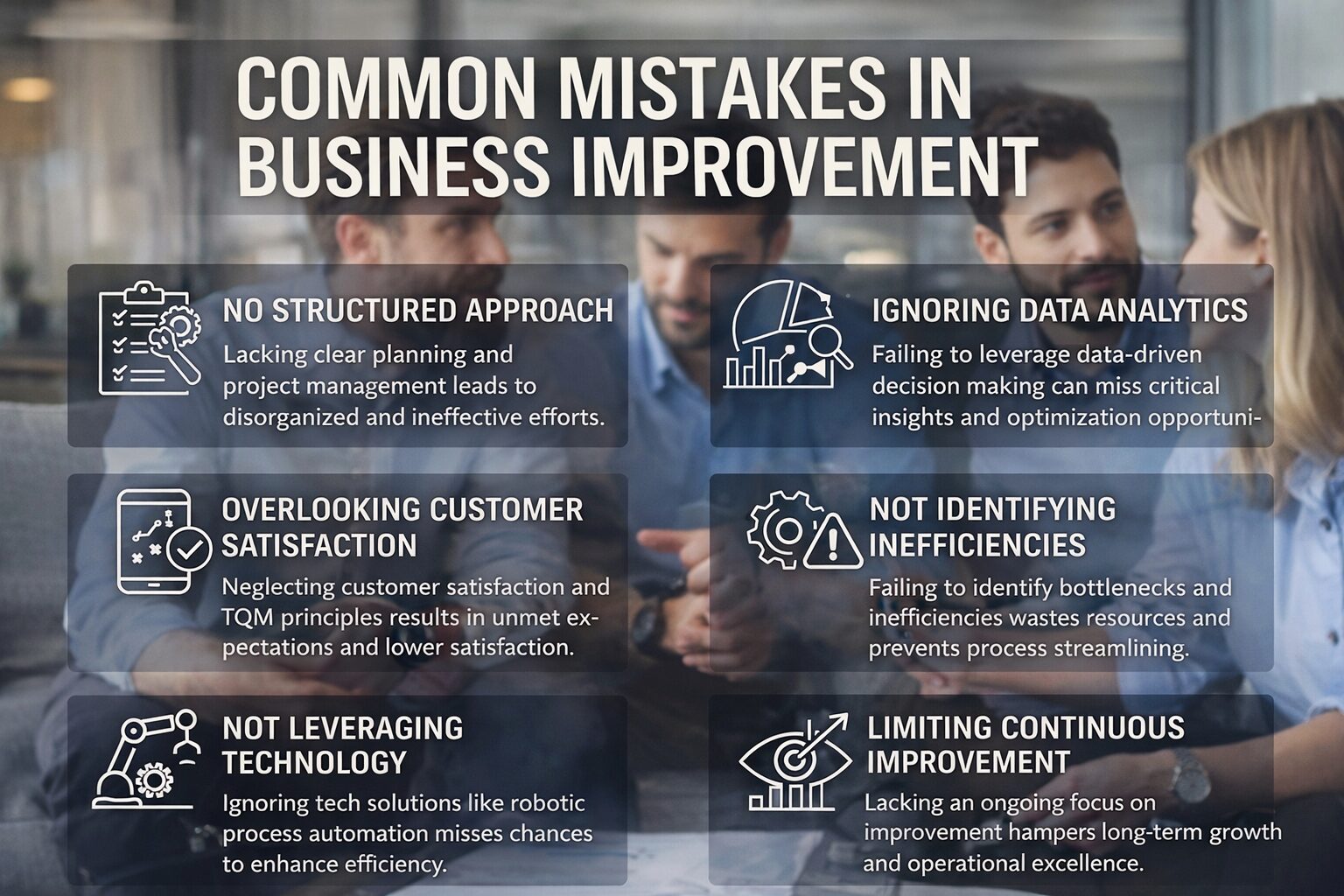
Even the best-intentioned improvement initiatives can fall short if common mistakes aren’t avoided. One major pitfall is failing to adopt a structured approach—without clear planning and project management, improvement efforts can become disorganized and ineffective. Neglecting data-driven decision making is another frequent error; without leveraging data analytics, it’s easy to miss critical insights and opportunities for optimization.
Overlooking customer satisfaction and not applying total quality management (TQM) principles can result in products or services that fail to meet expectations, undermining your business improvement goals. Failing to identify and address inefficiencies, or not leveraging technology such as robotic process automation, can also lead to wasted resources and missed opportunities to streamline operations.
By being mindful of these common mistakes and focusing on operational excellence, structured implementation, and continuous improvement, your business can develop effective improvement techniques that drive sustainable growth, improve quality and customer satisfaction, and secure a lasting competitive edge.
READ ALSO: Business Casual Look for Men Without Looking Boring
11. The Bottom Line: Business Improvement is an Ongoing Journey
There you have it—five essential business improvement techniques that can transform your operations and position you for success. Continuous improvement, process mapping, TQM, lean principles, and BPM are just the beginning. By applying these techniques consistently, your business will be in a better position to streamline operations, optimize efficiency, and meet customer expectations.
Remember, improvement is not a one-time event; it’s an ongoing journey. Don’t get discouraged if you don’t see instant results—keep pushing, keep improving, and keep your eyes on the prize. Staying committed to ongoing improvement helps your business quickly adapt to changing market trends, technological advancements, and evolving customer needs, ensuring you remain competitive in a dynamic environment. The competitive advantage you gain from applying these techniques will pay off in increased customer satisfaction, business growth, and operational excellence.
So, what are you waiting for? It’s time to implement improvement efforts, optimize your business processes, and take your business to new heights! Business improvement techniques also contribute to building a more resilient, adaptable, and high-performing organization capable of thriving over the long term.
UP NEXT: American Business Services That Save Serious Money
Source link