Can B.AI’s Agentic Payment System Make TRON Explode?
TRON has long been known as one of the most active blockchain networks for stablecoin transfers, especially USDT. But the launch of B.AI could push the network into a much more ambitious narrative: AI agents, autonomous payments, machine-to-machine transactions and on-chain financial execution.
At first glance, B.AI may look like another platform that allows users to access AI models and pay with crypto. But the deeper story is much more interesting.
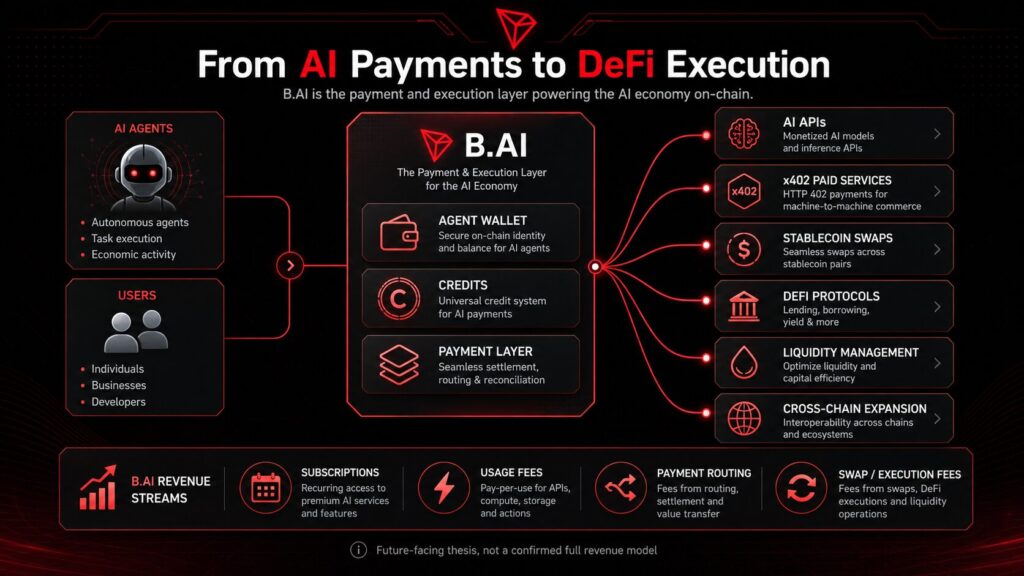
B.AI is positioning itself as an infrastructure layer for agentic AI a new generation of AI systems that do not simply answer questions, but can also perform tasks, access services, pay for resources, use wallets, interact with smart contracts and potentially execute DeFi operations.
That is why the launch matters for TRON and its native token, TRX.
The key question is simple:
If AI agents become real economic actors, could TRON become one of the main payment and settlement layers powering them?
If the answer is yes, then B.AI could become far more than an AI product. It could become a major catalyst for TRON’s next phase of growth.
What Is B.AI?
B.AI is an AI and Web3 infrastructure platform designed to connect artificial intelligence with blockchain-based payments, wallets and on-chain execution.
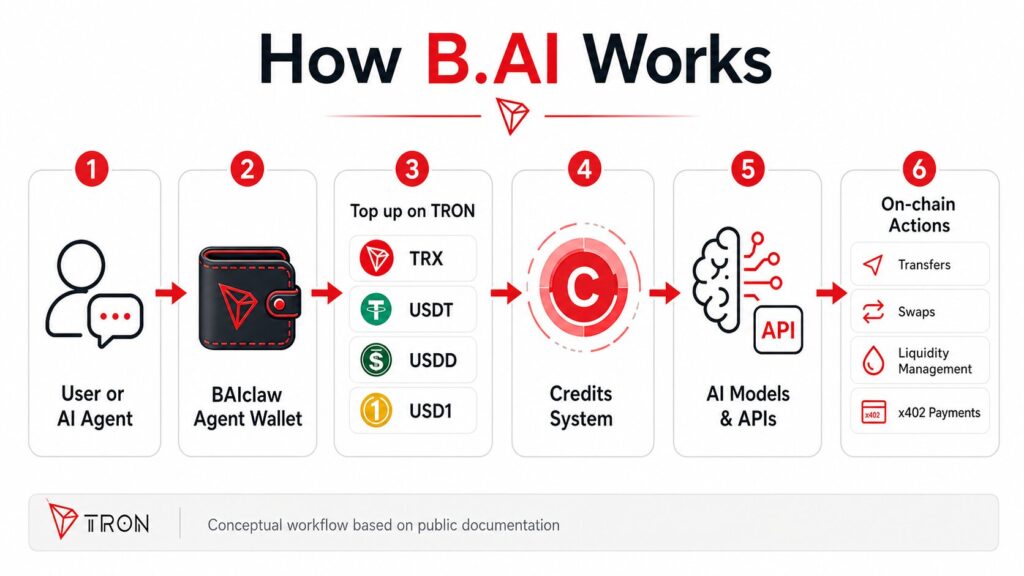
The platform allows users to access AI models and services through a unified system of Credits. These Credits are consumed when users interact with AI models, generate responses, use tools or access extra services. But the most important detail is how users can fund those Credits.B.AI supports crypto top-ups through the TRON ecosystem, including assets such as:
This makes TRON more than just a branding partner. It gives B.AI a direct payment connection to the TRON network.
In simple terms, B.AI is trying to create a bridge between three worlds:
- AI models
- Crypto payments
- Autonomous agent execution
That combination is what makes the project interesting.
Why B.AI Is More Than “Pay With Crypto To Use AI”
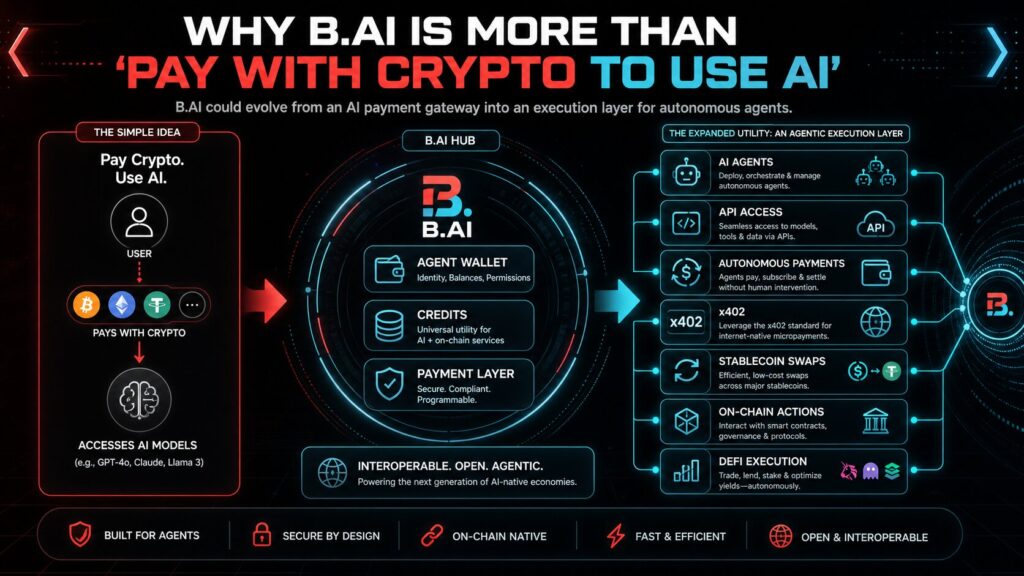
The simple version of B.AI is this: users can pay with crypto to access AI services.But that is not the full story. The more important version is that B.AI could become a financial operating system for AI agents.
Important note: This article explores a forward-looking thesis around B.AI, TRON and AI-agent payments. It does not suggest that TRX will automatically increase in price. The real impact will depend on adoption, on-chain activity, stablecoin volume and measurable demand for TRON network resources.
Most AI tools today are still passive. You type a question, the model gives an answer, and the process ends there.
Agentic AI changes that. An AI agent can potentially:
- search for data;
- compare prices;
- access paid APIs;
- pay for services;
- move funds;
- use a wallet;
- swap assets;
- interact with smart contracts;
- execute predefined strategies;
- manage digital resources.
This is where B.AI becomes much more interesting. Through its agent wallet and Web3 features, B.AI is not only giving users access to AI models. It is giving AI systems a way to interact with crypto infrastructure.
That means B.AI could evolve into a platform where AI agents do not just think or respond — they transact.
Is B.AI Actually Built On TRON?
B.AI should not be described as a standalone blockchain. It is better understood as an AI-agent and Web3 infrastructure platform with deep integration into the TRON ecosystem.
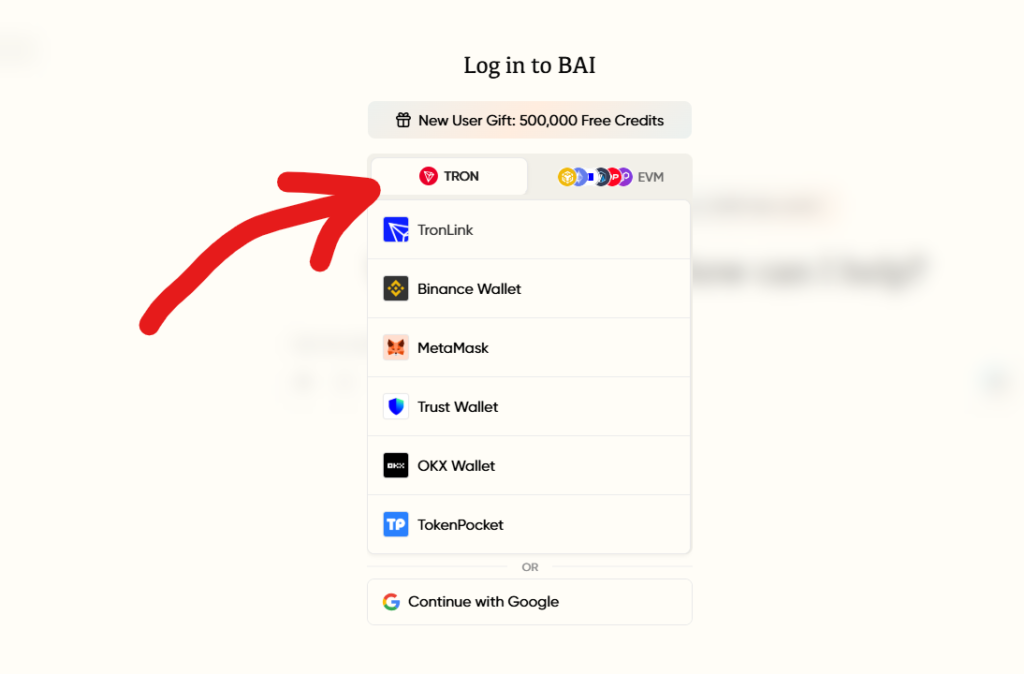
The AI models, APIs and Credits system may involve off-chain infrastructure, but the crypto payment layer is currently tied closely to TRON. B.AI supports top-ups through TronLink and assets such as TRX, USDT, USDD and USD1, making TRON the core blockchain payment rail behind the platform’s current crypto flow.
This distinction matters. B.AI is not “another TRON token” or a separate blockchain. It is a platform that connects AI agents with payments, wallets and on-chain execution, with TRON positioned as the settlement and payment infrastructure.
The Agentic Payment System: Why This Matters
The most powerful part of the B.AI narrative is the idea of an agentic payment system.
An agentic payment system is a payment layer built for AI agents rather than only humans. Instead of a person manually entering card details, logging into accounts or approving every small payment, an AI agent could be authorised to make controlled payments automatically.
For example, an AI agent could:
- pay for premium data;
- access a paid API;
- subscribe to a research tool;
- purchase compute resources;
- pay another agent for a task;
- settle a microtransaction;
- rebalance stablecoins;
- interact with a DeFi protocol.
This is a completely different payment model from traditional finance.
Credit cards were not built for autonomous AI agents. Bank transfers were not built for machine-to-machine microtransactions. But blockchain and stablecoins are much closer to what agents need: programmable, global, fast and always available.
This is where TRON enters the picture.
TRON already has strong stablecoin liquidity and low-cost transaction infrastructure. If AI agents need cheap and fast settlement, TRON could be a natural candidate.
The x402 Connection: Payments Built For AI Agents
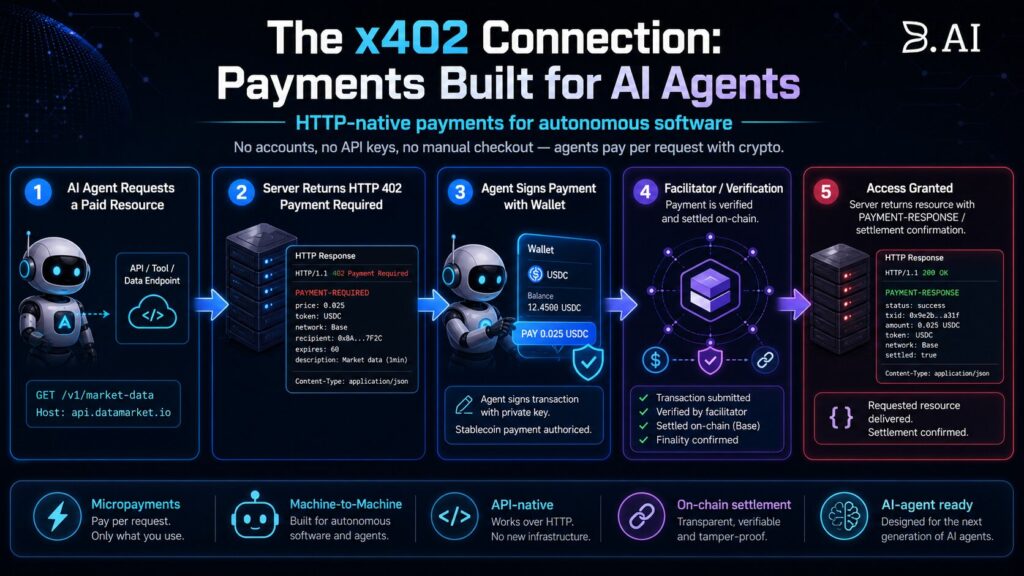
One of the most important pieces of this story is x402. x402 is a payment standard designed to bring the old HTTP 402 “Payment Required” concept back to life. In practice, it allows websites, APIs and digital services to request payment directly through internet infrastructure.
This is extremely relevant for AI agents.
Imagine an AI agent trying to access a premium database. Instead of creating an account, entering card details or waiting for manual approval, the service could return a payment request. The agent could then sign and complete the payment with a wallet, receive access and continue its task.
That is the type of internet-native payment experience AI agents may need.
B.AI’s agent wallet supports x402-style paid-resource access, which means the platform is being built around the idea that agents will need to pay for services directly.
This is important because it moves B.AI beyond the simple “AI subscription” model. It points toward a future where AI agents can become active users of paid digital infrastructure.
Why This Could Be Bullish For TRX
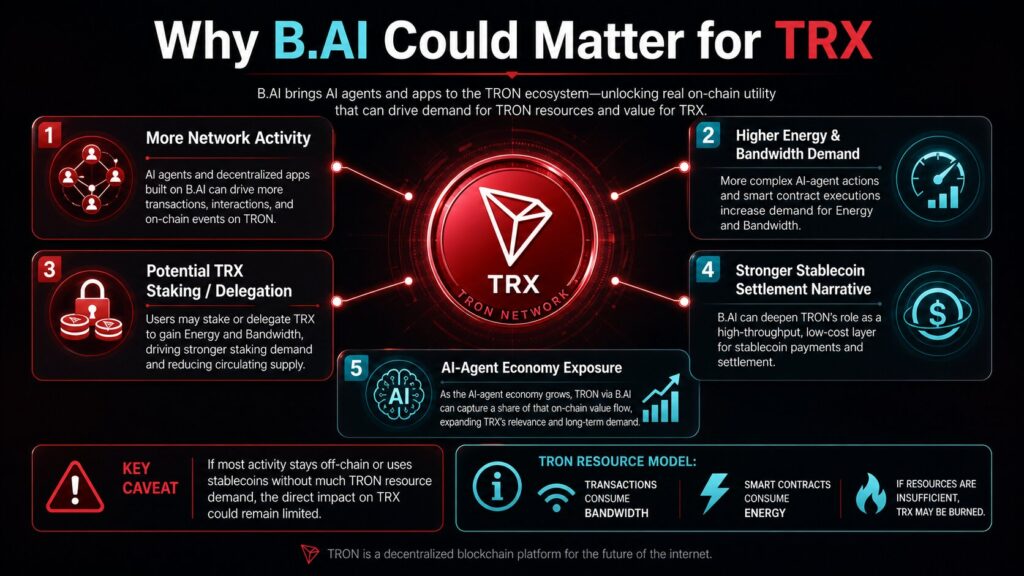
The bullish case for TRX depends on one main idea: more agentic activity on TRON could mean more demand for the TRON network.
TRX is the native token of TRON. It plays a role in network resources, staking, transaction execution and smart contract activity.
If B.AI brings more users, agents and transactions to TRON, several things could happen:
- more TRON wallet activity;
- more TRX used for payments;
- more demand for network resources;
- more stablecoin settlement on TRON;
- more smart contract interaction;
- more staking or delegation of TRX;
- more visibility for TRON as an AI payment chain.
The biggest opportunity is not simply that users can top up B.AI with TRX. That is useful, but not enough by itself.
The real opportunity is that B.AI could create a new category of users on TRON: AI agents.
If thousands or millions of agents eventually need to make payments, access services, move stablecoins, perform swaps or interact with DeFi, then TRON could benefit from a new wave of network demand.
That is the reason B.AI matters for TRX.
Stablecoins Could Be the Real Engine
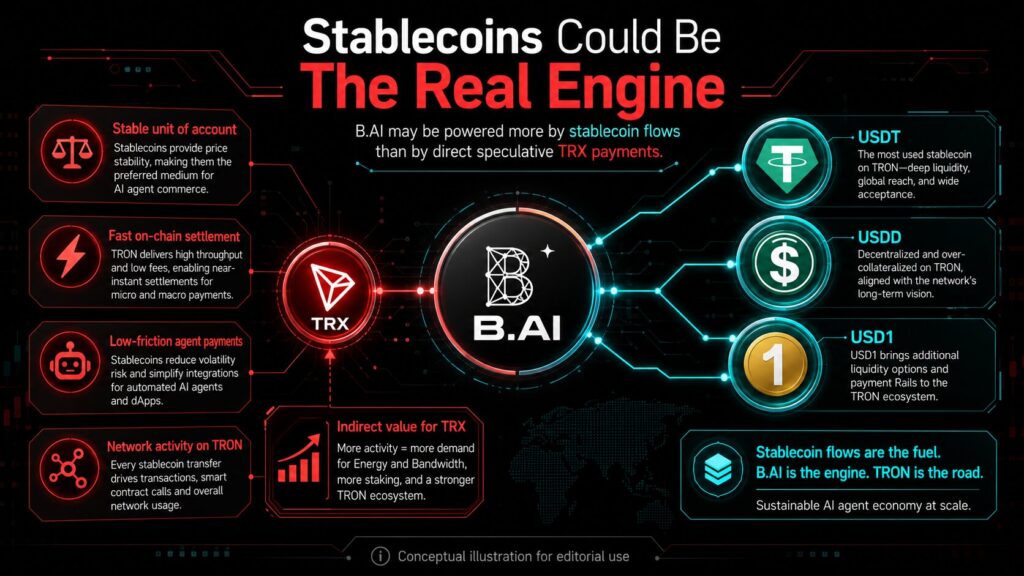
It is important to understand that the biggest driver may not be TRX payments directly.
The real engine could be stablecoins.
B.AI supports stablecoin-related payments in the TRON ecosystem, and TRON is already one of the most important networks for stablecoin transfers.
This matters because AI agents will likely prefer stablecoins for many tasks. An agent paying for data, APIs, compute or services does not necessarily want price volatility. It wants a stable unit of account.
That means assets like USDT, USDD or USD1 could become the primary payment instruments, while TRX benefits indirectly through network usage, Energy, Bandwidth, staking and transaction infrastructure.
This is a key point for investors:
B.AI may be bullish for TRX even if most payments happen in stablecoins.
Why? Because stablecoin activity still needs blockchain infrastructure underneath it. If that activity happens on TRON, the network becomes more valuable and TRX becomes more strategically important.
Could B.AI Profit From Stablecoin Swaps?
This is one of the most interesting possibilities.
B.AI could potentially generate revenue from several layers:
- AI subscriptions;
- usage-based Credits;
- enterprise access;
- API usage;
- agent wallet services;
- payment routing;
- stablecoin swaps;
- DeFi execution;
- cross-chain operations.
The stablecoin swap angle is particularly important.
If AI agents use B.AI to pay for services, they may need to convert between different assets. For example, an agent might hold USDT but need to pay in USDD, USD1 or another stablecoin. Or it might need to bridge liquidity across networks.
If B.AI becomes the interface that routes those transactions, it could potentially capture value through routing fees, swap integrations, execution fees or premium agent services.
This would make B.AI much more than an AI access platform.
It could become a payment, swap and execution layer for autonomous agents.
That would be a much more powerful business model than simply selling AI model access.
However, this part of the thesis should be treated as a forward-looking possibility. The platform shows signs of moving in this direction through wallet, swap and Web3 features, but the full revenue model around stablecoin swaps and DeFi routing is not yet fully proven in public.
Could B.AI Become A Gateway To DeFi For AI Agents?
This may be the most important long-term question.
If B.AI gives agents wallets, payment tools, swap functionality and Web3 execution, then the next logical step is DeFi.
An AI agent could eventually be used to:
- monitor DeFi yields;
- compare lending markets;
- move stablecoins between protocols;
- rebalance treasury funds;
- manage payments;
- execute predefined DeFi strategies;
- interact with smart contracts;
- optimise liquidity across chains.
This does not mean agents should have unlimited control over funds. Security, permissions and spending limits would be critical. But the concept is powerful.
The future of agentic finance may not be a human clicking buttons on a DeFi dashboard. It may be a user setting rules and an AI agent executing within those limits.
For example:
“Keep 40% in USDT, 40% in USDD, 20% in TRX. If stablecoin yield on a verified protocol rises above 8%, move up to 10% of idle funds there. Never exceed $500 per transaction without approval.”
That is the kind of functionality agentic finance could eventually enable.
If B.AI becomes one of the platforms that makes this possible, then its relevance to TRON becomes much bigger.
Could B.AI Connect TRON To Other Crypto Ecosystems?
Another major question is whether B.AI could eventually become an agentic payment system not only for TRON, but also for crypto ecosystems outside TRON.
This is possible, especially if B.AI integrates more cross-chain infrastructure over time.
AI agents will not want to be limited to one chain. They will need to access liquidity, data, assets and protocols wherever the best opportunity exists.
That means a serious agentic payment system may need to support:
- cross-chain swaps;
- bridges;
- multichain wallets;
- stablecoin routing;
- DeFi execution across multiple networks;
- payment settlement across different ecosystems.
If B.AI evolves in this direction, TRON could become the home base or settlement layer while still allowing agents to interact with broader crypto markets.
This could be very powerful for TRON.
Instead of competing only as a single-chain ecosystem, TRON could become a stablecoin and agentic payment hub connected to other chains.
That would strengthen the TRX narrative significantly.
Why TRON Is Well Positioned For This Trend
TRON has several characteristics that make it a logical fit for agentic payments.
First, TRON is already widely used for stablecoin transfers. This gives it a strong base for payment-related use cases.
Second, TRON offers fast and relatively low-cost transactions, which are important for frequent payments.
Third, TRON has an established wallet and stablecoin ecosystem, including TronLink and major TRON-based assets.
Fourth, TRON’s resource model gives TRX a functional role in network activity through Energy, Bandwidth and staking.
Fifth, TRON has a clear narrative advantage: it can position itself as a blockchain for real-world payments, not just speculation.
That last point matters. Many blockchains are still looking for real usage. TRON already has significant payment activity, and B.AI could extend that usage into the AI-agent economy.
The Main Risks Investors Should Understand
The B.AI story is exciting, but investors should not ignore the risks.
- The first risk is adoption. B.AI needs real users, developers and agents using the platform at scale.
- The second risk is that most activity may remain off-chain. If users pay once and then consume internal Credits without much blockchain activity, the direct impact on TRX may be limited.
- The third risk is stablecoin dominance. If most payments happen in USDT or other stablecoins, TRX may benefit indirectly rather than directly.
- The fourth risk is security. AI agents moving funds creates serious risks around permissions, wallet safety, smart contract interaction and user control.
- The fifth risk is execution. Many AI-crypto projects have strong narratives but struggle to create real product-market fit.
So while B.AI could become important for TRON, the market needs to see data: users, transactions, volumes, wallet activity, swaps and developer adoption.
What To Watch Next
To understand whether B.AI can become a real catalyst for TRX, investors should monitor several key signals.
The first is on-chain activity. Are B.AI-related wallets generating meaningful transactions on TRON?
The second is stablecoin volume. Are users and agents actually moving USDT, USDD, USD1 or other assets through the platform?
The third is TRX resource demand. Is there more Energy, Bandwidth or staking demand connected to B.AI activity?
The fourth is agent wallet adoption. Are users actually creating and using wallets for autonomous Web3 actions?
The fifth is DeFi integration. Does B.AI expand from payments into swaps, liquidity, trading, yield and protocol interaction?
The sixth is cross-chain expansion. Does B.AI remain TRON-native, or does it become a broader agentic payment layer connected to other ecosystems?
These are the metrics that will separate hype from real impact.
Final Thoughts: A New AI-Payment Narrative For TRON
B.AI could become one of the most interesting developments in the TRON ecosystem because it connects several major crypto narratives at once: AI, autonomous agents, stablecoins, x402 payments, wallets, swaps and DeFi execution.
For TRX, the opportunity is clear.
If B.AI becomes a real agentic payment system, TRON could benefit from a new category of network users: AI agents that need to pay, swap, settle and interact with on-chain finance. That could create more demand for TRON infrastructure and strengthen the role of TRX inside the network. However, investors should be realistic. B.AI does not automatically mean TRX will explode. The real question is whether B.AI can turn its narrative into measurable on-chain adoption.
The most bullish scenario is not simply that users pay with crypto to access AI models.
The most bullish scenario is that B.AI becomes a full agentic payment and DeFi execution layer, with TRON acting as one of the core settlement networks behind it.
If that happens, then B.AI could become more than a new AI product.
It could become one of the strongest reasons why TRON and TRX deserve serious attention in the next phase of the crypto market.
Source link