What Is The Best Strike For Covered Calls?
When investors view covered call assignment as a normal, healthy outcome, they begin choosing better strike prices and generating more consistent income rather than fearing assignment.
Let’s look at how to pick the best strike for the covered call based on the investor’s motives.
Contents
This approach is usually taken by longer-term investors whose priority is capital appreciation of the stock.
They want to continue to hold the stock due to conviction, dividends, or tax reasons.
While the premium will be much smaller, the odds of assignment drop dramatically.
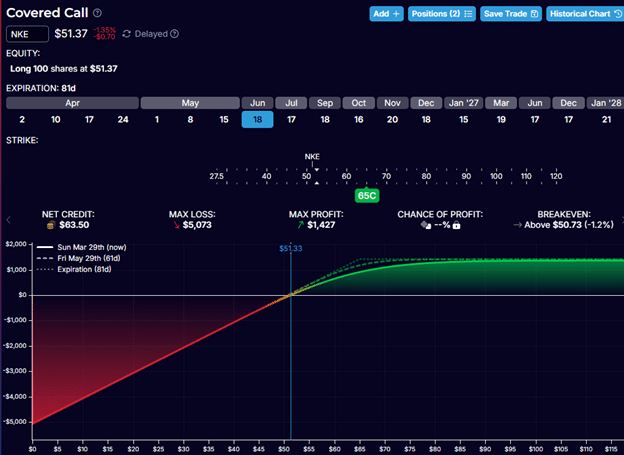
Below, we model the payoff graph for a covered call on Nike (NKE), in which the investor bought 100 shares of NKE at $51.37 per share and then sold a $65-strike call option expiring on June 18th, which is 81 days away.
The first thing you must understand when you sell a call option is that by doing so, you are obligated to sell 100 shares of the underlying if the underlying asset price exceeds the strike price at expiration.
And if it is an American-style settlement (which most equity and ETF options are), you are also obligated to sell the shares before expiration whenever the option holder decides to exercise their right.
Therefore, if NKE is above $65 per share on June 18th, the investor’s 100 shares will automatically be sold at $65 per share.
We say that the investor is “assigned the 100 shares” and that his shares were “called away”.
This caps the amount of profit that can be made from stock price appreciation.
Any stock price appreciation above $65 per share will not be realized, as it would be sold at $65 per share in that case.
If the investor bought 100 shares at $51.37 and sold them at $65, the maximum gain from the stock appreciation is
($65 – $51.37) x 100 = $1363
The investor had also received a credit of $0.64 per share, or $64 per contract, for selling the call option.
So all in all, the investor would profit.
$64 + $1363 = $1427
from the covered call if NKE is above $65 per share at expiration.
This is the max profit on this trade.
The $65 received is actually not a lot of premium for selling the call option.
The premium is low because the strike price is well above the stock’s current price.
The strike price was at the 14-delta on the option chain.
This means that NKE has only a 14% chance of being above the strike price at expiration.
This is fine for the long-term investor who does not want their stock called away and would like more room for it to appreciate.
The second thing to understand about selling a call option is that some investors view it as an income-generating strategy.
While $65 is not a large amount of income, selling a call option closer to the money, meaning with a strike price closer to the current stock price, will generate more income.
Below is a covered call on Newmont Corporation (NEM), in which the investor sells a call option with a strike price 10% above the current stock price.
The investor received $513 from selling the call option, which helped offset the cost of buying the shares.
Purchasing 100 shares would normally cost $10,208, but after applying the $513 credit, the investor’s net out-of-pocket cost was reduced to $9,695.
The two transactions can be executed in a single order, known as a covered call order or a buy-write order.
Date: March 27, 206
Price: NEM at $102.08
Buy 100 shares at $102.08
Sell to open one contract May 15 NEW $110 call @ $5.13
Net Debit: -$9695
An option’s price is made up of two components: intrinsic value and extrinsic value.
Intrinsic value reflects how much an option is “in the money,” while extrinsic value represents the time value, volatility, and demand built into the option’s premium.
An investor whose goal is to maximize income would want to collect the highest possible amount of extrinsic value.
This is because extrinsic value is what fully decays over time, allowing the seller to keep that amount as profit if the option expires worthless.
Options that are at-the-money contain the greatest amount of extrinsic value.
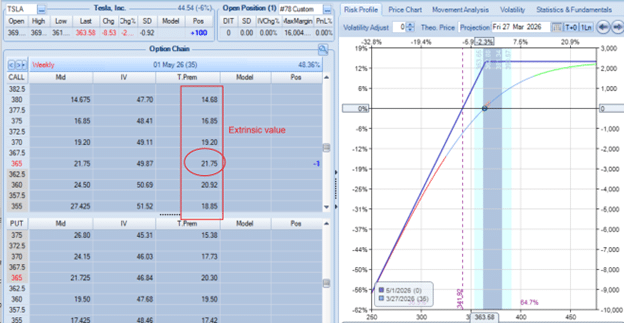
Tesla is trading at $363.58 per share, and the strike with the highest extrinsic value is the strike closest to the stock price.
An investor selling the $365 strike expiring in 35 days will collect a premium of $2175.
Because the stock price is just below $365 right now, all this premium is 100% extrinsic value.
Because the stock price is so close to the strike price, this stock has a high chance of being called away.
If the stock remains below $365 at expiration, the investor will keep the full $ 2,175.
Of course, the investor does not want the stock to drop too much, otherwise the stock price depreciation will be a much bigger loss than the $2175 credit.
To be precise, if the stock closes at $341.83 or below at expiration, then the loss in stock price would wipe out the entire premium collected.
This price is known as the break-even price.
An in-the-money covered call means selling a call option at a strike price below the stock price.
Because this generates a large upfront premium, it provides the strongest downside protection if the stock falls.
That premium includes both intrinsic value and extrinsic value.
This strategy also carries the highest likelihood of assignment.
In fact, some investors intentionally choose an in-the-money strike specifically to be assigned, aiming to capture only the option’s extrinsic value as their profit.
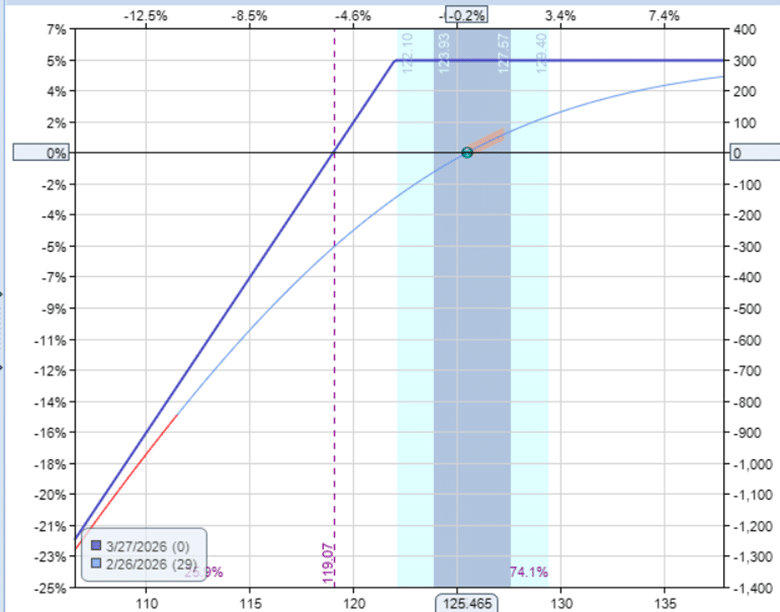
Take the example of Walmart (WMT):
Date: Feb 26, 206
Price: WMT at $125.46
Buy 100 shares @ $125.46
Sell to open one contract March 27 WMT $122 call @ $6.42
Net Debit: $12,546 – $642 = $11,904
Note the similarity in the payoff graph of selling the in-the-money covered call and selling an out-of-the-money short put.
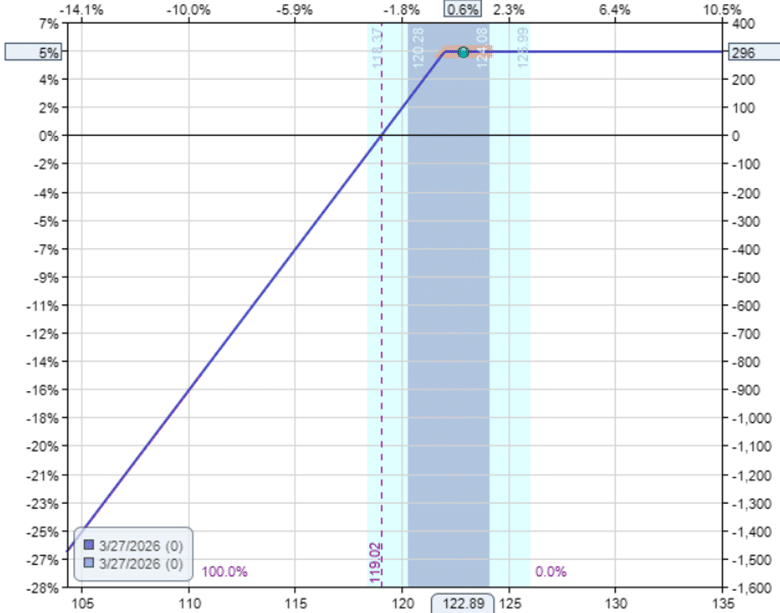
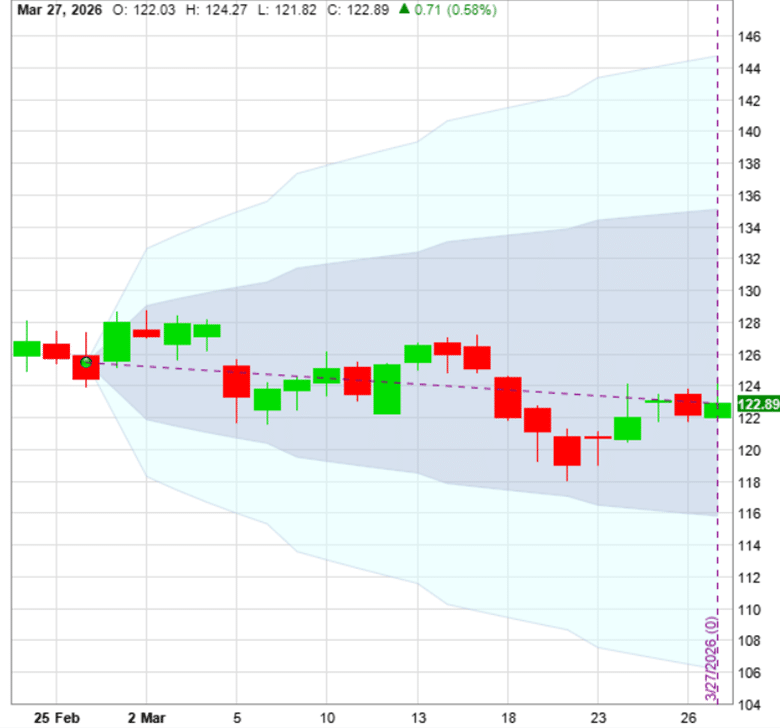
At expiration on March 27th, WMT closed at $122.89, which is above the strike price of $122.
Therefore, 100 shares were sold at $122 per share, and that’s the end of the trade.
How much did the investor make?
Paid $11,904 at the start of the trade.
Sold 100 shares at $122 at the end of the trade.
Net profit: $12,200 – $11,904 = $296
The stock price had actually gone down…
Yet the covered call was still profitable.
This is what is meant by downside protection when the stock drops.
The investor actually profited an additional $24 in dividends on top of that because he owned 100 shares on March 19, the day prior to the ex-dividend date.
He is therefore on record to receive the $ 0.24-per-share dividend.
Selling a call option means three things:
- Obligation to sell shares at the strike price whenever the owner of the call option exercises their right
- Generates an income credit
- Provides some downside protection
The far out-of-the-money strike reduces the likelihood of assignment.
The at-the-money option provides income generation.
And the in-the-money option provides downside protection.
An investor decides on the strike selection based on the mix of these three considerations.
If you still can not decide.
Let me give you one final way to select the strike price, which is a good balance between income generation and stock appreciation.
That is, select the strike price that will provide a 1% to 3% return on capital in one month if the stock is called away.
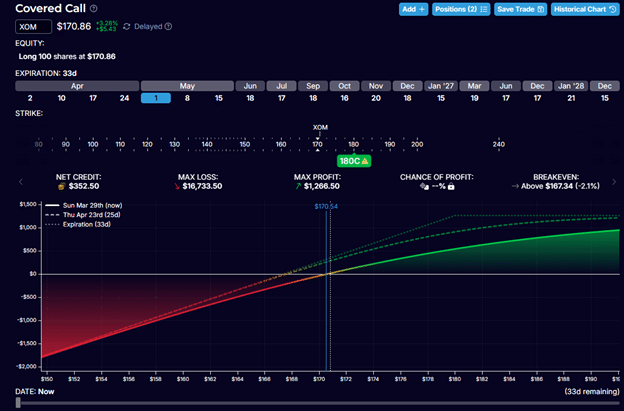
For example, Exxon Mobile (XOM) is trading at $170.86, and the investor sells the $180-strike call expiring in one month.
This gives him a $352 credit, which is a 2% return on capital in a month.
Because $352 / $17,086 = 2%
This strike is a slightly out-of-the-money call option at the 33-delta.
If you’re still unsure which strike to choose, think of it like ordering at a new restaurant – pick what most people are choosing.
It may not be perfect for every situation, but it’s popular because it tends to work well for most investors.
The slightly out-of-the-money covered call is the most commonly used approach among investors.
We hope you enjoyed this article on choosing the best strike price for covered calls.
If you have any questions, please send an email or leave a comment below.
Trade safe!
Disclaimer: The information above is for educational purposes only and should not be treated as investment advice. The strategy presented would not be suitable for investors who are not familiar with exchange traded options. Any readers interested in this strategy should do their own research and seek advice from a licensed financial adviser.
Source link