BTC miners see little light ahead at the end of 2025’s tunnel
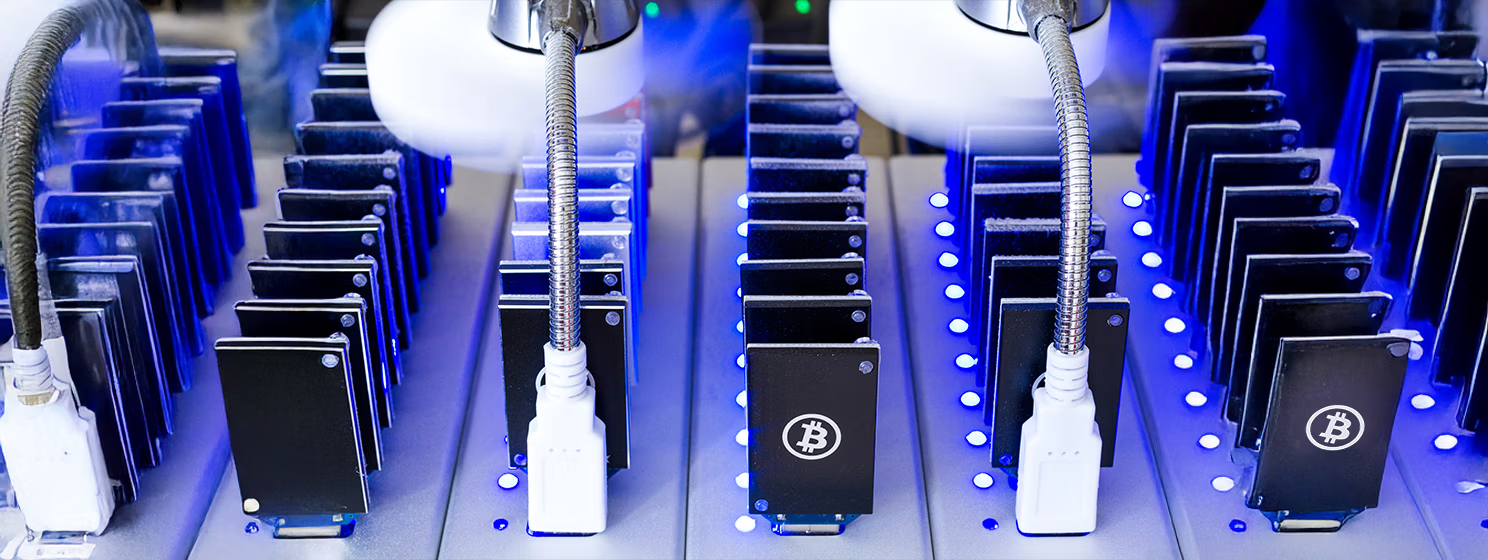
Block reward miners had a year they’d prefer to forget and see little sign of fiscal redemption in 2026, that is, unless they move to Ukraine to access some cheap nuclear power.
The final BTC network mining difficulty rate adjustment of 2025 saw a slight rise to 148.2 trillion, following several downward shifts from the all-time high of nearly 156 trillion at the end of October. Worse, the difficulty rate is expected to rise again to ~150 trillion come the first adjustment of 2026 (on January 8).
Rising difficulty means higher costs to ‘find’ a block on the BTC network, and the economics of mining are already unworkable. As of midday on December 29, the average cost (including depreciation of ASIC mining rigs) to mine a single BTC token was just under $100,000, while the price of a single BTC token was struggling to stay over $87,000. Like the name of that film, something’s gotta give.
One of the more obvious signs that mining’s economic model is broken was last week’s report of an ASIC price cut by Bitmain, the world’s dominant manufacturer of mining hardware (market share estimated at 80-90%). The Miner Mag reported that Bitmain was now offering discounts on its S19 and S21 series ASIC units, price reductions that would have been deemed ‘distressed sales’ had they occurred when the BTC token’s price was climbing to unprecedented heights earlier this year.
Having surrendered any claim to anything resembling actual utility, BTC’s entire raison d’être now depends on a perpetual, uninterrupted ‘number go up’ narrative. When that narrative fails, the economics cease to work, prompting more and more miners to ‘pivot’ to serving as data centers for AI and other high-performance computing (HPC) purposes.
Data centers provide far more reliable revenue streams than mining, which often relies on luck as much as brute hash power. Just this month, a solo miner—running a setup that might have seemed inadequate a decade ago—found a block and the 3.125 BTC reward worth nearly $290,000 at the time.
A recent Bloomberg report quoted an equity research firm’s managing director saying “investors that are piling in or had piled into these companies over the most recent months are mainly concerned about the AI business, with very little interest in their Bitcoin mining operations. You will see some of the group unplug their mining machines and put up AI data centers. You are going to see a lot of that over the coming years.”
Van Eck analysts recently reported that the BTC network’s hash rate fell further in the past 30 days than it did in the same period following the 2024 halving. Van Eck fingered ‘miner capitulation’ as the primary cause of this reduced computing power, although some of this reduced effort is likely due to China stepping up its crackdown on illegal domestic mining operators.
We’re now just a little over two years away from the next halving event, which will see the block reward fall to just 1.5625 BTC. If the token’s price fails to achieve significant growth between now and then, miners will continue to switch off their rigs, further concentrating an already concentrated sector and fueling concerns over network security.
Russia, Russia, Russia
To give themselves an edge, miners continue to search for the cheapest sources of energy, which (in addition to constant ASIC replacement) remains the principal item on their expense chart. This has led many operators to relocate to remote areas where energy is abundant and demand is minimal, but Russia may have just found a new energy motherlode to offer the mining community, or at least select members of that community.
Among the more bizarro elements to emerge from the ‘peace talks’ between Russia, Ukraine, and their mercurial American mediators is a discussion of how to manage Ukraine’s Zaporizhzhia nuclear power plant (ZNPP), which is currently in an area of the country under Russian control.
According to Russian media outlet Kommersant, in a Christmas Eve meeting with Russian business leaders, President Vladimir Putin claimed that Russia and the U.S. are negotiating a joint management agreement for the ZNPP facility, leaving Ukraine on the sidelines. (The BBC claims the U.S. wants Ukraine to also play a role.) Putin further claimed that Washington’s interest in the plant is as a source of cheap electricity for cryptocurrency mining.
While details were scant, it bears noting that President Trump’s two sons are involved in American Bitcoin Corp (NASDAQ: ABTC), a combo mining operation and BTC ‘treasury’ firm. ABTC currently ranks 20th on the list of largest BTC treasuries with 5,098 tokens, although much of this stack has been purchased rather than mined. Would it be cynical—or just realistic, given Trump’s famously transactional nature—to suspect that ABTC would be the principal beneficiary of a ZNPP joint-management deal?
Russia has long waged war on illegal mining operators within its borders, accusing them of straining electrical grids in remote regions of the country. Recently, the head of Russia’s state-owned Rosseti power company revealed that AI tools were being deployed “not only to promptly detect instances of theft or misuse of electricity purchased for utility and household needs, but also to predict potential deviations in real time.”
Rosseti’s Boris Ebzeev said the algorithms of the company’s proprietary AI software suite ‘Radar’ “identify consumption anomalies, localize meter tampering, and analyze event statistics, including those related to external influences.”
As for what occurs when anomalies are detected, Ebzeev somehow felt the need to stress that “we operate strictly within the law,” so presumably illegal mining bosses won’t suddenly find themselves wearing Novichok underwear or drinking polonium-laced tea. No, the goal is to “promote a culture of responsibility to create zero tolerance for electricity theft in society.”
These efforts are popular with local residents in Russia’s far-flung (and frozen) regions, where a lack of electricity could mean the difference between life and death. Russia recently proposed making its winter mining bans in these regions a year-round phenomenon, a prospect that local leaders enthusiastically support.
From Russia with ASICs
Russia isn’t entirely anti-mining, particularly since it imposed a 25% tax on state-approved miners’ income in November 2024 (which could explain why so many operators choose to operate without state approval).
Earlier this month, Elvira Nabiullina, governor of Russia’s Central Bank, claimed that mining could be helping to strengthen the ruble, a welcome boost given the punitive weight of Western economic sanctions since Russia invaded Ukraine in 2022. Nabiullina said it was “difficult to quantify” mining’s impact due to so much of it remaining “in the grey zone.”
In another sign of Russia’s growing interest in developing its legal mining sector, Russia’s largest bank, Sberbank, announced last week that it had conducted “a pilot cryptocurrency miner financing transaction” with Intelion Data, one of Russia’s largest licensed miners.
The loan broke new ground by using “self-mined digital currency as collateral.” The type of token wasn’t specified, but is widely presumed to be BTC. Sberbank said it will use its in-house crypto custody solution Rutoken “to guarantee the preservation of the asset during the lending term.”
Sberbank’s deputy chairman, Anatoly Popov, said the pilot loan “allowed us to test mechanisms behind digital collateral, which could lay the foundation for future regulation. We believe that this kind of product will be relevant not only for cryptocurrency miners, but for companies that own cryptoassets, too.”
Speaking to RBC Crypto, Intelion CEO Timofey Semenov hailed the deal as a further sign of the sector’s growing acceptance within traditional financial circles. Assuming Intelion doesn’t default on this loan—or the collateral’s value plunges precipitously during BTC’s next swan dive—Semenov suggested this pilot could be expanded to accelerate growth of the legal domestic industry.
November’s tale of the tape
The number of miners willing to issue monthly production reports has fallen by one-half since the year began, likely reflecting their newfound eagerness to be known primarily as AI/HPC data center operators, not miners. Regardless, the November 2025 production reports are listed below in descending order of magnitude.
- CleanSpark (NASDAQ: CLSK) mined 587 BTC in November, 25 fewer than in October, despite a modest 0.8-point increase in average operating hash rate to 47.4 EH/s. CleanSpark sold nearly all (565.4) of the tokens it generated in November, leaving its BTC treasury at 13,054 tokens.
- Cango (NYSE: CANG) mined 546.7 BTC in November, down from 602.6 in October, as average operating hashrate took a nearly two-point dip to 44.4 EH/s. Cango stuck to its policy of banking all its mined BTC in its treasury, boosting its total amount of tokens to 6,959.3. The China-based Cango just completed its transition to the New York Stock Exchange, allowing U.S. investors first dibs at direct share ownership following termination of its ADR program.
- Bitdeer (NASDAQ: BTDR) bucked November’s downward trend, as its self-mining production hit 526 tokens, up from 511 in October, extending the company’s growth streak to four months. Self-mining hash rate continues to rise, up another 4.5 points to 45.7 EH/s. Bitdeer’s HPC/AI annual recurring revenue hit $10 million by November’s end, a healthy gain from October’s $8 million, and the company expects “another meaningful increase in December.” However, Bitdeer’s BTC treasury shrunk to 2,179 in November, 54 fewer than at the end of October.
- Riot Platforms (NASDAQ: RIOT) generated 428 BTC in November, nine fewer than October’s tally, despite a 1.4-point gain in average operating hash rate to 34.6 EH/s. Riot’s ‘power credit’ revenue continues to rise, adding $2.3 million to the company’s November revenue. Riot sold 383 tokens in November, down slightly from the 400 it unloaded in October.
- Hive Digital (TSXV: HIVE) earned 290 BTC in November, just one more than in October, despite the average hash rate rising 1.6 points to 23.5 EH/s. However, since October’s tally was a new monthly record, November’s is too, so Hive will take the W.
- BitFuFu’s (NASDAQ: FUFU) November production slipped by 22 tokens to 231, with cloud-mining customers’ output falling from 223 to 190, while self-mining ops rose by 11 tokens to 41. BitFuFu “opportunistically” sold 205 BTC in November, pushing its treasury down to 1,764 by month’s end. The company insists that it still sees “a very compelling long-term outlook for Bitcoin” and is upgrading its mining rig fleet accordingly.
- Finally, Canaan Inc. (NASDAQ: CAN) produced 89 BTC in November, three fewer than the month before, despite its month-end operating hash rate nudging up half a point to 8.1 EH/s. Canaan’s BTC treasury shot up 120 tokens to 1,730 after the company “capitalized on recent price volatility to strategically acquire 100 additional bitcoins from the open market.” The ETH treasury grew by 1,121 tokens, just one more token than Canaan added in October, pushing its total ETH holdings to 3,951.
Watch | Mining Disrupt 2025 Highlights: Profitable trends every miner should know
title=”YouTube video player” frameborder=”0″ allow=”accelerometer; autoplay; clipboard-write; encrypted-media; gyroscope; picture-in-picture; web-share” referrerpolicy=”strict-origin-when-cross-origin” allowfullscreen=””>