Captain Condor Alleged Blow Up: Why Doubling Down Destroys Options Accounts

In late December 2025, social media exploded with reports of catastrophic trading losses involving zero-DTE iron condors on SPX.
According to posts on YouTube, MarketWatch, and various trading forums, a trading group led by an individual known as “Captain Condor” allegedly experienced significant losses on December 24th – some social media estimates suggested losses in the tens of millions of dollars.
While the specific details remain disputed and we cannot independently verify all claims, the incident sparked important discussions about a dangerous trading practice known as martingaling – doubling your position size after each loss in an attempt to recover.
Whether or not the reported strategy was actually used in this case, the concept serves as a critical lesson: martingaling is one of the fastest ways to destroy an options trading account, regardless of how good your underlying strategy is.
This isn’t about assigning blame to any individual or group.
This is about understanding what martingaling is, why it’s so dangerous, and how to ensure you never accidentally fall into this trap – because the math behind it can wipe out accounts and life savings faster than most traders realize.
Contents
What Happened In December 2025?
According to widely circulated reports on social media and trading forums, a significant trading loss occurred on December 24, 2025 – the shortened trading day before Christmas.
What was reportedly involved:
- Zero-DTE (or near-zero-DTE) iron condors on SPX
- A trading methodology that had allegedly been profitable for years
- December 24th saw SPX close at an all-time high of 6,932
- Social media posts from traders describing “catastrophic financial losses”
- Some posts mentioned GoFundMe pages to help with living expenses
- Unverified estimates on social media suggested group losses of $30-50 million
The key detail:
For a single day’s loss to cause account wipeouts, the position sizes must have been extraordinarily large – far beyond standard risk management parameters.
Options flow data from analytical software (like SpotGamma) showed unusually large SPX positions building during the pre-Christmas period when trading volume is typically lower
However, such software cannot definitively identify who placed specific orders.
Why this matters for education:
Regardless of who was involved or what exactly happened, the incident illustrates a critical lesson: when position sizes grow too large through martingaling or any other method, a single adverse move can destroy accounts.
The strategy used (zero-DTE iron condors) is not inherently dangerous. What’s dangerous is violating position sizing rules.
Let’s understand exactly what martingaling is and why it’s so destructive.
What Is The Martingale Strategy?
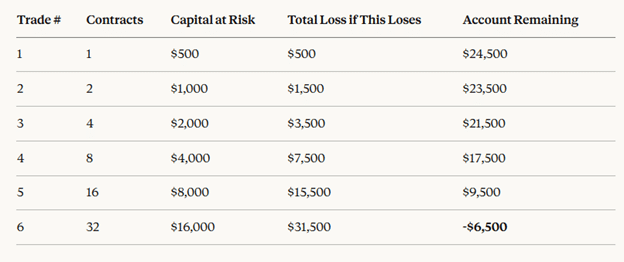
The martingale strategy is a betting system where you double your bet after every loss to recover previous losses and achieve a profit.
The Basic Concept:
Trade 1: Risk 1 unit, lose 1 unit
Trade 2: Risk 2 units (double), lose 2 units (total loss: 3 units)
Trade 3: Risk 4 units (double again), WIN 4 units
Result: +4 units won – 3 units lost = +1 unit profit
You’ve recovered all previous losses plus gained your original profit target.
The promise:
Eventually you’ll have a winning trade, and when you do, you’ll recover everything you lost plus make your original profit.
The reality:
This works perfectly… until it doesn’t. And when it doesn’t, it destroys accounts.
Why Martingaling Seems Logical
On the surface, martingaling appears to be a “can’t lose” strategy:
The Math Seems to Work:
If you’re trading a strategy with a 70% win rate (typical for iron condors), losing 3-4-5 times in a row seems unlikely. So doubling down after each loss means you’ll eventually hit a winner that recovers everything.
The Psychological Appeal:
After a loss, doubling your size makes you feel like you’re “taking control” and “being aggressive to recover.” It feels proactive rather than passive.
Historical Success:
Traders who use martingaling often experience years of success. Every losing streak eventually ends with a winner, reinforcing the belief that “it always works eventually.”
The Gambler’s Fallacy:
After 5 losses in a row, it feels like “a winner is due.” This makes doubling down seem even more logical – you’re betting big when you’re “most likely” to win.
The problem:
Every single one of these seemingly logical reasons is wrong.
Why Martingaling Doesn’t Work In Trading
The martingale strategy would work perfectly if and only if:
- You had unlimited capital (you could always double again)
- There were no bet limits (you could place any size trade)
- The game could continue indefinitely (no account blowup)
In trading, all three conditions fail:
-
Limited Capital:
Your account size is finite. By trade 6-8, you literally cannot place the required size – you’ve run out of buying power.
-
Position Size Limits:
Brokers have position limits. You can’t sell 1,000 iron condor contracts if you only have $50,000 in your account – margin requirements prevent it.
-
Psychological Breaking Point:
Even if you had the capital, risking $64,000 on a single trade after losing $63,000 requires steel nerves that most humans don’t possess.
The Monte Carlo Lesson
The most famous example of martingaling’s failure occurred on August 18, 1913 at the Monte Carlo Casino.
The roulette wheel landed on black 26 times in a row.
Gamblers kept betting on red, doubling their bets each time, convinced that “red was due.” They lost millions.
I lost around $500 (a lot for me at the time) when I was 18 and first went to a casino doing a similar strategy, so I know all too well the issues with martingale.
The probability of 26 blacks in a row: 0.00000149%
Impossibly rare? Yes.
Impossible? No.
And when that 0.00000149% event happened, everyone martingaling was wiped out.
The parallel to trading:
December 24, 2025 may have been that “26 blacks in a row” moment for traders using martingaling on zero-DTE condors. SPX rallied to all-time highs on shortened holiday trading with big institutions gone.
Unlikely? Yes. Impossible? No.
And if you’re martingaling, you don’t need to survive the probable – you need to survive the improbable. Because the improbable will eventually happen.
Conclusion
Casinos are smart; they have a limit on bet size for a reason.
Traders need to be smart, too; they need to have a limit on position size for each trade.
The maximum trade size for each individual trade should be 5% of the account size or less.
Martigalling is not smart.
When one follows unsafe practices, whole accounts and life savings can be wiped out, as this cautionary tale has shown.
When one learns proper principles, trading options can be safe. Iron condors can be safe. And zero-DTE can be safe.
Frequently Asked Questions
Where did the term martingale come from?
The French phrase “jeu à la martingale” means a reckless betting style.
Then, somehow, the casino houses started using the term “martingale” to describe strategies in which players keep increasing their bets after losses.
As such, a martingale is not based on a person’s name.
Hence, the word should not be capitalized (unless in the context of starting a sentence).
Is increasing risk wrong?
No, there are legitimate reasons for increasing risk in a trade.
Many professional traders do it properly when scaling up or adjusting a losing trade.
Scaling up and martingaling are not the same thing.
As you scale up, you have a fixed “planned capital” allocated to a trade and begin with a smaller portion of it.
You may increase the position once or twice at most, either because the setup improves or to enhance potential returns, but you never exceed your predetermined maximum size.
Martingaling ignores this constraint; it involves repeatedly doubling down after losses, hoping that the next trade will recover everything.
How do we know Captain Condor is martingalling?
We cannot definitively confirm the specific strategies used by any particular trader or group.
The information comes from social media reports, news coverage, and publicly available options flow data showing large SPX positions during that period.
Software like SpotGamma can detect large positions but cannot confirm who placed them or their exact strategy.
This article uses the reported incident as a case study for educational purposes about the dangers of martingaling and position sizing violations.
Q: Are zero-DTE iron condors too risky for retail traders?
Zero-DTE iron condors are not inherently too risky – they’re a defined-risk strategy with known maximum loss.
The risk comes from position sizing, not the strategy itself.
A trader selling 1-2 contracts with proper risk management can trade zero-DTE safely.
A trader selling 50-100 contracts violates position sizing rules regardless of the strategy used.
The problem is never the strategy – it’s always position sizing and risk management.
Want to Learn Proper Risk Management?
Understanding position sizing and risk management is the foundation of sustainable options trading.
If you want systematic approaches to managing positions without martingaling:
Options Income Mastery: Learn proper position sizing, risk management, and systematic trading approaches for income strategies ($397)
The Accelerator Program: Advanced training covering portfolio-level risk management, position sizing frameworks, and systematic income strategies ($997)
Related Articles
We hope you enjoyed this article on the alleged Captain Condor blow up.
If you have any questions, please send an email or leave a comment below.
Trade safe!
Disclaimer: The information above is for educational purposes only and should not be treated as investment advice. The strategy presented would not be suitable for investors who are not familiar with exchange traded options. Any readers interested in this strategy should do their own research and seek advice from a licensed financial adviser.

Source link