Coinbase Highlights Algorand as Leader in Post-Quantum Security
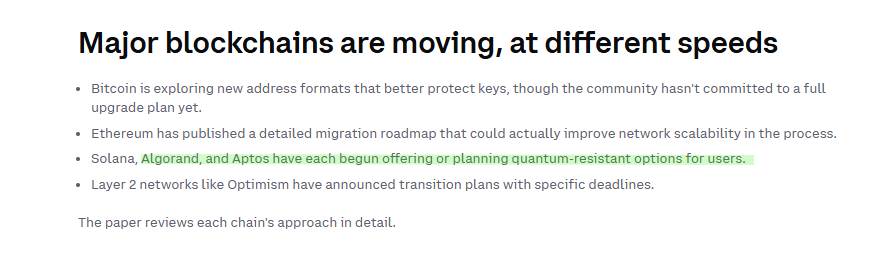
Another day, another major industry voice is forced to confront a truth crypto can no longer afford to ignore: quantum computing is not a meme risk, not a distant sci-fi topic, and not something the industry can solve at the last minute. This week, Coinbase’s Independent Advisory Board on Quantum Computing and Blockchain published its first position paper on the subject, and Algorand stood out as one of the very few networks recognized for already deploying meaningful post-quantum technology in production.
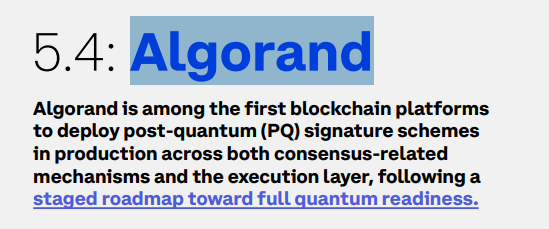
That is a big deal. In a space full of vague promises and future-roadmap marketing, Coinbase’s paper points to something much rarer: real implementation. The advisory board says Algorand is among the first blockchain platforms to deploy post-quantum signature schemes in production across both consensus-related mechanisms and the execution layer. In plain English, that means Algorand is not just talking about quantum resistance as a future ambition. It has already started putting the pieces live on mainnet.
Why quantum computing matters for crypto
To understand why this matters, it helps to start with the basics. A quantum computer is not simply a faster classical computer. According to Coinbase’s paper, quantum computers use qubits and quantum-mechanical effects in ways that could eventually let them solve certain cryptographic problems that are currently impractical for normal machines. Google Research recently reinforced that warning, saying future quantum computers may be able to break the elliptic-curve cryptography protecting cryptocurrency with fewer qubits and gates than previously estimated.
And that is the part the market should pay attention to. Most major crypto networks rely, directly or indirectly, on public-key cryptography to secure wallets, validate signatures, and maintain trust across the system. Coinbase’s board says a sufficiently powerful fault-tolerant quantum computer does not exist yet, but it also says it has high confidence that such a machine will eventually be built. Its conclusion is straightforward: the threat is not immediate, but it is clearly on the horizon, and the time to prepare is now.
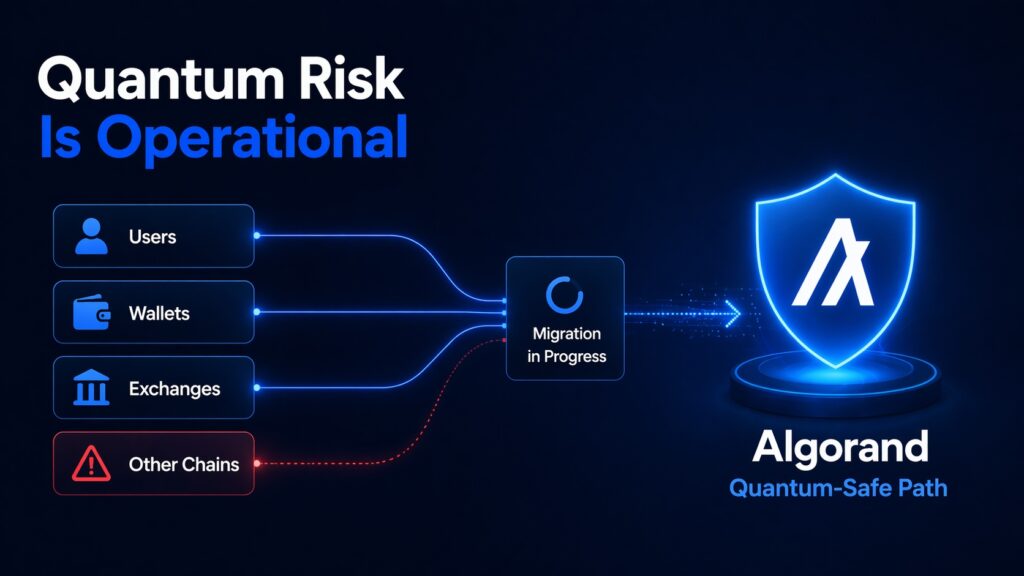
The real danger is not only technical. It is operational.
This is where many investors underestimate the issue. The biggest risk is not just that a future machine could break old cryptography. It is that migrating an entire decentralized ecosystem takes years. Coinbase’s paper says blockchains, wallets, custodians, exchanges, and users all need time to transition. The report also highlights one of the toughest problems in the entire sector: dormant or abandoned assets that may never be upgraded in time.
Google’s whitepaper makes the same point even more sharply. It says the technical and social complexity of switching blockchains to post-quantum signature schemes means the process will take years and cannot be delayed until the exact timeline for cryptographically relevant quantum computers is fully known. The paper also warns that dormant, inaccessible, or abandoned assets represent a distinct and critical challenge because they cannot simply migrate themselves to new standards.
That is why post-quantum readiness is becoming one of the most important long-term questions in crypto. It is not just about whether a blockchain can add a new cryptographic tool someday. It is about whether the network has already started building a credible migration path before the pressure becomes existential. That is exactly why Coinbase’s recognition of Algorand matters.
What Coinbase actually says about Algorand
Coinbase’s position paper does not hand out praise lightly. In its section on major blockchains, it says Algorand is among the first blockchain platforms to deploy post-quantum signature schemes in production across both consensus-related mechanisms and the execution layer, following a staged roadmap toward full quantum readiness. The paper also notes that at the transaction and execution layers, Algorand already provides the cryptographic tools needed to support quantum-resistant accounts.
Even more importantly, Coinbase says Algorand recently executed its first post-quantum transaction on mainnet using FN-DSA, with FN-DSA verification integrated as a native virtual-machine primitive. It adds that through logic signatures verifying FN-DSA signatures over transaction identifiers, users can create quantum-resistant accounts without requiring protocol modifications. That is not theory. That is live infrastructure.
This is exactly the kind of distinction that could matter more and more over time. Plenty of chains may eventually announce research, plans, frameworks, or exploratory tests. Far fewer can point to actual production deployment on mainnet and say the transition has already begun.
Algorand’s post-quantum story did not start yesterday
Coinbase’s recognition also fits into a broader timeline. Algorand says its first major step toward post-quantum readiness came in 2022 with the launch of State Proofs, a post-quantum secure compact certificate system signed using Falcon. According to Algorand, these State Proofs help secure the chain’s historical record against future quantum threats.
Then, in 2025, Algorand says it executed the world’s first post-quantum transaction on mainnet using NIST-selected Falcon signatures, extending post-quantum protection from historical state verification into live digital-asset transactions on a public blockchain. Algorand’s technical materials and product pages consistently frame this as a major step toward broader quantum readiness, not as the end of the journey.
That nuance matters. This is not a story about pretending the problem is solved. In fact, both Coinbase and Algorand acknowledge that more work remains.
Important nuance: Algorand is ahead, but the job is not finished
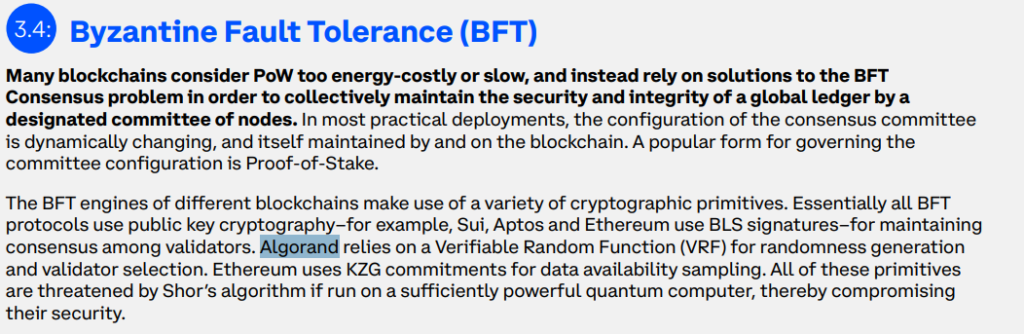
One of the reasons this story is credible is that the sources do not oversell it. Algorand’s own post-quantum page explicitly says its Verifiable Random Function, which is part of its consensus mechanism, is still based on elliptic-curve cryptography and will eventually need to be replaced with a post-quantum secure version. It says the search for viable post-quantum VRF methods remains an active area of research.
That is a much stronger position than empty marketing. It shows Algorand is already live with meaningful post-quantum components while being transparent that some consensus-layer elements still need further evolution. Coinbase’s broader paper makes the same larger point for the industry: quantum migration is not a binary switch. It is a staged process, and the winners may be the projects that start early and execute methodically.
Google also pointed to Algorand
This is not the first major external validation Algorand has received on this front. Google Quantum AI’s recent whitepaper says some blockchains, including Algorand, the XRP Ledger, and Solana, have made early experimental deployments of post-quantum protocols. Later in the paper, Google goes further and says the challenges of post-quantum transition are feasible to overcome, as demonstrated by Algorand, Solana, and the XRP Ledger, which have made notable progress in real-world adoption of PQC.
Google Research’s accompanying blog post makes the urgency even clearer. It says future quantum computers may break the elliptic-curve cryptography protecting cryptocurrency and that the community should improve security and stability before that becomes possible, including by transitioning blockchains to post-quantum cryptography.
So when Coinbase now highlights Algorand as one of the first and only chains with real post-quantum functionality on mainnet, this is not happening in isolation. It follows a pattern: major research and industry voices are increasingly acknowledging that Algorand is further ahead than most networks in the race to make blockchain architecture durable in a post-quantum world. That is an inference drawn from the overlap between Coinbase’s paper, Google’s whitepaper, and Algorand’s implementation record.
Why this could matter far beyond just “security”
This is where the investment angle becomes more interesting. Post-quantum readiness is not just a cybersecurity talking point. It may become part of the value proposition for chains that want to host long-duration assets, institutional settlement, tokenized real-world assets, and other infrastructure that cannot afford cryptographic uncertainty. Google’s whitepaper specifically notes that tokenization and blockchain-based finance are expanding the pool of assets governed by smart contracts, while Coinbase warns that unresolved migration decisions are already contributing to uncertainty that could affect investment behavior.
In other words, the market may eventually begin separating blockchains not only by throughput, user growth, and ecosystem size, but by how seriously they prepared for the cryptographic future. If that happens, being early will matter. Algorand is increasingly positioning itself as one of the few chains that can say it did not wait for panic before starting the transition.
Final take
The headline here is not just that Coinbase mentioned Algorand. The real headline is that one of the biggest names in the industry has now publicly reinforced what a growing number of researchers are already saying: post-quantum preparation has started, and Algorand is one of the few blockchains already doing something concrete about it on mainnet.
Quantum risk may still be years away from becoming an immediate emergency. But in crypto, the chains that survive major technological shifts are usually the ones that prepare before everyone else realizes the shift is real. Right now, Algorand looks increasingly like one of those chains. That forward-looking interpretation is based on Coinbase’s recognition, Google’s research, and Algorand’s documented deployment milestones.
Source link