Day 17: Risk Management In ICT & SMC Trading — Position Sizing, Stop Loss & Drawdown | Trading Strategy Guides
The Lecture Most Traders Skip. The One That Actually Keeps You Alive.
Welcome back. Today’s topic isn’t the most exciting lecture in this series. There are no diagrams of order blocks, no FVG examples, no breaker block comparisons. But of everything we have covered across seventeen days, this is the lecture that will most directly determine whether you are still trading a year from now.
The hard truth is this: a trader with a mediocre strategy and excellent risk management will outlast a trader with an excellent strategy and mediocre risk management every single time. The market gives you unlimited chances to succeed — but only if you are still funded enough to take them.
Let’s build your risk management framework from the ground up.
The One Rule That Overrides Everything Else — The 1% Rule
Before discussing any technique, any tool, or any setup — there is one rule that both ICT and SMC communities universally agree on:
Never risk more than 1–2% of your trading account on a single trade.
That’s it. One rule. Every other risk management principle flows from it.
Here is why it matters in plain numbers. If you risk 1% per trade and you hit ten consecutive losses — an extreme but possible sequence — you have lost approximately 10% of your account. Painful, but survivable. Your account is still 90% intact. You can recover.
If you risk 10% per trade and hit ten consecutive losses, your account is gone. No recovery possible. Game over.
The 1% rule is not about being timid. It is about making sure that the inevitable losing streaks — and every trader, no matter how skilled, has them — never remove you from the game permanently. Professionals risk 1%. Beginners who blow accounts consistently risk far more.
Position Sizing — The Formula Every ICT and SMC Trader Needs
Knowing you will risk 1% per trade is meaningless if you don’t know how to convert that into an actual lot size. This is where position sizing comes in — and it is a calculation you must run on every single trade, without exception.
The formula is:
Position size = (Account balance × Risk %) ÷ Stop loss distance in pips (or points)
A worked example: you have a $10,000 account. You want to risk 1% — that is $100. Your stop loss on the current setup is 50 pips away from your entry. A standard forex lot has a pip value of approximately $10 per pip. So:
$100 ÷ (50 pips × $10 per pip) = $100 ÷ $500 = 0.20 lots
You enter 0.20 lots. If your stop is hit, you lose exactly $100 — 1% of your account. Not more. Not less.
The critical implication of this formula is that wider stop losses mean smaller position sizes. If the correct stop placement for a setup is 100 pips away, you take a smaller position — not a tighter stop. Never compress your stop loss to fit a desired position size. That inverts the logic entirely and will get you stopped out by normal price noise before the trade has a chance to work.
Stop Loss Placement — The ICT and SMC Approach
In both methodologies, the stop loss has one job: invalidate the trade idea. It is not placed at a round number. It is not placed at a “comfortable” distance. It is placed at the exact level where, if price reaches it, the entire analytical basis for the trade is proven wrong.
In SMC: stop goes below the liquidity sweep low (for a long trade) — the wick that swept the SSL before price reversed. If price returns below that wick, the institutional reaction you traded from has failed.
In ICT: stop goes below the low of the Judas Swing for a long trade. If price retraces past that point, the Judas Swing was not the manipulation phase — the narrative is broken.
Neither methodology places stops below a zone broadly. They place stops at the specific structural point of invalidation. This keeps stops tight relative to the trade’s risk-reward, and it means that when you are stopped out, you know exactly why — not just that price moved against you.
Moving to Break-Even — When and How
One of the most common trade management decisions is moving the stop loss to the entry price once a trade has moved sufficiently in your favour. This converts a risk trade into a free trade — worst case, you exit at breakeven with zero loss.
The standard ICT and SMC approach: move to break-even once price has cleared the first significant structural level in your direction. For an SMC trade, that is typically once price has swept the nearest internal liquidity and is approaching the first BSL target. For an ICT trade, it is once price clears the 0.0% level of the OTE Fibonacci — the original swing high — with momentum.
The mistake most beginners make is moving to break-even too early — at the first sign of any move in their direction. Move it too soon and you will get break-evened out of trades that go on to hit full target. Patience here is as important as patience at entry.
Partial Profits and Running the Rest
Taking partial profits at an intermediate target while letting the remainder of the position run toward the full target is a widely used trade management technique in both frameworks.
The standard approach: take 50% of the position off at Target 1 (the first draw on liquidity, or the -0.27 Fibonacci extension in ICT). Move the stop on the remaining 50% to break-even. Let that runner continue toward Target 2.
This approach does three things simultaneously: it locks in real profit, it eliminates risk on the remainder of the trade, and it keeps you in the market for the full potential of the move. You have already won something — now you are playing with the market’s money on the runner.
The Daily Loss Limit — Your Personal Circuit Breaker
Position sizing protects you on each individual trade. The daily loss limit protects you across an entire session.
A daily loss limit is a hard rule: if you lose more than X% of your account in a single trading day, you stop trading immediately and do not return until the next session. Most professional traders and prop firm evaluation frameworks set this at 3–5% of account equity.
Here is why this rule is non-negotiable. After two or three consecutive losses in a session, most traders enter a psychological state sometimes described as “tilt” — where the desire to recover losses overrides disciplined analysis. Trades taken in this state violate every rule of the plan. Position sizes grow. Setups are forced. The sequence that began with two controlled 1% losses becomes a catastrophic 10–15% loss in a single afternoon of revenge trading.
The daily loss limit is a firewall against that sequence. Once it is triggered, the session is over. No exceptions. Not even for “one more trade to get it back.”
If you lose 3% today, come back tomorrow. The market will still be there.
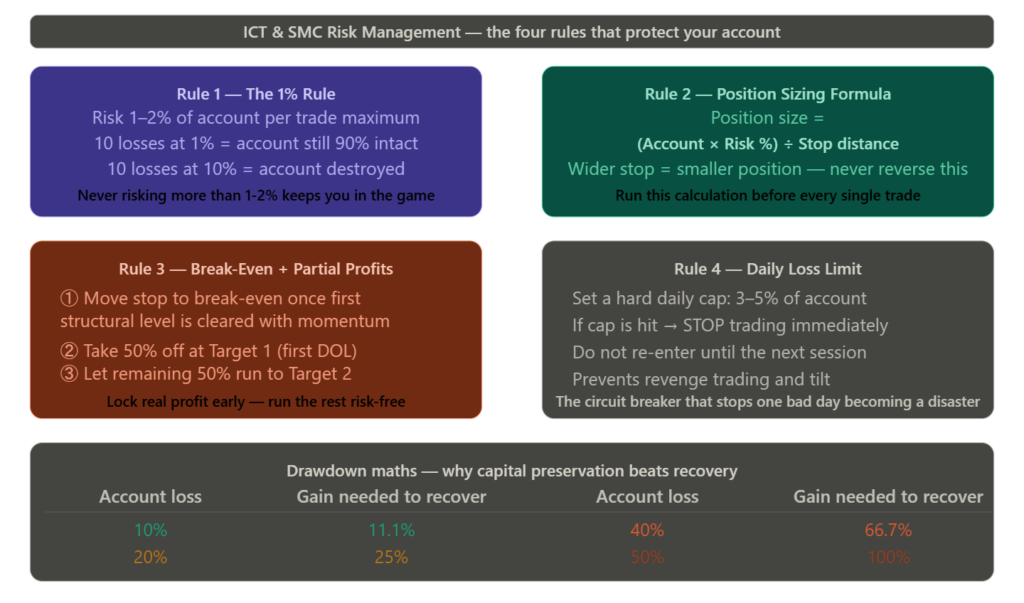
The Drawdown Maths You Need to See Once
The bottom of the diagram shows a table that changes how most traders think about losses permanently. Losing 50% of your account does not require a 50% gain to recover. It requires a 100% gain — because you are now working from a smaller base.
This asymmetry is why capital preservation is always prioritised over aggressive profit-seeking in professional trading. It is mathematically easier to not lose 20% than it is to make 25% after you have lost 20%.
Every time you break the 1% rule, every time you revenge trade, every time you ignore the daily loss limit — you are pushing yourself further up that recovery curve. The professionals who last in this business are not the ones who make the most on their best days. They are the ones who lose the least on their worst days.
How ICT and SMC Approach Risk Differently
Both methodologies share the same foundational risk rules — the 1% rule, position sizing from the stop, and logical invalidation-based stop placement. The difference lies in how tight the entries are.
ICT: Because entries are refined through the Kill Zone, OTE, and Judas Swing confirmation, stop distances tend to be very tight — often 10–30 pips on forex pairs. Tight stops with 1% risk mean ICT traders can trade larger position sizes while keeping dollar risk fixed. This produces the high risk-reward ratios (1:5, 1:10) that ICT is known for, but demands precise entry execution.
SMC: Entries are confirmed by the LTF CHoCH at the POI. Stop goes below the liquidity sweep low. Stop distances tend to be slightly wider than ICT’s tightest setups, but still structurally defined. SMC typically targets a minimum 1:3 risk-reward, which remains very compelling when applied consistently.
Neither approach works without the 1% rule underneath it. The strategy provides the edge. The risk management ensures you survive long enough to let the edge compound.
The Revenge Trading Trap — And How to Close It
Every trader reading this will face a day where they take two or three losses in a row and feel the urge to immediately open another trade to recover. That urge is not ambition. It is a stress response — your brain attempting to eliminate the discomfort of a loss by taking action.
The trade you take from that state is almost always the worst trade of the day. It is oversized. The setup is forced. The plan is bypassed. And it turns a 2% controlled loss into a 6% uncontrolled one.
The fix is mechanical, not motivational: set your daily loss limit in writing before you begin every session. When it is hit, close the platform. No exceptions, no negotiations. The market will open again tomorrow. Your capital, once gone, will not come back on its own.
Up Next — Day 18
Tomorrow we tackle a question that beginners ask constantly: does ICT and SMC work on forex, crypto, and stocks equally? The answer is nuanced — and the differences matter significantly for how you apply the tools depending on what market you are trading.
Day 18 covers exactly that.
→ See you on Day 18.