Day 18: ICT & SMC On Forex, Crypto & Stocks — Key Differences Explained | Trading Strategy Guides
Same Framework. Different Market. Here’s What Actually Changes.
Welcome back. One of the most common questions across the ICT and SMC communities is a simple one: does this work on crypto? Does it work on stocks? Or is it just a forex thing?
The short answer is that the core concepts — market structure, liquidity, order blocks, FVGs, BOS and CHoCH — work across every liquid market. Institutions operate in all of them. Liquidity is hunted in all of them. Price leaves the same structural footprints in all of them.
But the application is not identical. Three things change meaningfully between markets: session structure, liquidity density, and the role of time. Getting those adaptations right is what separates traders who succeed across multiple asset classes from those who copy a forex setup onto Bitcoin and wonder why it keeps failing.
Let’s go through each market systematically.
Forex — The Home Market for ICT and SMC
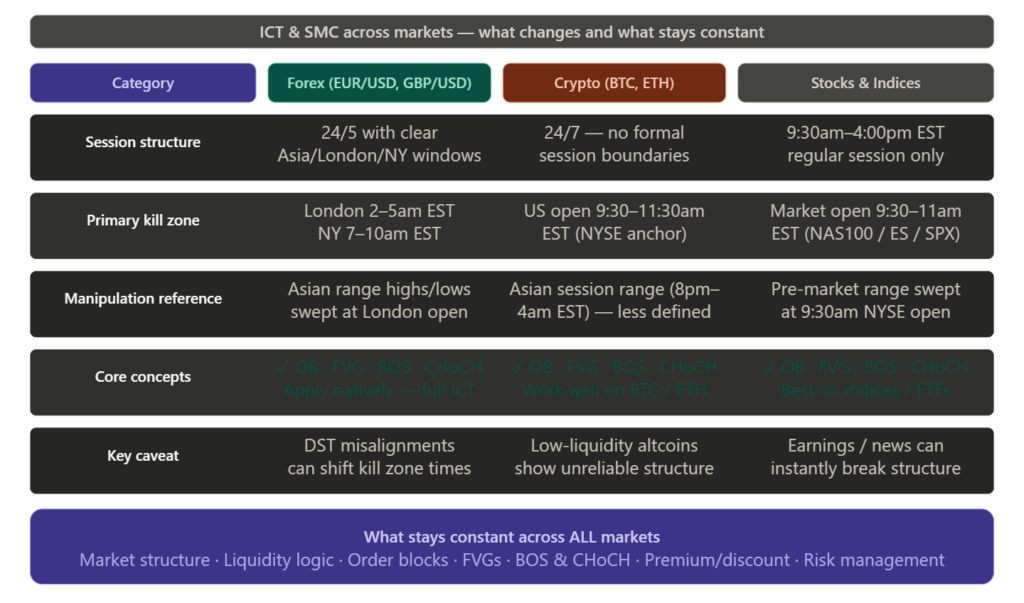
ICT concepts were built specifically for forex — and it shows. The Kill Zone times (London 2–5am EST, New York 7–10am EST) map directly to the two biggest institutional order flow windows in global currency markets. The Asian session range (built during 8–10pm EST) provides the daily liquidity reference points that London then hunts. The AMD model — Accumulation in Asia, Manipulation at London open, Distribution in New York — was designed around this exact session structure.
In forex, this is why the Judas Swing concept is so clean and so consistent. The Asian session creates a tight, well-defined range. London opens, sweeps one side of it — the fake move — and New York delivers the true directional expansion. Three distinct sessions, three distinct functions, operating on a 24-hour cycle from Sunday evening to Friday evening EST.
Best pairs for ICT and SMC in forex: EUR/USD and GBP/USD are the primary pairs — highest institutional volume, tightest spreads, cleanest structure. USD/JPY works well during the Asian Kill Zone. GBP/JPY has high volatility but wider spreads and noisier structure, making it more demanding to trade cleanly.
The one complication in forex is the ICT Kill Zone time for indices versus pairs. For forex pairs, the New York Kill Zone runs 7–10am EST. For indices like the Nasdaq 100 (NAS100) and S&P 500 (SPX), it shifts to 8:30–11am EST, aligning with the US equity market open at 9:30am EST. This is a distinction worth memorising — confusing the two timeframes is a common beginner mistake.
Gold (XAUUSD) — The Crossover Market
Gold sits between forex and commodities, and it is arguably the most popular instrument in the ICT and SMC trading community after EUR/USD. It is traded as XAU/USD on the forex market, meaning it follows the same 24-hour Monday-to-Friday session structure as currency pairs.
However, gold has its own behavioural characteristics that matter for ICT and SMC application. The most important: gold’s institutional volume is heavily concentrated during the London-New York overlap — roughly 8am–12pm EST — when physical gold pricing is established through the London bullion market’s twice-daily fix process. This window produces the clearest displacement moves, the most reliable FVG fills, and the strongest kill zone setups on XAUUSD.
Gold also moves in larger absolute point values than most forex pairs, which affects position sizing (a 100-point move on XAUUSD is significant). The AMD model applies cleanly to gold — the Asian session builds the range, London manipulates, New York distributes. ICT’s Silver Bullet strategy (a specific 60-minute entry window at 10–11am EST) was originally developed with gold and indices in mind and works particularly well on XAUUSD during that New York AM window.
Crypto — The 24/7 Adaptation
Crypto is the market that requires the most deliberate adaptation of ICT and SMC concepts. The reason is fundamental: there is no session structure. Bitcoin trades around the clock, seven days a week, 365 days a year. There is no London open, no New York close, no overnight session. The Asian range that ICT relies on for the Judas Swing setup does not exist in the same clean way it does in forex.
This does not mean the concepts fail — it means the time-based filters must be re-anchored.
The adaptation that has become standard in the ICT and SMC crypto community: use the US equity market open at 9:30am EST as the primary Kill Zone anchor. This is when institutional crypto volume peaks, because the vast majority of US institutional participants — hedge funds, family offices, crypto ETF operators — become fully active at the NYSE open. Bitcoin and Ethereum consistently show their sharpest displacement moves and clearest FVG formations during the 9:30am–11:30am EST window.
The Asian session low and high on crypto charts (approximately 8pm–4am EST) still function as daily liquidity reference points, even without a formal session close. Price regularly sweeps the Asian range highs or lows before the US session begins — a recognisable Judas Swing equivalent that experienced crypto traders watch for.
What does not change in crypto: market structure, order blocks, FVGs, BOS and CHoCH identification, and the premium/discount framework all apply directly. The structural concepts are asset-class agnostic. The time-based rules require recalibration.
One critical caution for crypto: the smaller and less liquid the coin, the less reliable the ICT and SMC concepts become. On Bitcoin and Ethereum — where institutional participation is now substantial and well-documented — the concepts work well. On mid-cap altcoins, liquidity is fragmented across exchanges, institutional footprints are less consistent, and news events can invalidate technical structure instantly. Stick to the majors.
Stocks — The Sessioned Equity Adaptation
US stocks present a different set of constraints. Unlike forex and crypto, equities trade only during defined market hours — 9:30am to 4:00pm EST for the regular session — with pre-market (4am–9:30am) and after-hours (4pm–8pm) trading available but structurally less reliable for ICT and SMC setups.
The Kill Zone equivalent in stocks is the market open window: 9:30–11:00am EST. This is when institutional volume peaks, opening-range liquidity is swept, and the daily directional move is typically established. ICT’s AMD model applies directly to the US equity session: the pre-market range is the Asian equivalent (Accumulation), the opening sweep in the first 30–60 minutes is the Manipulation phase, and the 10:30am–12:00pm EST range is the Distribution.
Order blocks, FVGs, BOS, and CHoCH all work on major liquid stocks and indices like the NAS100, SPX500, and large-cap tech names with sufficient daily volume. The caveat is that individual stocks are far more vulnerable to fundamental events — earnings reports, FDA decisions, regulatory filings — that can instantly invalidate any technical structure. ICT and SMC work best on individual stocks when they are used on index ETFs or the index futures themselves (ES, NQ), where institutional footprints are cleaner and less subject to single-company news disruptions.
Pre-market order blocks require special caution: zones formed during pre-market tend to be less reliable because liquidity is thinner and the participants active during those hours are different from the institutional flow that drives regular session moves. Always anchor your primary analysis to regular-session price action.
The One Thing That Never Changes
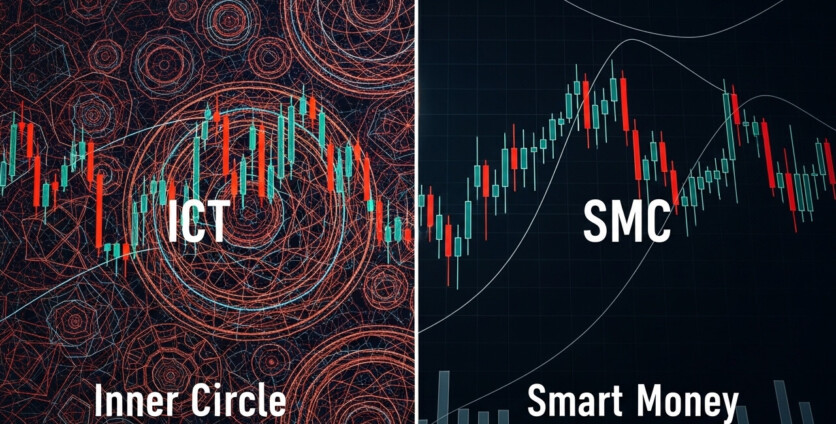
The diagram above shows what differs. This section covers what is identical — and it is the more important list.
Market structure — higher highs, higher lows, lower lows, lower highs, BOS, and CHoCH — is a universal language that any liquid price chart speaks. Whether you are reading a EUR/USD daily chart or a Bitcoin 4H chart or an NAS100 15-minute chart, structure is structure.
Liquidity logic — the principle that price seeks out stop-loss clusters above swing highs and below swing lows before reversing — operates in every market where participants place orders with stops. Which is every market.
Order blocks and FVGs — the last opposing candle before an impulse, and the three-candle price imbalance — form identically across all markets. The structure of the pattern does not change because the underlying mechanism (institutional order placement leaving a structural footprint) is the same.
Premium and discount — the 50% equilibrium logic, buy from discount, sell from premium — applies anywhere you can draw a Fibonacci tool.
Risk management — the 1% rule, position sizing formula, stop at structural invalidation — is completely market-agnostic.
What changes is the timing layer — specifically which hours produce the highest institutional participation and therefore the most reliable ICT and SMC patterns. Get that timing layer right for your chosen market, and the rest of the framework transfers directly.
The Practical Recommendation
If you are new to ICT and SMC, start with forex — specifically EUR/USD or GBP/USD. The session structure is the clearest, the Kill Zone windows are the most well-defined, and the concepts were built for this market. The feedback loop between analysis and outcome is the fastest.
Once the framework is solid on forex, expanding to gold is the natural next step — it behaves most similarly to forex with the session-based Kill Zone structure largely intact. From there, crypto (with the US open anchor) and indices (with the NYSE open anchor) are straightforward adaptations rather than new methodologies entirely.
What you should never do is attempt to run the strict ICT time-based filters — Judas Swing at London open, Kill Zone mandatory entries — on a 24/7 crypto market without adjustment. The pattern will exist but the timing will not. Adapt the time layer. Keep everything else.
Up Next — Day 19
Tomorrow we tackle the mistakes that cost beginners the most money — and the most time. Day 19 is a direct, no-filler breakdown of the most common errors traders make when learning ICT and SMC, why each one happens, and the specific fix for each. This one will save you months of expensive trial and error.
→ See you on Day 19.