Day 20: Combining ICT And SMC Trading — The Hybrid Approach That Works | Trading Strategy Guides
The Question You’ve Been Asking Since Day 1.
Welcome back. Twenty days in. One day to go.
Throughout this series we have consistently presented ICT and SMC side by side — sometimes in agreement, sometimes highlighting real differences, always noting that they share the same foundational toolkit. Which has inevitably led to the question that shows up in every ICT and SMC community:
Can you actually combine them? Or does using one invalidate the other?
The answer is direct: not only is combining them possible — it is what many of the most effective traders in this space already do. The methodologies do not conflict. They complement. And today we give you the specific hybrid framework that shows exactly how.
First — Why People Think They Conflict
The perception of conflict almost always traces back to terminology. ICT and SMC use different words for the same things — or similar words for subtly different things. This creates the impression that the two systems are more distinct than they actually are.
A few examples you have already encountered throughout this series:
What ICT calls a PD Array in the discount zone, SMC calls a bullish Point of Interest. Same zone, different label. What ICT calls a Market Structure Shift, SMC calls a Change of Character. Same event, different name. ICT’s Judas Swing is SMC’s liquidity sweep / manipulation phase within the AMD model. Same mechanism. What ICT prescribes as a mandatory Kill Zone filter, SMC recommends as a preferred but not required high-volume session window. Same concept — one enforced, one advisory.
The tools underneath the labels are identical. The structural concepts are the same. The logic of institutional order flow, liquidity hunting, and price imbalance filling does not change between the two systems. What changes is the strictness of the rules around how and when you apply those tools.
Understanding this resolves the conflict entirely. You are not choosing between two different theories of how markets work. You are choosing between two different operating procedures for applying the same theory.
The Legitimate Difference — And Why It Creates the Hybrid Opportunity
There is one genuine, substantive difference between ICT and SMC that matters for trade execution: ICT adds a mandatory time dimension. SMC does not.
ICT insists that the Kill Zone is non-negotiable. A setup that forms outside a Kill Zone is not traded, regardless of how structurally perfect it looks. The Judas Swing must complete. Displacement must occur. The FVG must form inside the Kill Zone window. These are mandatory conditions, not guidelines.
SMC leaves time as advisory. The four POI quality criteria — BOS trigger, liquidity protection, freshness, proximity — are structural filters, not time filters. An SMC trader can enter a valid setup at 11am EST if the structure is clean enough, whereas a strict ICT trader would pass on the identical setup because the Kill Zone ended at 10am.
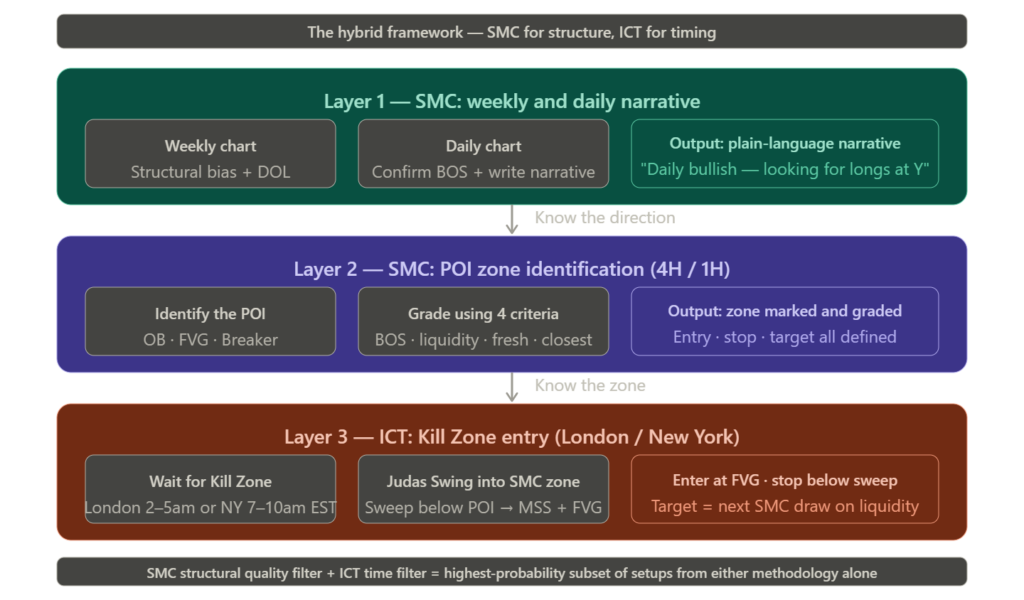
This difference creates the opportunity for a hybrid: use SMC’s structural clarity to build the narrative and identify the zone, then use ICT’s time filter to decide when to enter within that zone.
The result is a framework with SMC’s flexibility at the analysis level and ICT’s precision at the execution level. It is arguably the most complete approach available from either methodology alone.
The Hybrid Framework — Three Layers
Layer 1 — SMC for the Weekly and Daily Narrative
Start every week the way the SMC trade plan from Day 15 instructs. Open the weekly chart. Define the structural bias — are we in a bullish or bearish phase? Where is the nearest draw on liquidity? Identify whether the current market is in an expansion, retracement, or consolidation phase.
Drop to the daily. Confirm the BOS sequence. Identify the most significant unmitigated bullish or bearish POI between current price and the weekly draw on liquidity. Apply the four SMC quality criteria. Write the narrative in plain language.
You are now operating with SMC’s broader, flexible structural thinking — which is excellent at defining the where and the why without locking you into rigid timing requirements before you even have a setup.
Layer 2 — SMC for Zone Identification (4H and 1H)
Drop to the 4H and 1H charts. Use SMC’s POI framework to identify the specific order block, FVG, or breaker block that price is most likely to react from when the pullback occurs. Grade it against all four quality criteria. Mark the zone boundaries — the entry level, the stop level, and the target.
At this point you know what you are looking for and where it is. You are not yet inside any trade. You are positioned and ready.
Layer 3 — ICT for Kill Zone Entry
Now apply ICT’s time filter. You have your SMC zone marked. Your job is to wait — not just for price to reach it, but for price to reach it during a Kill Zone.
If price enters the zone at 1pm EST, you do not enter. The volume is thin, institutional participation is low, and the setup has a lower probability of follow-through. You wait.
When London opens the next morning and begins engineering the session’s liquidity sweep, you watch your marked zone. If the Judas Swing takes price into your SMC POI — sweeping the liquidity sitting below it — and the 5-minute chart then prints an MSS with displacement and a clear FVG, that is your entry. You are inside a Kill Zone, at a structurally graded SMC POI, with an ICT-confirmed entry signal.
That is the hybrid at full execution.
[📸 IMAGE PROMPT FOR PUBLISHER: Insert a three-panel annotated chart. Panel 1 (Daily): SMC narrative — bullish trend, pullback in progress, unmitigated bullish POI (OB/FVG zone) marked and labelled. Panel 2 (4H/1H): POI graded — zone boundaries, stop and target labelled. Panel 3 (5M): London Kill Zone active — Judas Swing sweeps below the SMC POI, MSS forms, FVG entry candle highlighted. Label each panel with its layer. Use EURUSD or XAUUSD.]
Why This Works Better Than Either Alone
The SMC-only trader has a strong structural framework but no mandatory time filter. This means they sometimes enter structurally valid setups during low-volume periods and get chopped out by noise before the actual move materialises. The setup was right. The timing was not.
The pure ICT trader has strong time discipline but sometimes finds that the SMC structural context — particularly the four POI quality criteria — would have helped them avoid entering zones that were technically inside a Kill Zone but structurally weak.
The hybrid combines both strengths. SMC’s structural quality filter reduces the frequency of entering weak zones. ICT’s time filter reduces the frequency of entering valid zones at invalid times. The intersection — structurally graded SMC zones entered during ICT Kill Zones — produces the highest-probability subset of setups from either methodology.
The Warning About Combination
Here is the one thing that can make the hybrid approach dangerous rather than powerful: using it as an excuse to add complexity rather than precision.
Some traders combine ICT and SMC not because they have genuinely integrated both frameworks but because they cannot decide which one to follow. They use SMC when an ICT rule inconveniently disqualifies a setup, and they invoke ICT terminology when an SMC setup needs justification. The result is a system with no consistent rules — which is worse than either methodology alone.
The hybrid only works when the rules of each layer are applied unconditionally. SMC POI criteria are applied in full at Layers 1 and 2 — no shortcuts, no accepting a zone that fails one of the four criteria because it “feels strong.” ICT Kill Zone timing is applied in full at Layer 3 — if the setup forms outside the Kill Zone, it does not qualify, regardless of how clean the SMC zone is.
Both sets of filters must be applied rigorously in every session, or the hybrid collapses into the same inconsistency that strategy-hopping produces.
The Terminology Translation You Need
Since SMC and ICT share concepts under different names, here is the direct translation map that prevents confusion when you move between layers:
| SMC term | ICT equivalent |
| Point of Interest (POI) | PD Array in premium or discount zone |
| Change of Character (CHoCH) | Market Structure Shift (MSS) |
| Liquidity sweep | Stop hunt / inducement |
| Manipulation phase (AMD) | Judas Swing |
| Draw on liquidity (DOL) | IPDA draw on liquidity target |
| LTF CHoCH confirmation | Displacement + FVG after MSS |
| Bullish POI in discount | Discount-zone bullish PD array |
When you read “enter at the LTF CHoCH at the POI during London” in an SMC context, and “enter at the FVG formed by MSS displacement during the London Kill Zone” in an ICT context — those are describing the same entry. Knowing this translation removes all ambiguity between the two systems.
Which Combination Suits Which Trader
The hybrid is not the only valid approach. Two pure approaches also work — and for some traders, simplicity beats the additional filtering that the hybrid requires.
Pure SMC suits traders who value flexibility above precision. Those who trade across multiple timeframes and markets without fixed session restrictions. Swing traders who may hold positions overnight or across multiple days where Kill Zone timing is less relevant. Beginners who want to master structural concepts before adding time-based filters.
Pure ICT suits traders who thrive on explicit, non-negotiable rules. Those who trade forex and indices during defined Kill Zones and have the patience to wait for the full sequence — IPDA narrative, Judas Swing, MSS, displacement, FVG — before entering. Traders who want a more mechanical system with fewer discretionary judgements.
The hybrid suits traders who have learned both systems well enough to apply both layers rigorously — and who want the additional confluence that comes from satisfying both structural and timing filters simultaneously. It produces fewer setups than either system alone, but those setups carry higher average probability when all conditions align.
One combination that rarely works: treating SMC and ICT as interchangeable labels for the same thing without understanding the genuine differences. That produces neither the structural clarity of SMC nor the time-based precision of ICT. It produces noise dressed up as analysis.
Up Next — Day 21
Tomorrow is the final lecture of this series. Day 21 delivers what this entire twenty-day build has been pointing toward: which should you actually use? ICT, SMC, or the hybrid — and how do you make that decision based on your specific situation, schedule, personality, and goals?
The final verdict. With a complete action plan.
→ See you on Day 21.