eToro Launches Developer App Store and Builders Portal for Retail Platform
eToro is
opening up its platform to outside developers, rolling out an eToro App Store
and a companion builders portal that let third parties and users create,
publish and install trading and analytics tools that plug directly into the
retail investing platform.
Singapore Summit: Meet the largest
APAC brokers you know (and those you still don’t!)
The
Nasdaq-listed broker, ticker
ETOR, which counts around 40 million registered users across 75 countries,
said the App Store will bring together developers, quantitative strategists,
Pro Investors and retail clients around a shared library of applications that
tap into eToro’s core trading functions. At launch, users will be able to
browse apps by category, install them with one click and use them inside the
eToro platform, the company said in a statement Tuesday.
The
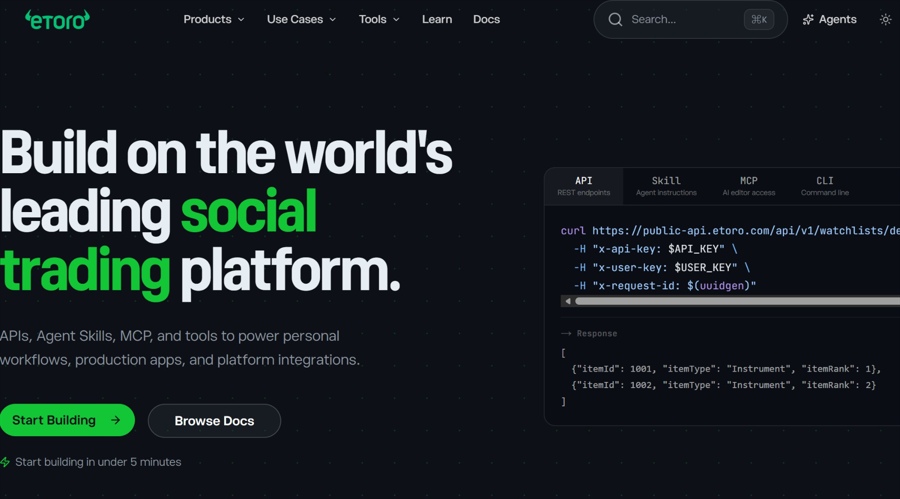
builders portal sits alongside the store and gives developers what eToro
describes as structured access to its APIs, agent skills, Model Context
Protocol server, command-line tooling and technical documentation. Users
without a coding background will also be able to publish their own tools
through what the firm calls AI-powered, no-code capabilities.
A Longer-Running AI Play
for the Retail Broker
The App
Store has been telegraphed for months. eToro first unveiled its public API and
an AI assistant called Tori in August 2025, pitching the combination as a way
to give retail traders features once reserved for quant hedge funds, as Finance
Magnates reported at the time.
By late
October, the company extended its public APIs and patented CopyTrader tool to
US investors and previewed a wave of user-built applications created
through so-called “vibe coding,” a natural-language interface
that lets people design trading tools without formal programming skills.
In a March
interview with Finance Magnates at eToro’s Limassol office, CEO
Yoni Assia said the company already had more than 800 of its Pro Investors
who had built upwards of 1,000 apps, some of which would eventually be housed
in the App Store.
[#highlighted-links#]
Last month,
eToro also began rolling out Agent
Portfolios, a feature that lets users connect their own AI agents to live
sub-accounts with defined budgets and risk limits, placing the company ahead of
incumbents like Interactive Brokers, Charles Schwab and Fidelity in packaging
agentic AI as a client-facing trading product.
Commenting
on Tuesday’s launch, Assia said investing had always evolved with technology
but that AI was accelerating the process. “The eToro App Store opens up
financial innovation to anyone with an idea,” he said in the statement.
“Developers and quants finally have a direct line to millions of retail
investors, and those investors finally get the more flexible and user-designed
tools they’ve always wanted.”
Broker Marketplaces Are
Not New Territory
eToro is
entering a space where several technology providers have been running developer
marketplaces for years. Spotware’s
cTrader Store, launched in late 2022 and expanded since, already functions
as a global marketplace for trading robots, indicators, copy strategies and
Open API apps, with built-in licensing and dedicated sections for prop firm
evaluations.
Finance
Magnates reported last week that Spotware’s platform now serves
more than 11 million traders through over 300 broker and prop firm clients,
with the store drawing an estimated 10,000 visitors a day, according to the
company.
MetaQuotes,
the dominant player in CFD broker technology, runs its own MQL5 code base and
in early April launched
metatrader.com, a consumer-facing portal that bundles charting, news and a
developer marketplace with an Algo Forge layer described as a GitHub-like
collaboration space for developers.
Earlier
iterations of broker-run developer programs go back more than a decade, with IG
Group opening its IG Labs API portal back in 2014, though without an app
marketplace component.
The
difference eToro is pitching is less about the infrastructure itself and more
about distribution. The company is also marrying the store to its existing
social layer, where users have historically followed and copied Pro Investors
rather than downloading tools.
This article was written by Damian Chmiel at www.financemagnates.com.
Source link