Fair Value & Margin of Safety Calculator
A stock is only a good investment if you buy it at the right price.
That is the idea behind fair value and margin of safety. Fair value is your estimate of what a stock is worth based on the earnings it can generate in the future. Margin of safety is the discount you demand before buying, to protect yourself against overly optimistic assumptions, unexpected setbacks, or market volatility.
This calculator helps you estimate both. Instead of guessing whether a stock “looks cheap,” you can model its value using earnings, growth expectations, a required rate of return, and a future valuation multiple. You can also switch to Bear, Base, and Bull scenarios to see how sensitive the valuation is to different assumptions.
Used properly, this calculator will not tell you exactly what a stock is worth with certainty. What it will do is help you think more clearly about valuation, discipline, and risk.
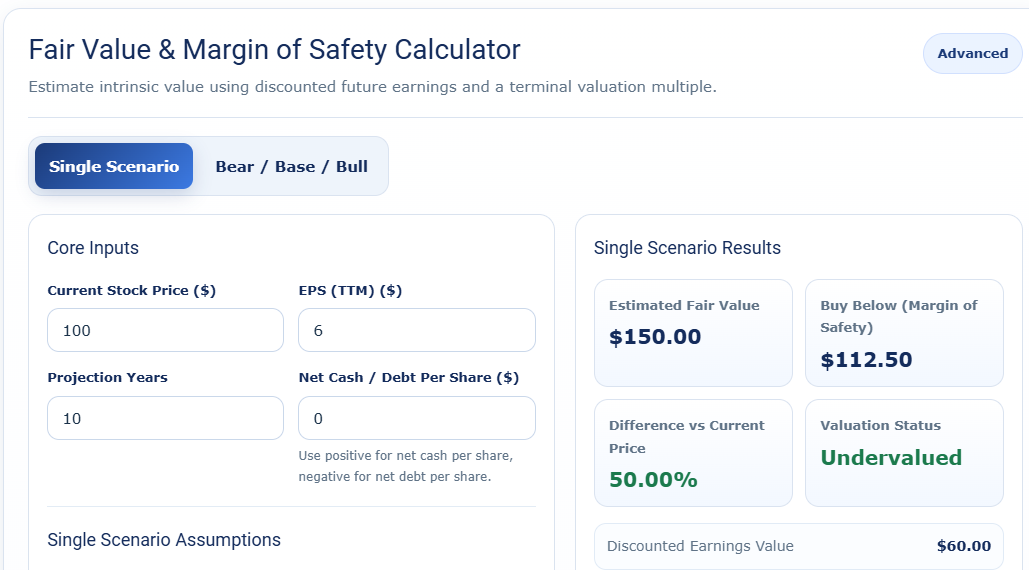
Core Inputs
Single Scenario Assumptions
Model note: This calculator discounts each year’s projected earnings and adds a discounted terminal value based on a future P/E multiple. Use scenario mode to build a valuation range rather than relying on a single exact estimate.
Single Scenario Results
Estimated Fair Value
$0.00
Buy Below (Margin of Safety)
$0.00
Difference vs Current Price
0.00%
Valuation Status
—
Discounted Earnings Value$0.00
Discounted Terminal Value$0.00
Net Cash/Debt Adjustment$0.00
Undervalued
Fairly Valued
Overvalued
Projected Earnings & Present Value
| Year | Projected EPS | Discount Factor | Present Value |
|---|---|---|---|
| Enter your assumptions and click Calculate. | |||
This calculator is for educational purposes only and simplifies real-world valuation. Always compare outputs against business quality, balance sheet strength, cyclicality, and realistic growth expectations.
How to Use the Calculator
Start by entering the current stock price and the company’s trailing twelve-month earnings per share, or EPS. Then choose how many years you want to project earnings into the future. In most cases, 5 to 10 years is a reasonable range.
Next, enter your assumptions. In Single Scenario mode, you only need one set of inputs:
- annual EPS growth rate
- discount rate or required return
- terminal P/E multiple
- margin of safety
If you want a more realistic range of outcomes, switch to Bear / Base / Bull mode. This allows you to test a conservative case, a central estimate, and an optimistic case side by side.
Once the assumptions are entered, the calculator estimates fair value, the margin-of-safety buy price, and the difference between the current market price and your calculated value. The goal is not to force one exact answer, but to show whether today’s Price looks attractive under reasonable assumptions.
Formula Explanation
This calculator uses a discounted future earnings approach.
First, it projects earnings per share forward over the number of years you select using your assumed annual EPS growth rate. That gives an estimate of what the company could earn in each future year.
Next, each year’s projected earnings is discounted back to the present using your required return. This reflects a basic investing principle: money you receive in the future is worth less than money you have today.
The calculator then estimates a terminal value. This is the value of the business at the end of the forecast period, based on the projected final-year EPS multiplied by your chosen terminal P/E ratio.
The simplified logic is:
Fair Value = Present Value of Future Earnings + Present Value of Terminal Value + Net Cash or Debt Adjustment
The margin-of-safety buy price is then:
Buy Below Price = Fair Value × (1 – Margin of Safety)
So if the fair value is $100 and your required margin of safety is 25%, your buy-below Price would be $75.
Worked Example
Assume a stock is trading at $100 per share and has a current EPS of $6.00.
You use the following assumptions:
- growth rate: 10%
- projection period: 10 years
- discount rate: 10%
- terminal P/E: 15
- margin of safety: 25%
- net cash/debt adjustment: $0
Under these assumptions, the calculator projects earnings forward, discounts them back to the present, and then adds the discounted terminal value. Let us say the result is an estimated fair value of about $101.
That would imply a buy-below price of roughly $75.75 after applying the 25% margin of safety.
In practical terms, that means:
- At $100, the stock is close to fair value
- It may not offer enough of a discount for a margin-of-safety investor
- The business could still be attractive, but the entry price is less compelling
Now compare that with scenario analysis. In a Bear case, fair value might fall to $72. In a Bull case, it might rise to $132. That is why scenario analysis is useful: it shows that valuation is a range, not a single magic number.
Interpretation Guidance
The most important thing to remember is that this calculator is only as good as the assumptions you put into it.
If the current Price is well below fair value and also below your margin-of-safety buy price, the stock may be undervalued based on your assumptions. That usually means it deserves closer attention.
If the current Price is near fair value, the market may already be pricing the business reasonably. In that case, future returns may depend more on business execution than on valuation expansion.
If the current Price is above fair value, the stock may be overvalued. That does not automatically mean it is a bad company. It may simply mean the expected return from today’s Price is less attractive.
The best way to use the result is alongside business quality analysis. Check whether the company has durable profitability, manageable debt, stable margins, and realistic growth potential. A calculator can help you frame the valuation question, but it cannot replace judgment.
For most investors, the best approach is to test multiple scenarios. A company that looks attractive only in the Bull case is much riskier than one that still looks reasonable in the Base or even Bear case.