Hi-Lo Originals 2026 Strategy Guide | BitcoinChaser
Hi-Lo is one of the most popular provably fair Originals games in crypto casinos, built around a simple concept of predicting whether the next card will be higher or lower. Unlike traditional casino games, every outcome is generated using a verifiable system, giving players full transparency over how results are produced.
Because of this, Hi-Lo is not about hidden mechanics or guesswork. The game is driven by probability, and every decision you make is based on visible information. This makes it one of the few games where your approach can have a real impact on your results.
With RTP often sitting around 99%, and even reaching 100% on some platforms, Hi-Lo offers strong value compared to most casino games. In this guide, we break down how it works, the strategies players use, and how to get the most out of it over time.
Table of Contents
RTP and Best Sites to Play Hi-Lo
RTP is the single most important factor in Hi-Lo, even more so than in Mines, because the game is decision-based.
| Casino | RTP | Notes |
|---|---|---|
| Gamdom | Up to 100% | Zero house edge model |
| Stake | ~99% | Fixed edge |
| Rainbet | ~99% | Similar structure |
| BC.Game | ~98–99% | Slightly lower |
Gamdom stands out with its zero-edge model across Originals. In simple terms, the game is not designed with a built-in house edge in the same way as standard versions. Instead, the platform generates value elsewhere, allowing the base game to run at 100% RTP.
That said, Hi-Lo is not a fixed RTP game like Mines. The 100% figure assumes optimal decisions. Poor decisions immediately reduce your effective return. Even with that considered, starting from a zero-edge model still makes Gamdom the strongest option overall.
How Probability Works in Hi-Lo
This is where Hi-Lo becomes a strategy game.
Every card shown gives you a probability edge. Low cards heavily favour “higher”, high cards favour “lower”, and middle cards are close to neutral. The closer the card is to the middle of the deck, the less advantage you have. This is the key concept most players ignore.
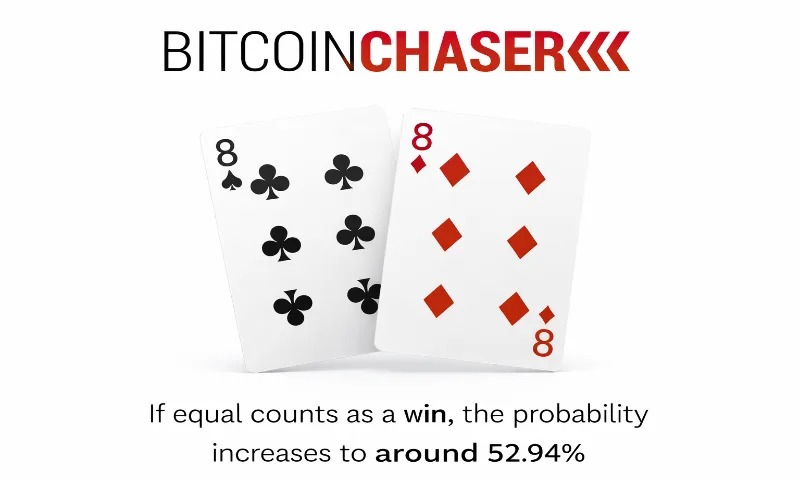
To show how this works in practice, take an example where the current card is an 8. In a standard 52-card deck, with one 8 already revealed, 51 cards are remaining:
- Higher cards → 24
- Lower cards → 24
- Equal cards → 3
From here, the odds depend on how equal cards are treated.
If equal counts as a loss, both higher and lower sit at 24 / 51, or around 47.06%. This creates a near-neutral position, slightly against you once the house edge is applied.
If equal is treated as a push, those 3 cards are removed from the equation. This leaves 24 higher and 24 lower out of 48, giving a true 50/50 decision.
If equal counts as a win, those 3 cards are added to your winning outcomes. This brings the probability up to 27 / 51, or around 52.94%, giving you a small edge on each decision.
Most modern crypto Hi-Lo games treat equal cards as either a push or a win, which improves player value compared to versions where equal counts as a loss.
Hi-Lo is not about guessing correctly. It is about only playing when the odds are clearly in your favour and avoiding decisions where that edge disappears.
The Three Real Strategies in Hi-Lo
There are only three legitimate approaches to Hi-Lo, and all of them come down to how you handle probability and risk.
The conservative approach is the closest thing to optimal play. You only take strong probability positions and exit once the edge starts to disappear. This keeps variance low and aligns best with high RTP play, especially on platforms like Gamdom or Stake.
The balanced approach allows you to extend rounds slightly. You take favourable positions but continue to make a few decisions to build a multiplier. The key here is recognising when the card moves into a neutral zone and exiting before the edge disappears.
The aggressive approach is where players chase larger multipliers by continuing through multiple rounds regardless of probability strength. This is where variance increases sharply, and mathematically, this is where expected value starts to work against you.
There is no system beyond this. Everything else is just variation of these three approaches.
Why Most Players Lose
Hi-Lo does not hide its probabilities. It shows them clearly.
Players lose because they ignore them.
Two consistent mistakes:
- continuing on neutral cards
- chasing streaks after early wins
As soon as you move away from favourable probability decisions, your long-term return drops below the RTP baseline.
Cash-Out Strategy
This is the most important part of Hi-Lo.
Each correct decision increases your multiplier, but it also increases your exposure to losing everything. The longer you continue, the more likely it becomes that you will hit a losing card.
Strong players treat Hi-Lo as a sequence of value decisions, not a streak game. Once the edge reduces, the correct decision is to exit.
This is where most players fail, not because of bad luck, but because of poor stopping points.
Bankroll Control
Hi-Lo feels low risk due to its high RTP, but it can still lead to quick losses if approached incorrectly.
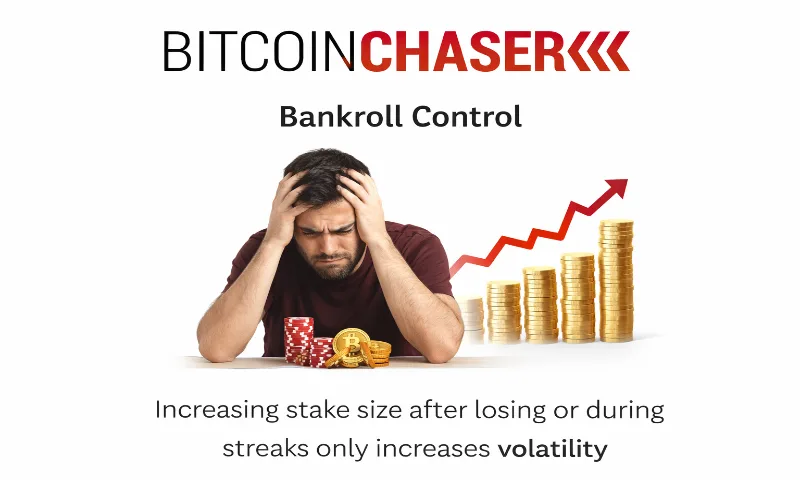
The key is stability. Keeping stake size consistent and avoiding reactive increases is critical. The moment you start increasing bets after losses or during winning streaks, you introduce unnecessary volatility.
This is also why progression systems like Martingale are flawed in Hi-Lo. They do not change probability and simply increase risk exposure.
Hi-Lo is one of the best games for extracting value outside the base game.
Because RTP is already high, combining it with:
can significantly improve your overall return.
This is where platforms like Gamdom become even stronger. Starting from a zero-edge base and adding rewards on top creates the best overall value environment.
Final Thoughts
Hi-Lo stands out among provably fair Originals because of its simplicity and transparency. Every decision is based on clear probabilities, and every outcome can be verified, removing the uncertainty found in traditional casino games.
That doesn’t mean it is easy to beat. The edge comes from understanding when the odds are in your favour and having the discipline to act on it. Players who consistently take strong probability spots and avoid unnecessary risk will always perform better over time.
When combined with high RTP platforms and reward systems, Hi-Lo becomes one of the most efficient games for value. It is not about chasing long streaks, but about making controlled, repeatable decisions within a provably fair system.
If you enjoy provably fair games, be sure to check out our selection of the best provably fair casinos to find the strongest platforms available.
Source link