How to buy stocks: The simple & effective 3-point post-earnings check | investingLive
Key takeaways for stock investors and swing traders
- OKLO was already trading below its post-earnings anchored VWAP before Friday’s sharp drop.
- Thursday’s rally into that VWAP area was rejected, which was a warning sign.
- Earnings should be judged by the stock’s price reaction, not only by EPS or revenue headlines.
- Anchored VWAP from the latest earnings date is one of the simplest tools investors can use before buying a stock.
- This is not a crystal ball, but it can improve decision quality and reduce emotional buying.
Hindsight is not useless in trading education
Someone in one of the investing groups mentioned that they bought OKLO stock on Thursday. Then Friday arrived, and the daily candle was ugly. Whether we call it a sharp sell-off, a risk-off session, or simply a bad day for many stocks, the result on OKLO’s daily chart was clear: sellers took control.
Now, before anyone says, “It is easy to analyze this in hindsight,” that is true. This specific example is being reviewed after the fact.
But there is nothing wrong with hindsight when it is used properly.
In fact, traders and investors who never review charts in hindsight are missing one of the best learning tools available. Hindsight can teach us, remind us of lessons we already know, and help us recognize patterns that may matter again in the future.
The point here is not to mock anyone who bought OKLO. The point is to turn the example into a simple, practical decision tool.
As the saying goes, this is not about giving the fish. It is about giving the fishing pole.
The simple tool: anchored VWAP from the latest earnings date
When looking at a stock for a possible medium-term buy or swing trade, one of the first questions I ask is very simple:
Where is the stock trading relative to its latest earnings reaction?
Bought OKLO on Thursday but under earnings anchored VWAP
Most investors still focus too much on the headline earnings result. They search for whether the company beat EPS, beat revenue, raised guidance, missed guidance, or gave a confident management statement.
That matters, of course. But the market’s real verdict is usually found in the price reaction.
A stock can “beat earnings” and still go down. A stock can “miss earnings” and still go up. Why? Because the market is not only reacting to the headline numbers. It is reacting to expectations, positioning, valuation, guidance, future growth assumptions, and how institutions want to adjust exposure after the event.
A very simple way to measure the market’s post-earnings opinion is to place an anchored VWAP on the earnings date.
VWAP means volume-weighted average price. In simple terms, it shows the average price where volume has traded from a chosen starting point. If we anchor it to the latest earnings date, it gives us a practical view of the stock’s average post-earnings trading price.
What OKLO was showing before the drop
On the OKLO daily chart, the anchored VWAP from the latest earnings date is shown as the purple line.
Looking at Thursday’s candle, the stock was not clearly above that VWAP. It was below it, and when price tried to move toward that area, it was rejected.
For a stock that is trying to recover after earnings, buyers generally want to see price reclaim that post-earnings VWAP and hold above it. That would suggest the market is beginning to accept higher prices again.
But when price rallies into the anchored VWAP and fails, the message is different. It suggests that supply is still present. It may mean that participants who have been trapped, disappointed, or reducing exposure since earnings are using that rally as a better place to sell.
That does not mean the stock must fall the next day. Nothing in markets is that certain.
But it does mean a Thursday long entry was fighting a clear technical warning.
Why this matters for equity investors
Most people do not have time to sit in front of charts all day. They have jobs, families, portfolios, and other responsibilities.
That is exactly why this type of tool is useful.
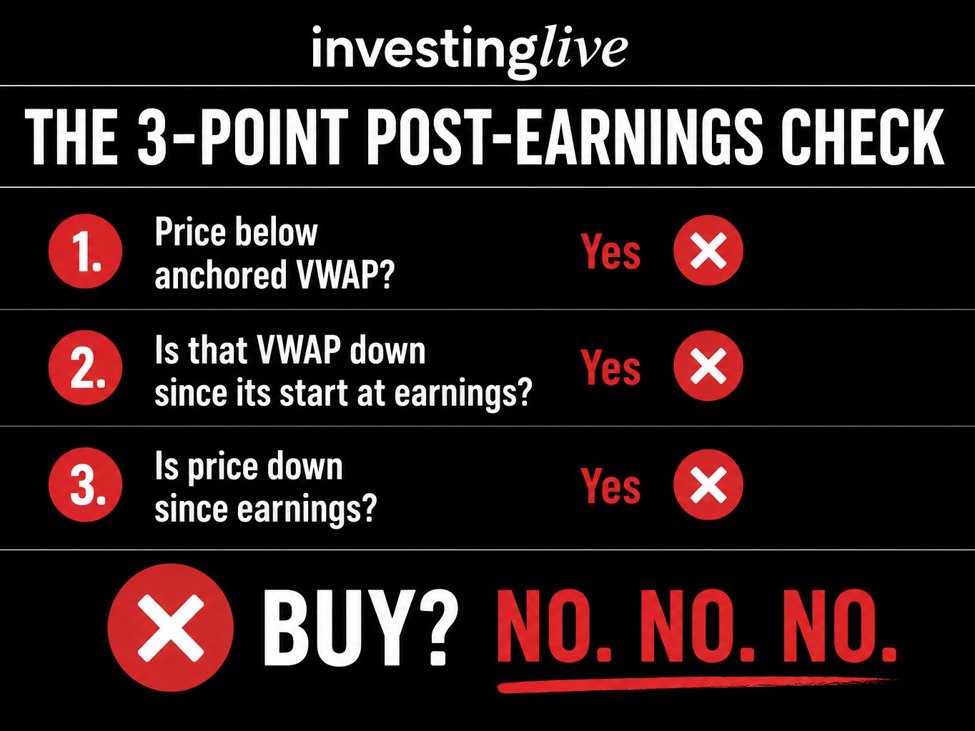
You do not need a complicated system to start improving your stock selection process. Before buying a stock after earnings, do this:
- Open the daily chart.
- Find the most recent earnings date.
- Add an anchored VWAP from that date.
- Ask one simple question: is price above it, below it, or being rejected by it?
- Ideally, check this closer to the daily close, not only in the middle of the session.
If the stock is above the post-earnings VWAP and holding it, the setup may be healthier.
If the stock is below the VWAP and rejecting from it, the buy case is weaker.
If the stock is sitting right at the VWAP, then it is usually a decision zone. In that case, patience can be more valuable than rushing.
A practical OKLO lesson (but you will see this with other stocks)
For OKLO, Thursday’s candle was already warning that the stock had not repaired its post-earnings structure. Friday’s large red candle then confirmed that the rejection mattered, at least in the short term.
The lesson is not “never buy OKLO.”
The lesson is this:
Buying a stock below its post-earnings anchored VWAP, especially after a rejection from that VWAP, is usually a lower-quality entry unless there is another strong reason to support the trade.
What would have made the OKLO long idea stronger?
- A daily close back above the anchored VWAP.
- A pullback that holds the VWAP as support.
- A higher low forming after the reclaim.
- Relative strength versus the broader market on a weak day.
- Strong volume accompanying the reclaim, not just a weak bounce.
Without those signs, the stock was still vulnerable.
This is not a crystal ball but you wil see how simple and effective of a tool this is before you buy your next stock. It can save and make you money.
When you consider buying your next stock, put up a chart (TradingView is the typically best for the majority of users, IMHO) and try my tip with anchoring the vwap from the recent earnings date.
Remember…No chart tool offers 100% certainty.
Could OKLO gap higher on the next trading day because of unexpected news, a partnership, an acquisition rumor, or a major company announcement? Of course. Markets can always surprise us.
But the goal is not certainty. The goal is probability.
A simple anchored VWAP check can help investors avoid buying directly into post-earnings supply. It can also help them wait for confirmation before entering a stock that may still be under distribution.
For long-term investors and swing traders, this can be one of the easiest and most effective chart checks available.
It is not the only tool. It should not replace research, risk management, valuation, catalysts, or portfolio discipline.
But before buying a post-earnings dip, it is worth asking:
Has the stock repaired above its post-earnings VWAP, or is it still being rejected by it?
In OKLO’s case, the answer on Thursday was already cautionary. Friday simply made the lesson much louder.
Check out the free investingLive.com Telegram channel where there may some other periodic lessons.