JavaScript Disabled


Click here to meet some of our expert analysts who have traded millions in assets through their best-selling courses, systems, strategies and exclusive trading rooms.
You will gain access to their simple yet highly effective market strategies they’re using in the current market. [Check out the webinar schedule >>]
Gold has been in the headlines lately.
Google “Gold”, and you will find a flurry of articles discussing its soaring price and what might push its momentum in 2024.
This interest is understandable because gold prices have been on a tear for the past couple of months.
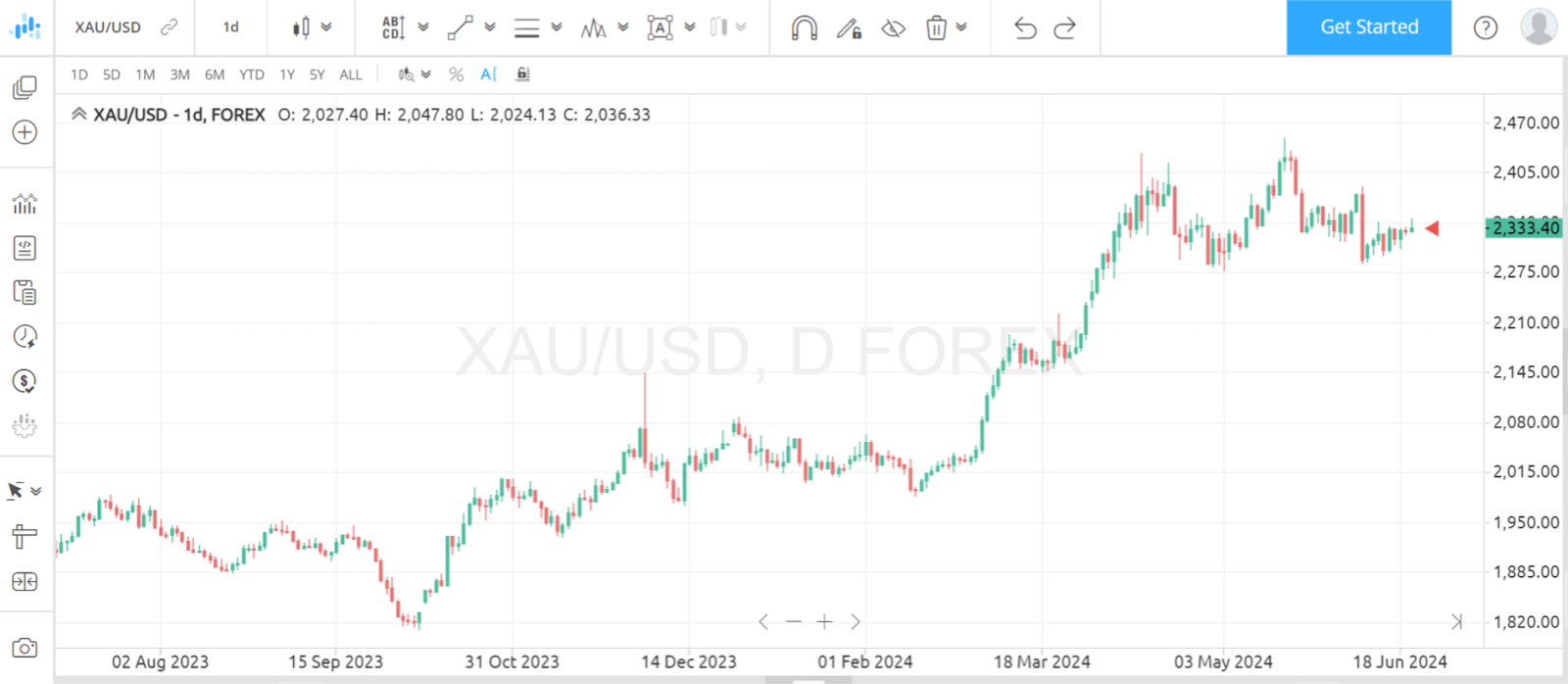
They have been rising from $1,820 per ounce in September 2023 to currently around $2,300 – around 25% increase in about 10 months.
Here’s a look:
Gold’s Stellar Rise
Source: SmartTrader, Market Traders Institute
So, you can say that gold is on every trader’s and investor’s mind of late.
But should it be?
Let’s face it, gold loves drama. It often keeps grabbing headlines as any shift in the economic or political landscape sends its price moving.
And while it’s not crazy to think that the existing market environment could be driving some of the gold price movement, the question is whether the entire price movement could be explained by these issues which have been going on for months now. That seems unlikely.
Take the recent narrative around gold, for example – it’s that a few factors are driving prices higher.
What are these factors?
Well, a crucial one has to be the fluctuating value of the US dollar against the developed and emerging market currencies. You see, gold is priced in US dollars. Meaning, it is purchased and sold using the US dollar globally. Therefore, a weaker dollar makes gold appear more affordable for investors using other currencies.
Next, we have the US Federal Reserve and its interest rate adjustments. The US central bank stopped raising interest rates after July 2023 and with encouraging economic data, it is now considering even lowering them. All of that has made the US government bonds less appealing compared to gold because of the lower yields they offer. So, as a trader or investor you would want to make a better penny on gold than parking your money in these bonds.
Then there’s the rise in global inflation, geopolitical tensions, and market volatility. All of these factors have made gold a more appealing safe-haven asset for investor’s portfolios seeking to navigate market risk.
But you may ask – don’t these factors always keep changing and affecting gold prices?
And you’re right – yes, they do.
There are times (and sometimes decades) where gold outperforms the market. This is seen mostly during periods of high inflation and recessions. On the contrary, there are times where gold underperforms.
So, how does one know whether the ongoing rally in gold has enough legs, and if the yellow metal is undervalued or overvalued?
One metric could be to track the gold buying data, and it’s good to pay heed to global central banks here.
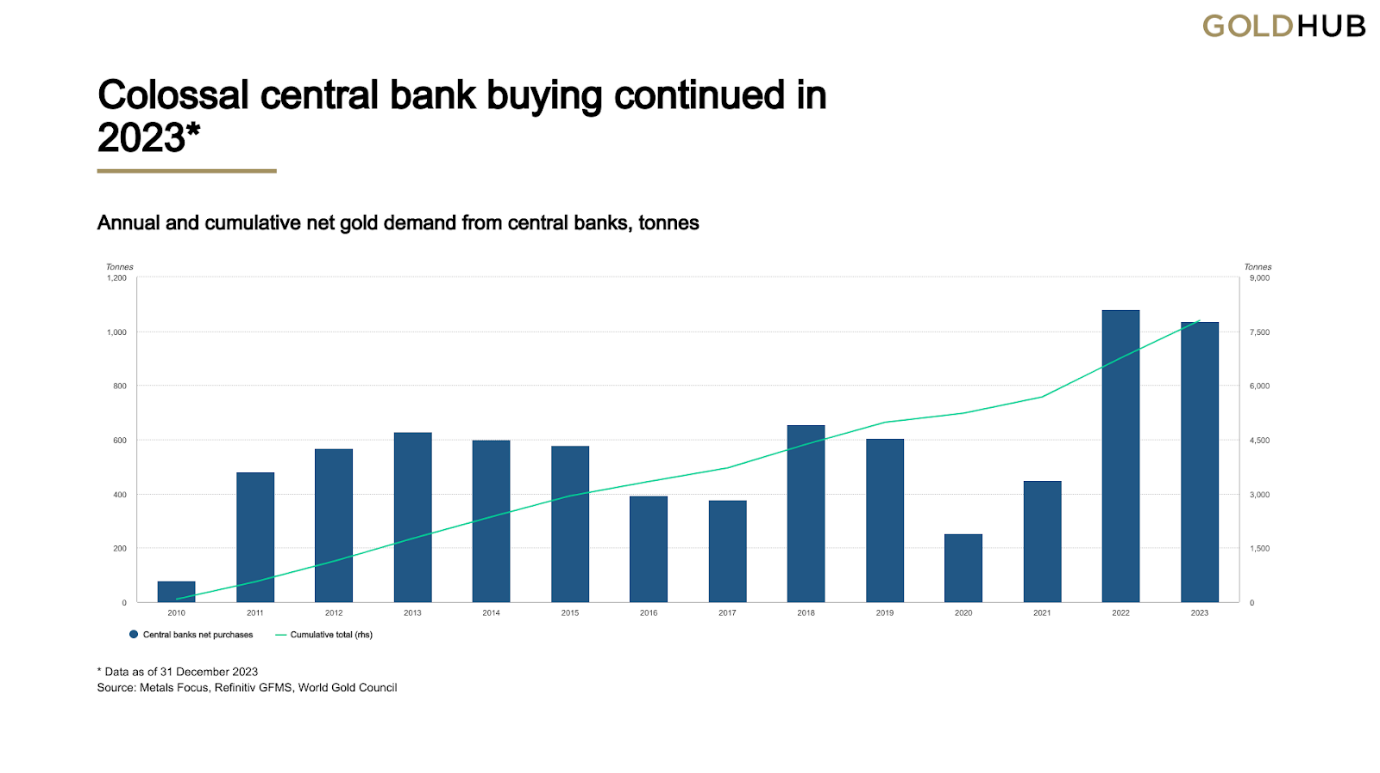
Because global central banks have been acting like billionaires emptying their wallets on gold. Their demand for gold hit a record in 2022, totalling 1,136 tonnes, marking the highest level of annual gold demand by central banks on record back to 1967.
While this demand cooled at 1,037 tonnes in 2023, it is close to the number seen in 2022 and makes 2023 the second consecutive year of central banks significantly adding to their gold reserves.
Here’s a look…
Central Bank Gold Buying in 2023
Source: World Gold Council
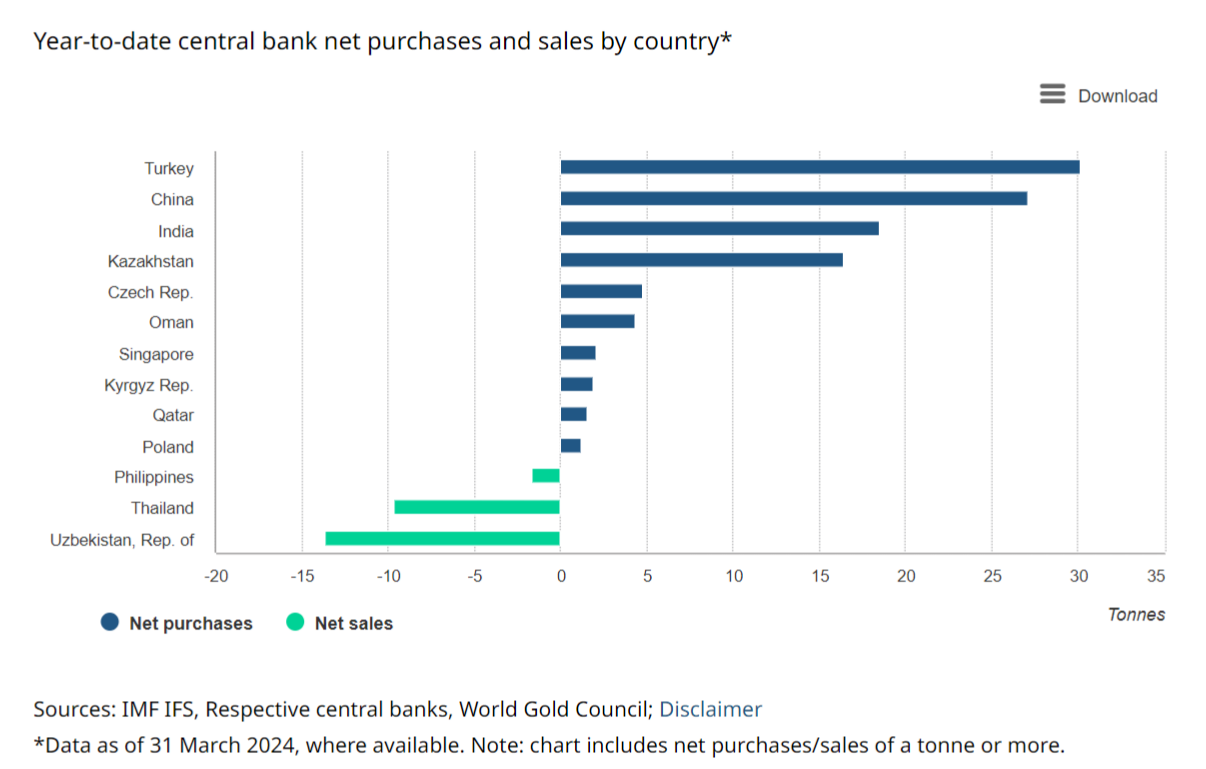
What about 2024? Well, the trend continues!
Central banks went on lapping large quantities of gold in 2024.
Central Bank Gold Buying in 2024
Source: World Gold Council
So, gold is clearly the new hotness among central bankers.
However, the problem with gold buying data is that it gives you just the number of gold purchased, without any comparison for analysis.
And here’s where the data on money supply comes in handy.
What’s money supply, you ask?
In simpler terms, it is the total amount of currency in an economy. Because there are many definitions of money and the things that go into it, the central banks and economists usually classify it into M0, M1, M2, and M3.
In the US, M2 money supply is the broadest measure of money supply and tracks cash, checking deposits, savings deposits, and money market funds in the US.
You may be wondering, how does all of this help in gauging gold’s trend
Well, if history is any evidence, it is clear that when the money supply increases, the gold price follows. In fact, as per the World Gold Council, gold has reliably tracked global money supply growth for the last 50 years.
And when we say money supply, we’re talking about dollars. It’s because of two main reasons – one, the dollar is the global reserve currency, and two, gold is priced in U.S. dollars on most global exchanges.
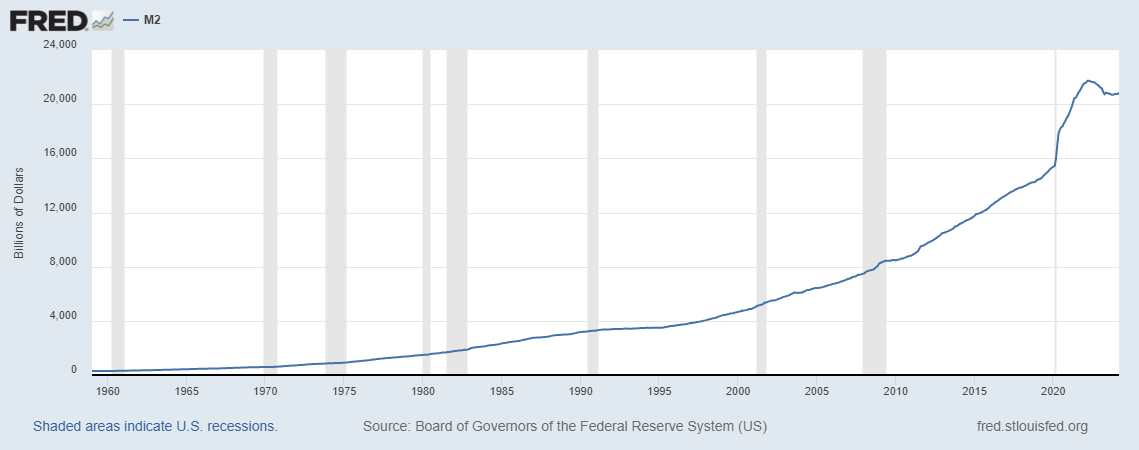
How has the M2 money supply in the US been over the last few years? It’s been on a one way rise!
As the central banks continued with their accommodative monetary policies, they flushed more money into the market by printing dollars, and the M2 supply went on rising.
In fact, M2 money supply has been growing exponentially since the Federal Reserve started tracking the metric back in 1959.
M2 Money Supply Over Years in the US
Source: Board of Governors of the Federal Reserve System (US)
Now, a decent M2 money supply is generally desirable, but there’s a problem when it spikes overboard.
Because a significant rise in M2 would mean too much money sloshing around in the economy. It might be a sign of inflation – and a classic case of too much money chasing the same or less amount of goods and services, which can erode the value of the currency and other assets.
This could prompt market participants towards the safe-haven gold as a hedge against a weakening currency. Moreover, during such times, central banks may turn to gold to protect their reserves from the impacts of inflation.
If you want to take this analysis further, there’s something called the Gold/M2 ratio which is derived by dividing the price of gold by M2 money supply.
What this ratio basically tells you is how overpriced or underpriced gold is compared to the money supply in the market. When the ratio is high, it suggests gold might be overvalued relative to the dollar. Conversely, a low ratio might signal an undervalued gold.
But do note that while money supply offers valuable insights, it’s not the sole factor to consider. Investors should also explore other metrics like Gold exchange traded funds (ETFs) and the gold-to-silver ratio for a more nuanced analysis.
While no one can tell for sure whether gold will continue its rise, the more important question for investors and market participants should be ‘Is there an investing case for gold in 2024?’. And the answer depends on your risk tolerance, trading or investment goals, and how gold compares to other investment options.
Also, know that apart from earning returns, gold is highly considered as a portfolio investment to improve diversification and hedge against the risks of fiat money.
So, there are compelling arguments for and against gold, and the link between gold and money supply is an interesting one to follow.
Who knows, the recent surge in gold prices and money supply might be telling us more about the future than the current market environment. It could be hinting at a bigger story about the future of our financial system. Only time will tell what unfolds and we’ll have to wait and see.
This brings us to…
What Should Investors and Traders Do?
Well, first of all, it’s important to keep in mind that gold prices can be volatile, and there are no guarantees that prices will continue to move one way up. Moreover, investing or trading in gold can differ from person to person depending on their return expectations, risk appetite, and time horizon.
As far as gold investments go, one option is to invest in physical gold, such as gold bars or coins. This can be a good choice for investors who are looking for a long-term store of value. Another option is to invest in gold exchange-traded funds (ETFs) or gold bonds, which provide exposure to the price of gold without the need to physically hold the metal. Traders may consider trading gold futures or options, which allow for more short-term speculation on the price of gold.
Traders can also potentially profit from central banks buying gold by taking advantage of the correlation between gold and the U.S. dollar. When central banks buy sizable gold, it can lead to a potential decrease in the value of the U.S. dollar relative to other currencies. Traders can take advantage of this trend by tracking this trend and strategizing their trades accordingly.
In conclusion, while there are no guarantees that gold prices will continue to rise in the future, gold can provide a valuable diversification tool for investors and traders looking to protect their portfolios against volatility and inflation.
If you’re someone looking to profit from the above trend, join our top analysts in the upcoming LIVE webinar. Click here to save your spot >>
And if you’re looking to ace your trading game, we’ve created something that matches your specific trading needs. Here is your new trading experience from MTI
We have more data…We have an army of best currency specialists…And a highly specialized algorithm with a built in strategy! No matter if it’s forex, stocks, options, or cryptos…this ULTIMATE trading toolkit is what our in-house experts use to extract money from the market!
Check it out by clicking here.
Predictions are not a guarantee of this or any result. Information provided on this prediction is for general information purposes only. We offer no representation or warranty with regard to this prediction. No prediction is personalized or otherwise directed at any individual or particular circumstances. We disclaim and will not accept any liability for losses associated with this prediction.
Some of the information presented may be provided by a third party. MTI is not responsible for any claims, products, services, or information provided by any third parties. MTI does not provide any warranty or representation as to any third party data. MTI expressly disclaims any responsibility and accepts no liability with respect to such third party information, services, and/or products. The third party data is provided for convenience only and is in no way meant to imply an endorsement by MTI or any other relationship.
Please see our full risk disclaimer.
The post Money Supply’s Influence on Gold and Strategies to Maximize Gains appeared first on Market Traders Institute.
Source link