Nifty’s “Perfect Bounce”: A New Bull Trend is Born from a Cyclical Low – Bramesh’s Technical Analysis
A Hollow Victory: The Anatomy of a Classic Short Squeeze
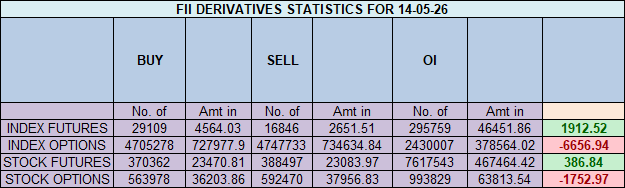
On May 14, 2026, the Nifty market delivered a powerful 237-point rally, giving the appearance of a major bullish reversal with strong institutional backing. The headline showed Foreign Institutional Investors (FIIs) as massive net buyers of 9,414 contracts. However, this surface-level strength is a profound deception.
The day’s most critical and revealing event was a colossal collapse in net Open Interest (OI) of 9,752 contracts. This is not the signature of a new, healthy bull run. This is the unmistakable footprint of a violent, late-stage short squeeze, built on a foundation of profound trend exhaustion and participant capitulation.
Decoding the Data: The Mechanics of a Hollow Rally
1. The FIIs’ “Deceptive” Buy: This is a Strategic Exit, Not a New Entry
The headline “buy” figure is a classic misdirection. The granular breakdown exposes the FIIs’ true, brilliant strategy. The definitive signal that this was not a new bullish initiative is that they covered (bought back) a colossal 10,060 short contracts.
The astrological reason for this action is that the market reached a point of climactic exhaustion where professional players saw the perfect opportunity to exit. The catalyst for their buying was the mass panic, which provided the ideal liquidity for a massive profit-taking operation. Simultaneously, they added only 2,203 new long contracts, likely as a tactical hedge. This was a massive profit-taking operation. They were not building a new bull case; they were cashing in their winning bearish tickets. Their overall positioning remains profoundly bearish at 11:89, proving they have not changed their core view; they have simply secured their profits.
2. The Main Event: The Great Client Capitulation
The most stunning number of the day came from the retail clients. They covered (sold) a staggering 10,610 long contracts, a classic sign of capitulation where long-time holders can no longer stand the pain and are forced to sell, often right at the market’s turning point. This massive selling provided the bids the FIIs needed to cover their shorts.
This dual-sided capitulation is why the OI collapsed so violently. The market is “hollowing out.”