Retail Traders Enter Faster Markets but Find Decisions Slowing Under AI Overload
A login screen, a live chart, and a platform that already feels like it
is moving faster than they are. In reference to Rupert Osborne’s article: “Everyone Talks About AI’s Power. Few Ask What It Does to
Financial Decisions”.
Singapore
Summit: Meet the largest APAC brokers you know (and those you still don’t!).
The article raises an important question: what does AI actually do to
financial decision-making? It is a question that deserves more attention,
particularly from the perspective of the end user—the retail trader.
The financial industry is in the midst of an AI-driven transformation.
From back-office automation to market analytics and marketing engines, brokers
and traders now have access to an unprecedented range of tools, data, and
insights. On the surface, this looks like clear progress. However, there is a
less discussed consequence of this rapid evolution: cognitive overload.
Consider a new trader logging into a trading platform for the first time.
Within seconds, they are expected to make a series of complex decisions: which
asset to trade, when to enter or exit, how much capital to allocate, and what
level of leverage to use.
At the same time, they are exposed to a constant stream of stimuli:
promotional banners, pop-ups, trading signals, alerts, market analysis, data
feeds, and multi-channel notifications. AI systems can surface thousands of
potential opportunities instantly, but traders must still process and filter
this information in real time.
An “opportunity-rich environment” can quickly feel like entering a candy
store while being asked to make high-stakes financial decisions.
For beginners, this is compounded by uncertainty, fear of loss, and lack
of confidence. The result is often the opposite of what brokers intend: doubt,
confusion, and reduced decision quality, ultimately contributing to higher
churn rates.
AI as Both Solution
and Amplifier
AI is widely positioned as a solution to complexity—and in many ways, it
is. Yet it is also a major driver of information inflation: more signals, more
insights, more recommendations, more content.
The assumption is that more information leads to better decisions.
Behavioral science suggests otherwise.
Human attention is finite. When cognitive capacity is overwhelmed,
individuals do not necessarily become more rational—they become more reactive,
more hesitant, more confused, or disengaged altogether.
This leads to a critical shift in perspective:
The bottleneck in trading is not access to information, but the ability
to process and prioritize it.
Traders’ Attention
is the New Currency
In this environment, attention becomes the most valuable—and
scarce—resource.
Every alert, banner, or recommendation competes for it. As attention
fragments across competing stimuli, clarity of thought declines. Decision
quality weakens, and the ability to manage stress, losses, and uncertainty
deteriorates.
For less experienced traders, this often
results in hesitation, missed opportunities, overtrading driven by noise,
reduced confidence, and faster churn.
In short, traders need the cognitive space to direct their attention—not
have it continuously captured.
From Information
Abundance to Decision Clarity
Decision-making is not a “buy/sell” click. It is a process of structured
information processing.
Brokers are not responsible for traders’ decisions or outcomes. However,
they are responsible for providing an environment where better decisions can be
made.
The next phase of trading platform innovation should therefore focus less
on increasing information volume and more on improving information usability.
This requires a shift from generic, feature-driven design to
behavior-aware personalization.
At the same time, brokers face a delicate balance: protecting traders
from information overload while preserving their ability to explore data independently.
Delivering the right information, at the right time, in the right context, for
the right user is not trivial. It requires a strong grounding in cognitive
theory and decision-making models, applied dynamically to live trading
environments.
Yoni Assia: Agents trading markets is obvious.
“What would you do if you were AI and you realized that in order to buy GPU and get more power, all you need to do is figure out how to trade the markets.”
Coming soon: agents collaborating to generate capital, keeping money in… pic.twitter.com/JfqjlPkTlM
— Milk Road (@MilkRoad) May 9, 2026
The Business Case
for Clarity
Traders who are able to filter, process, and integrate information
effectively tend to remain active for longer than those exposed to uncontrolled
data streams.
For brokers, a personalized, low-noise trading environment can support
more consistent trading behavior, improve learning from past decisions,
increase trader confidence over time, and build stronger long-term resilience.
In other words, clarity is directly linked to survivability and churn.
This reframes personalization from a UX enhancement into a core business
driver.
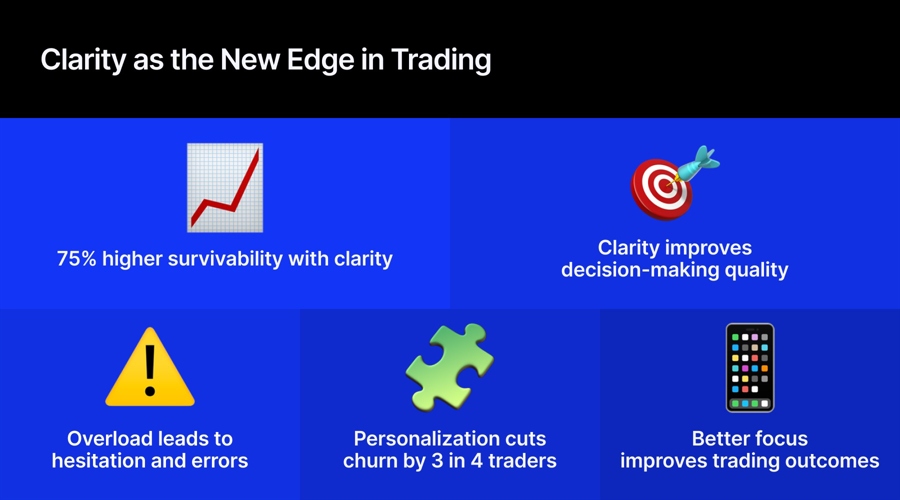
Data from CPattern indicates a 75% increase in trader survivability when
the right personalized information is delivered effectively—highlighting its
significance for both brokers and traders.
Conclusion: Less
Noise, Better Decisions
The AI revolution will continue to expand the volume of available
information. The key challenge is no longer who generates more data, but who
enables traders to make sense of it.
Higher trading activity is not driven by more inputs, but by better
information processing, clearer thinking, sustained focus, and the ability to
manage emotional dimensions such as fear, stress, and excitement.
Ultimately, in an AI-saturated trading environment, clarity—not
complexity—becomes the defining competitive advantage.
A login screen, a live chart, and a platform that already feels like it
is moving faster than they are. In reference to Rupert Osborne’s article: “Everyone Talks About AI’s Power. Few Ask What It Does to
Financial Decisions”.
Singapore
Summit: Meet the largest APAC brokers you know (and those you still don’t!).
The article raises an important question: what does AI actually do to
financial decision-making? It is a question that deserves more attention,
particularly from the perspective of the end user—the retail trader.
The financial industry is in the midst of an AI-driven transformation.
From back-office automation to market analytics and marketing engines, brokers
and traders now have access to an unprecedented range of tools, data, and
insights. On the surface, this looks like clear progress. However, there is a
less discussed consequence of this rapid evolution: cognitive overload.
Consider a new trader logging into a trading platform for the first time.
Within seconds, they are expected to make a series of complex decisions: which
asset to trade, when to enter or exit, how much capital to allocate, and what
level of leverage to use.
At the same time, they are exposed to a constant stream of stimuli:
promotional banners, pop-ups, trading signals, alerts, market analysis, data
feeds, and multi-channel notifications. AI systems can surface thousands of
potential opportunities instantly, but traders must still process and filter
this information in real time.
An “opportunity-rich environment” can quickly feel like entering a candy
store while being asked to make high-stakes financial decisions.
For beginners, this is compounded by uncertainty, fear of loss, and lack
of confidence. The result is often the opposite of what brokers intend: doubt,
confusion, and reduced decision quality, ultimately contributing to higher
churn rates.
AI as Both Solution
and Amplifier
AI is widely positioned as a solution to complexity—and in many ways, it
is. Yet it is also a major driver of information inflation: more signals, more
insights, more recommendations, more content.
The assumption is that more information leads to better decisions.
Behavioral science suggests otherwise.
Human attention is finite. When cognitive capacity is overwhelmed,
individuals do not necessarily become more rational—they become more reactive,
more hesitant, more confused, or disengaged altogether.
This leads to a critical shift in perspective:
The bottleneck in trading is not access to information, but the ability
to process and prioritize it.
Traders’ Attention
is the New Currency
In this environment, attention becomes the most valuable—and
scarce—resource.
Every alert, banner, or recommendation competes for it. As attention
fragments across competing stimuli, clarity of thought declines. Decision
quality weakens, and the ability to manage stress, losses, and uncertainty
deteriorates.
For less experienced traders, this often
results in hesitation, missed opportunities, overtrading driven by noise,
reduced confidence, and faster churn.
In short, traders need the cognitive space to direct their attention—not
have it continuously captured.
From Information
Abundance to Decision Clarity
Decision-making is not a “buy/sell” click. It is a process of structured
information processing.
Brokers are not responsible for traders’ decisions or outcomes. However,
they are responsible for providing an environment where better decisions can be
made.
The next phase of trading platform innovation should therefore focus less
on increasing information volume and more on improving information usability.
This requires a shift from generic, feature-driven design to
behavior-aware personalization.
At the same time, brokers face a delicate balance: protecting traders
from information overload while preserving their ability to explore data independently.
Delivering the right information, at the right time, in the right context, for
the right user is not trivial. It requires a strong grounding in cognitive
theory and decision-making models, applied dynamically to live trading
environments.
Yoni Assia: Agents trading markets is obvious.
“What would you do if you were AI and you realized that in order to buy GPU and get more power, all you need to do is figure out how to trade the markets.”
Coming soon: agents collaborating to generate capital, keeping money in… pic.twitter.com/JfqjlPkTlM
— Milk Road (@MilkRoad) May 9, 2026
The Business Case
for Clarity
Traders who are able to filter, process, and integrate information
effectively tend to remain active for longer than those exposed to uncontrolled
data streams.
For brokers, a personalized, low-noise trading environment can support
more consistent trading behavior, improve learning from past decisions,
increase trader confidence over time, and build stronger long-term resilience.
In other words, clarity is directly linked to survivability and churn.
This reframes personalization from a UX enhancement into a core business
driver.
Data from CPattern indicates a 75% increase in trader survivability when
the right personalized information is delivered effectively—highlighting its
significance for both brokers and traders.
Conclusion: Less
Noise, Better Decisions
The AI revolution will continue to expand the volume of available
information. The key challenge is no longer who generates more data, but who
enables traders to make sense of it.
Higher trading activity is not driven by more inputs, but by better
information processing, clearer thinking, sustained focus, and the ability to
manage emotional dimensions such as fear, stress, and excitement.
Ultimately, in an AI-saturated trading environment, clarity—not
complexity—becomes the defining competitive advantage.