SpaceX IPO: What Investors Need to Know Before the Listing – R Blog – RoboForex


SpaceX is preparing for one of the most anticipated IPOs in market history. Elon Musk’s company plans to list on Nasdaq under the ticker SPCX at a valuation of around 1.75 trillion USD. In this article, we break down SpaceX’s business model, its three key growth segments, the financial figures, and what it all means for investors.
In Brief
- SpaceX plans to list on Nasdaq under the ticker SPCX on June 12.
- The company’s estimated valuation is 1.75 trillion USD.
- Starlink is already profitable: 2025 revenue is 11.39 billion USD.
- AI is the most expensive segment with a Q1 2026 operating loss of 2.47 billion USD.
- SpaceX could be added to the Nasdaq-100 in 15 days after its IPO.
- The Tesla 2010 parallel: a loss-making company with an enormous addressable market.
SpaceX IPO: The Key Numbers
SpaceX plans to go public on Nasdaq under the ticker SPCX, with trading scheduled to begin on June 12, 2026. The company aims to raise up to 75 billion USD at a valuation of approximately 1.75 trillion USD. The estimated share price is 105 USD, following a 5-for-1 stock split approved by shareholders.
If the offering proceeds on these terms, SpaceX will become the largest IPO in market history and immediately rank among the most valuable publicly traded technology companies in the world. Investor attention is focused on three business segments: Starlink satellite internet, the Starship rocket program, and AI services.
SpaceX and Tesla: Why the Comparison Makes Sense
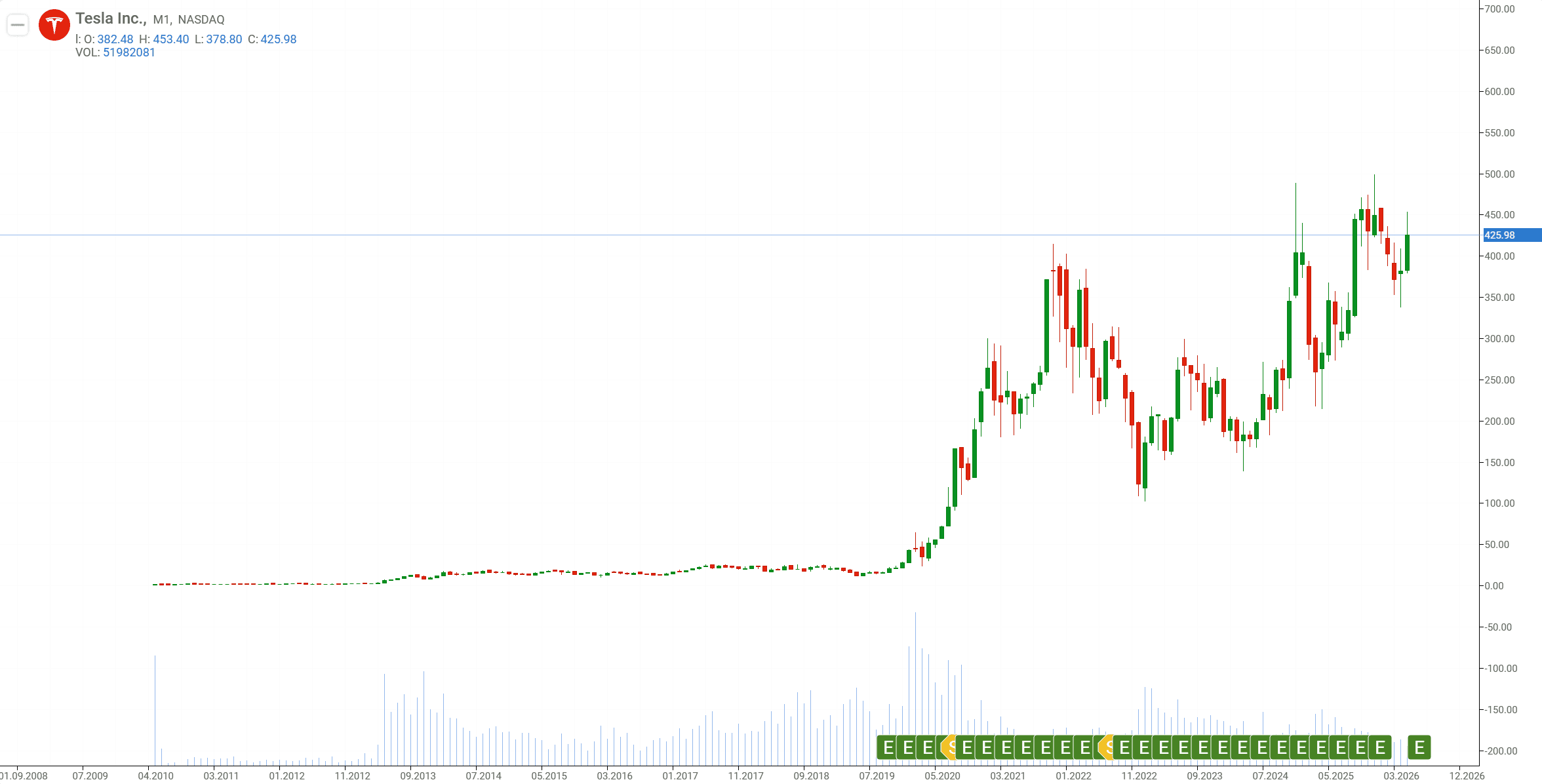
When Tesla went public in 2010, it was a bet on a company that had only promised to transform the automotive market. Shares priced at 17 USD, the offering raised around 226 million USD, and the market cap on day one reached 2.2 billion USD. Investors were not investing in current EV market, which was not existed at that point, but rather the future the market and Tesla’s chance to lead it.
Investors who bought Tesla shares during its IPO saw their investment increase roughly x375. Tesla later completed two stock splits: 1-for-5 in 2020 and 1-for-3 in 2022. A single share bought at IPO for 17 USD would have become 15 shares — at a price of 425 USD per share in early June 2026, that original 17 USD investment would be worth approximately 6,375 USD.
The SpaceX IPO follows a similar logic, but at a fundamentally different scale. SpaceX operates across three business segments: Space, Connectivity, and AI. Its pre-IPO valuation of 1.75 trillion USD is nearly 800 times Tesla’s market cap on its first day of trading.
The key difference lies in the competitive barrier. In the automotive industry, large incumbents already had factories, engineers, suppliers, and capital — they simply needed to adapt to electric vehicles. In the space industry, the barriers are far higher: reliable rockets, reusable systems, a track record of successful launches, regulatory approvals, government customer relationships, and a proprietary satellite network. Replicating that path is difficult even at the national level.
Starlink: The Profitable Core
Starlink is SpaceX’s most mature asset. The service has grown well beyond an experiment and is now a large-scale satellite internet business. According to Reuters, Starlink app downloads and monthly active users more than doubled year-over-year in Q1 2026, with the subscriber base surpassing 10 million as of February 2026.
The Connectivity segment, which includes Starlink, delivers solid financial results. In 2025, it generated 11.39 billion USD in revenue and 4.42 billion USD in operating profit. In Q1 2026, revenue reached 3.26 billion USD with operating profit of 1.19 billion USD. This makes Starlink the primary cash engine for SpaceX — funding the more capital-intensive Starship and AI infrastructure efforts.
Direct-to-device mobile connectivity represents an additional growth vector. In May 2026, the FCC approved the sale of part of EchoStar’s spectrum to SpaceX and AT&T. SpaceX is acquiring 65 MHz of spectrum for 17 billion USD to develop the next generation of Starlink with direct satellite-to-device connectivity — eliminating the need for ground infrastructure. This is a potential entry into the mobile communications market serving hundreds of millions of users worldwide.
Starship: The Long-Term Space Bet
Starship is SpaceX’s fully reusable launch system, designed to serve as the backbone of the company’s future space operations. If the system reaches regular operations, SpaceX could dramatically reduce the cost of getting payloads to orbit — strengthening its position in commercial missions, Starlink deployment, government contracts, and lunar programs.
Financially, the Space segment still requires significant investment. In 2025, it generated 4.09 billion USD in revenue but recorded an operating loss of 657 million USD. In Q1 2026, revenue was 619 million USD with an operating loss of 662 million USD. The FAA has already reviewed the possibility of increasing the launch frequency at the Boca Chica facility to 25 orbital launches per year — a key step toward transitioning Starship from a test program to regular commercial operations.
AI: The Biggest Investment and the Biggest Losses
Following the merger with xAI, SpaceX gained access to a new market: AI services and products for enterprise clients. The company estimates its total addressable market across all segments at 28.5 trillion USD, of which 26.5 trillion USD is attributed to AI services alone.
In practice, this is the most expensive segment in the company right now. In 2025, the AI segment generated 3.20 billion USD in revenue against an operating loss of 6.35 billion USD. In Q1 2026, revenue was 818 million USD with an operating loss of 2.47 billion USD. Capital expenditure on AI reached 12.72 billion USD in 2025, and an additional 7.72 billion USD was spent in Q1 2026 alone — more than SpaceX spent on the Space and Connectivity segments combined.
If Grok, X, and enterprise AI services gain meaningful traction, this segment could significantly change the valuation story for SpaceX. For now, it accounts for the bulk of losses and capital deployment.
Financials and Valuation
SpaceX enters the public market as a fast-growing but capital-intensive company. In 2025, its revenue reached 18.67 billion USD, but the year closed with a net loss of approximately 4.94 billion USD. In Q1 2026, revenue grew 15.4% year-over-year to 4.69 billion USD, while the net loss widened to more than 4.27 billion USD from 528 million USD in the same period a year earlier.
The 1.75 trillion USD valuation seems quite high. In December 2025, secondary market transactions valued the company at 800 billion USD — at 421 USD per share. The near-doubling of valuation in a matter of months means the market is already pricing in rapid Starlink growth, successful Starship commercialization, and a transition of the AI segment from a loss center to a major business.
The Tesla parallel holds here too: the company was loss-making at IPO but that did not prevent consistent share price appreciation over the following decade. For investors, the central question is valuation: what entry price is justified given the current level of uncertainty.
Why SpaceX Is Going Public
SpaceX is going public because its projects require more capital, and raising it on the private market is becoming increasingly difficult. Starlink already generates significant cash flow for the company, but that is not enough to simultaneously fund Starship, expand the satellite network, and develop the AI segment that came with the xAI merger. In its IPO filing, the company indicated that proceeds are planned for expanding AI computing capacity, improving rockets, and developing satellite constellations.
The main driver behind the growing capital need is xAI. Before the merger, SpaceX’s investment story was straightforward: a profitable Starlink funding rockets, Starship, and the satellite network. After adding the AI segment, the company gained access to a major new market, but also significantly higher costs. A public listing is the logical next step — SpaceX could continue raising money privately, but going public opens access to a much broader investor base: large funds, ETFs, and retail investors.
For a company simultaneously building rockets, launching satellites, operating Starlink, developing Starship, and entering the AI market, private capital may no longer be sufficient at the required scale. The IPO could also accelerate the AI business. OpenAI, Anthropic, and others in the space are investing heavily in data centers, chips, and model training. As a public company, SpaceX could raise capital faster and potentially on better terms than private competitors, which may ultimately help it establish a leading position in the AI market.
Nasdaq-100 Inclusion as an Additional Catalyst
The SpaceX IPO could be supported by a rapid inclusion in the Nasdaq-100. Since May 1, 2026, Nasdaq has applied the Fast Entry rule: if a newly listed company enters the top 40 of Nasdaq-100 constituents by market capitalization and meets the index’s other requirements, Nasdaq can begin the evaluation process as early as the seventh trading day. Addition to the index is possible within 15 trading days of the IPO.
For SpaceX, this would generate additional demand from index funds and ETFs that must buy the stock to replicate the index composition. Inclusion in the Nasdaq-100 improves liquidity and broadens the institutional investor base. That said, the demand is technical in nature and does not guarantee further price appreciation — once the initial effect fades, the market will focus on SpaceX’s financial results.
What This Means for Investors
The SpaceX is on track to become a technology megacorporation spanning rockets, satellite internet, space infrastructure, AI services, and potentially the future economy beyond Earth. In that sense, SpaceX is starting to resemble the kind of corporation that once only existed in science fiction — one that controls a significant share of the global economy.
With Tesla, Elon Musk demonstrated how to create a new market and change the way consumers think about it. Before Tesla, electric vehicles were considered a niche product. The company shifted the perspective of investors, automakers, and buyers alike. Traditional carmakers accelerated their own EV transitions, and Tesla quickly faced strong competition. Musk understood that a dominant position could not be held indefinitely, which is why he aggressively scaled production capacity.
With SpaceX, the situation for potential competitors is far more difficult. In the automotive industry, incumbents already had factories, suppliers, engineers, brands, and access to capital — they only needed to adapt their production lines to electric powertrains. In the space industry, the barriers are substantially higher. Building reliable rockets, achieving reusability, accumulating a launch track record, obtaining regulatory approvals, establishing government customer relationships, and developing a satellite network in parallel — all of this is difficult to replicate even at the national level, let alone for private companies.
For investors, that is a strong argument for SpaceX’s valuation and a rare opportunity to become shareholders in a company reshaping perceptions of space, connectivity, and the future technology economy. SpaceX has long ceased to be just a rocket company. It is becoming a civilization-scale project. That is why the SpaceX IPO is set to generate extraordinary interest among market participants and stands to be one of the most anticipated listings in the history of the technology sector.
This article is for informational purposes only and does not constitute investment advice or a recommendation to buy or sell any financial instruments. Trading in financial markets involves significant risk. Past performance is not indicative of future results. The price levels and scenarios mentioned are for illustrative purposes only. Always conduct your own research or consult a qualified financial advisor before making investment decisions. RoboForex is not responsible for any losses arising from the use of information provided in this article.
Source link