The Smarter Way to Trade: Understanding Market Episodes – Forex Trading Forum
Most traders are taught to look for trends to find direction, follow it, and stay in the trade as long as possible.
It’s a simple idea, but real markets don’t behave that cleanly.
Whether you’re trading stocks, crypto, forex, or indices, price rarely moves in a straight line, especially intra-day. It may accelerate, stall, reverse, and shift direction, sometimes within the same session. Because of this, experienced traders don’t rely on trends alone. They focus on market episodes or short-term phases that reflect what price is doing right now.
When you start viewing the market through episodes instead of continuous trends, your decision-making becomes sharper, more adaptable so you avoid being on the wrong side of the market by trading an old episode when a new one has begun.
What Is a Market Episode?
A market episode is a period where price shows a clear behavior or bias. That bias could be upward, downward, or sideways.
Unlike trends, which are often viewed as ongoing and stable, episodes are temporary. They form, develop, and eventually come to an end.
Each episode typically includes:
- A starting point where momentum begins
- A phase where price moves or consolidates
- An ending point where behavior shifts or breaks down
The core principle is simple:
Trade the episode that’s happening now and not the one that already happened.
Failing to recognize that shift is where many traders lose consistency and find them fighting the last battle when a new one has started in the other direction.
Chasing the Next Flash: How Headlines Drive Financial Markets
Why Episodes Matter More Than Trends
Trends look obvious in hindsight. On a chart, it’s easy to point to a clean move and imagine how simple it would have been to trade.
In real time, it’s very different.
Markets are dynamic. A strong move can lose momentum quickly, reverse without warning, or transition into consolidation. What looked like a clear trend can suddenly become noise.
Focusing on episodes helps you stay aligned with current market conditions rather than outdated expectations.
Here’s why that matters:
- Direction can change quickly, even within a single session
- Momentum can fade without clear warning signs
- Pullbacks and continuations don’t always behave predictably
- Traders often get stuck holding onto a previous bias
Episodes force you to respond to what the market is doing now rather than what it did earlier.
The Danger of Trading an Old Episode
One of the most common mistakes traders make is staying mentally anchored to a move that has already ended.
This can show up as:
- Entering short positions after the market has already bottomed
- Buying after a move has already peaked
- Expecting continuation when momentum has already weakened
The challenge isn’t just identifying opportunities but recognizing when conditions have changed.
If you continue trading based on a past episode, you’re no longer reacting to the market, you’re arguing with it.
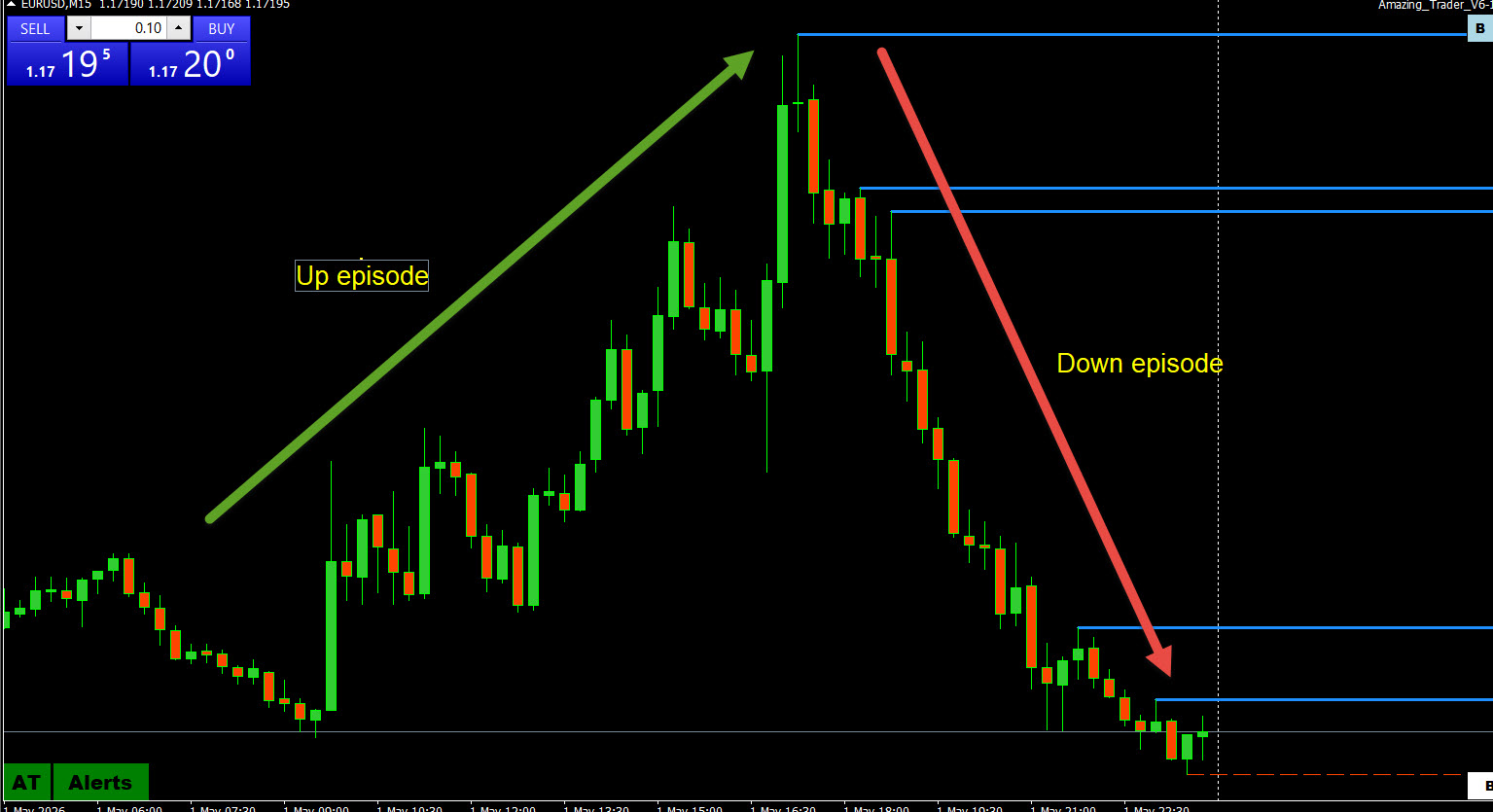
EURUSD Up episode => Down episode
How Episodes Shift in Real Time
Market behavior often changes faster than traders expect.
A strong upward move can suddenly reverse and turn into a downward phase. A trending market can lose energy and transition into sideways consolidation. Sharp wicks or sudden spikes can signal stop runs and the exhaustion of a move.
These transitions mark the end of one episode and the start of another.
You don’t need to predict every shift perfectly but you do need to recognize when the environment is no longer the same.
Hint: When a high or low is in for the day, there are no more stops left to run on that side. When there are no more stops left to run, algos will lose interest on that side and probe the other side in search of stops.
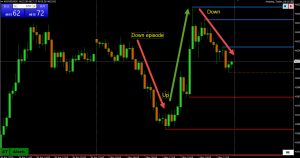
XAUUSD Down episode => Up episode => Down episode
A Simple Analogy: Musical Chairs
Think of market episodes like a game of musical chairs.
As long as momentum is active, price keeps moving in a particular direction. But when participation changes, whether due to new orders, profit-taking, or shifting sentiment, the movement slows or or, as in musical chairs, the music stops.
That’s when the episode ends.
If you keep trading as if the previous move is still in play, you risk being caught off guard when the market changes direction.
To sum up, successful trading isn’t about finding perfect trends. It’s about staying aligned with current conditions.
By focusing on market episodes, you:
- Stay grounded in real-time price action
- Adapt more quickly to changes
- Avoid getting stuck in outdated ideas
In any market, the traders who perform consistently are the ones who adjust as conditions evolve and not the ones who hold onto what used to work.
Source link