Two New Platforms Aim to Fix Broker and Prop Firm Discovery; Can They Avoid Familiar Biases?
The way retail traders discover brokers and proprietary
trading firms is starting to shift, as a growing number of platforms attempt to
impose structure on a fragmented and often opaque market.
Singapore
Summit: Meet the largest APAC brokers you know (and those you still don’t!).
For years, discovery has been dominated by affiliate-driven
review sites, forums, and user-generated ratings, where commercial incentives
and inconsistent standards can make comparisons difficult. As the number of
brokers and prop trading firms expands—and as prop firm models face increasing
scrutiny—new tools are emerging that aim to standardize how traders evaluate
options.
Two such efforts moved forward. FXStreet, in partnership
with Swiset, launched Propinder, a tool focused on prop trading challenges,
while investingLive expanded its broker comparison directory. Notably,
investingLive and Finance Magnates are both part of Ultimate Group.
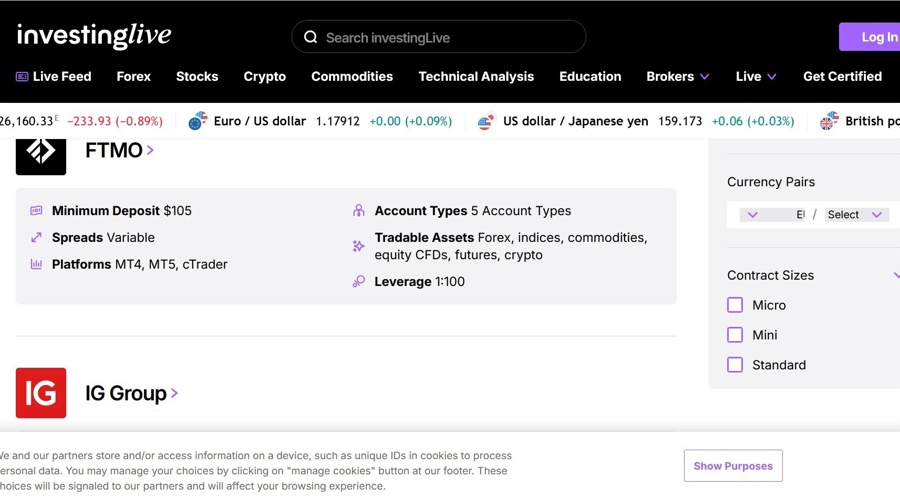
investingLive’s directory is built around structured,
side-by-side comparison. It lists brokers in a standardized format, including
regulatory licenses such as CySEC, FCA, and FSCA, along with platforms like
MT4, MT5, and cTrader, asset classes, minimum deposits, and support details.
Users can filter results by criteria such as regulation or platform.
The directory currently includes 35 brokers, reflecting a
curated rather than exhaustive approach.
Neophytos Papageorgiou, CEO of investingLive and Finance Magnates
Propinder, by contrast, takes a guided route. The tool
asks users to complete a short survey covering experience, platform
preferences, risk tolerance, and location. It then generates three prop trading
challenge suggestions, based on aggregated data from similar user profiles.
Each result highlights rules such as profit targets, drawdown limits, and time
constraints.
Both platforms are positioning themselves as clarity tools
in segments where offerings can appear similar at a glance but differ
significantly in underlying terms.
Neutrality Claims Under Scrutiny
Both companies emphasize that commercial relationships do
not influence how providers are presented.
Javier Hertfelder, CEO of Propinder, Source: LinkedIn
Neophytos Papageorgiou, CEO of investingLive and Finance Magnates, said inclusion
and evaluation are kept separate, arguing that rankings and filters are not
affected by partnerships. At Propinder, CEO Javier Hertfelder framed the
product as an educational tool, saying its goal is to ensure traders understand
conditions “before it costs them anything.”
Those claims reflect a long-standing tension in the
comparison space. Platforms that aggregate brokers or prop firms typically rely
on some form of monetization—whether through cost-per-acquisition (CPA),
cost-per-lead (CPL), or listing arrangements—raising questions about how
inclusion is determined and how visibility is priced.
A Crowded Comparison Market
Tools like these are entering an already competitive
landscape.
In the broker segment, platforms such as BrokerChooser, Finder, Investopedia,
and Forex Peace Army have long offered reviews and rankings. In the prop
trading space, sites like PropFirmMatch, Prop Firm Compare, and PropFirms.com
provide side-by-side evaluations of funding programs, while some firms publish
their own comparison content.
What distinguishes the new entrants is their attempt to
standardize inputs more tightly—either through fixed data fields, as in
investingLive’s directory, or through profile-based matching, as in Propinder.
Whether that results in more reliable comparisons, or simply repackages
existing affiliate models in a more structured interface, remains to be seen.
Prop firm challenges look identical until you read the rules. 🔍
Propinder surfaces conditions, profit targets and payout structures upfront.
Find my challenges 👉 https://t.co/M5xY5OGUPt#propfirm #forextrading pic.twitter.com/U3nW3gRitm
— FXStreet News (@FXStreetNews) April 17, 2026
What It Means for Brokers and Prop Firms
For brokers and prop trading firms, the emergence of more
structured discovery tools could have commercial implications.
Visibility in these environments may increasingly shape how
firms are evaluated by retail traders, raising questions about how listings are
managed, what data is surfaced, and whether paid placement becomes a factor.
Firms may also need to monitor how their conditions—spreads, rules, or funding
terms—are represented in standardized formats.
More broadly, the shift suggests that the retail discovery
layer itself is being rebuilt. The key question is whether these new tools can
balance usability with transparency, or whether they will inherit the same
trust issues that have long defined the comparison space.
The way retail traders discover brokers and proprietary
trading firms is starting to shift, as a growing number of platforms attempt to
impose structure on a fragmented and often opaque market.
Singapore
Summit: Meet the largest APAC brokers you know (and those you still don’t!).
For years, discovery has been dominated by affiliate-driven
review sites, forums, and user-generated ratings, where commercial incentives
and inconsistent standards can make comparisons difficult. As the number of
brokers and prop trading firms expands—and as prop firm models face increasing
scrutiny—new tools are emerging that aim to standardize how traders evaluate
options.
Two such efforts moved forward. FXStreet, in partnership
with Swiset, launched Propinder, a tool focused on prop trading challenges,
while investingLive expanded its broker comparison directory. Notably,
investingLive and Finance Magnates are both part of Ultimate Group.
investingLive’s directory is built around structured,
side-by-side comparison. It lists brokers in a standardized format, including
regulatory licenses such as CySEC, FCA, and FSCA, along with platforms like
MT4, MT5, and cTrader, asset classes, minimum deposits, and support details.
Users can filter results by criteria such as regulation or platform.
The directory currently includes 35 brokers, reflecting a
curated rather than exhaustive approach.
Neophytos Papageorgiou, CEO of investingLive and Finance Magnates
Propinder, by contrast, takes a guided route. The tool
asks users to complete a short survey covering experience, platform
preferences, risk tolerance, and location. It then generates three prop trading
challenge suggestions, based on aggregated data from similar user profiles.
Each result highlights rules such as profit targets, drawdown limits, and time
constraints.
Both platforms are positioning themselves as clarity tools
in segments where offerings can appear similar at a glance but differ
significantly in underlying terms.
Neutrality Claims Under Scrutiny
Both companies emphasize that commercial relationships do
not influence how providers are presented.
Javier Hertfelder, CEO of Propinder, Source: LinkedIn
Neophytos Papageorgiou, CEO of investingLive and Finance Magnates, said inclusion
and evaluation are kept separate, arguing that rankings and filters are not
affected by partnerships. At Propinder, CEO Javier Hertfelder framed the
product as an educational tool, saying its goal is to ensure traders understand
conditions “before it costs them anything.”
Those claims reflect a long-standing tension in the
comparison space. Platforms that aggregate brokers or prop firms typically rely
on some form of monetization—whether through cost-per-acquisition (CPA),
cost-per-lead (CPL), or listing arrangements—raising questions about how
inclusion is determined and how visibility is priced.
A Crowded Comparison Market
Tools like these are entering an already competitive
landscape.
In the broker segment, platforms such as BrokerChooser, Finder, Investopedia,
and Forex Peace Army have long offered reviews and rankings. In the prop
trading space, sites like PropFirmMatch, Prop Firm Compare, and PropFirms.com
provide side-by-side evaluations of funding programs, while some firms publish
their own comparison content.
What distinguishes the new entrants is their attempt to
standardize inputs more tightly—either through fixed data fields, as in
investingLive’s directory, or through profile-based matching, as in Propinder.
Whether that results in more reliable comparisons, or simply repackages
existing affiliate models in a more structured interface, remains to be seen.
Prop firm challenges look identical until you read the rules. 🔍
Propinder surfaces conditions, profit targets and payout structures upfront.
Find my challenges 👉 https://t.co/M5xY5OGUPt#propfirm #forextrading pic.twitter.com/U3nW3gRitm
— FXStreet News (@FXStreetNews) April 17, 2026
What It Means for Brokers and Prop Firms
For brokers and prop trading firms, the emergence of more
structured discovery tools could have commercial implications.
Visibility in these environments may increasingly shape how
firms are evaluated by retail traders, raising questions about how listings are
managed, what data is surfaced, and whether paid placement becomes a factor.
Firms may also need to monitor how their conditions—spreads, rules, or funding
terms—are represented in standardized formats.
More broadly, the shift suggests that the retail discovery
layer itself is being rebuilt. The key question is whether these new tools can
balance usability with transparency, or whether they will inherit the same
trust issues that have long defined the comparison space.