JavaScript Disabled
The buzz on Wall Street couldn’t be louder.
Analysts are painting a rosy picture for 2025, confidently forecasting strong growth and vibrant markets.
From corporate boardrooms to financial news segments, everyone seems to be singing the same tune: a positive 2025 is expected. Yet, there’s one glaring omission from these bullish narratives – the ominous warning sign of a potential recession.
Yes, the “R” word no one likes to hear.
We all know another recession will happen, but no one knows exactly when.
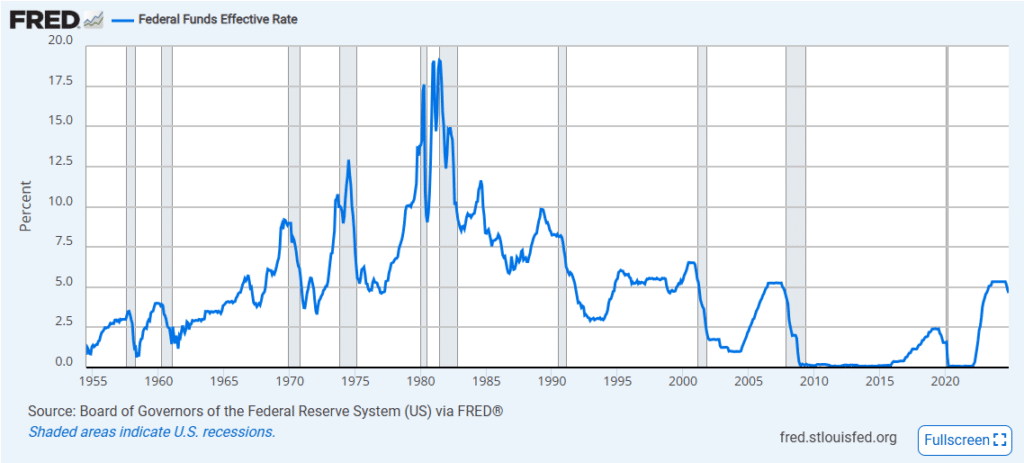
Well, based on this little chart I’m sharing with you today, 2025 could be the year we get the latest recession.
Take a look:
A careful look at the data tells a different story, one that Wall Street seems reluctant to discuss.
Historically, the Federal Reserve’s interest rate hike cycles have been a reliable precursor to economic downturns. With rates soaring through 2022 and 2023, we might be standing on the precipice of a recession that few are willing to acknowledge.
History’s Repeated Lessons: Rate Hikes and Recessions
The chart offers a clear pattern.
Every major interest rate hike cycle since the 1950s has been closely followed by a recession, indicated by the shaded gray areas. Whether it’s the sharp spikes of the late 1970s or the more gradual increases of the early 2000s, the Fed’s tightening of monetary policy often correlates with economic contraction.
The logic behind this relationship is straightforward.
Higher interest rates make borrowing more expensive, slowing down consumer spending and business investment.
Over time, this cooling effect on the economy can tip the scales into a full-blown recession.
Fast forward to today.
In response to soaring inflation, the Federal Reserve embarked on one of its most aggressive rate hike campaigns in decades, raising rates at a rapid pace through 2022 and 2023. While these moves were necessary to tame inflation, they come with a cost.
Despite this clear warning from history, the market consensus remains fixated on optimism.
Analysts are brushing off the possibility of a downturn, instead pointing to strong corporate earnings, a resilient labor market, and easing inflationary pressures as reasons to celebrate.
But are these indicators enough to defy decades of economic precedent? The chart suggests otherwise.
Why 2025 Could Be a Rough Ride
Economic cycles don’t unfold in isolation, and the lagging effect of rate hikes is a critical factor.
It often takes 12 to 24 months for the full impact of higher interest rates to filter through the economy. This means the aggressive rate hikes of 2022 and 2023 could weigh heavily on economic activity in late 2024 and beyond.
For traders, ignoring the possibility of a recession could be a costly mistake.
Betting solely on Wall Street’s optimism without preparing for downside risk is a gamble no seasoned trader should take.
While 2025 could indeed deliver positive surprises, traders need to balance this optimism with caution. Monitoring key economic indicators like unemployment rates, corporate earnings, and debt levels will be crucial in identifying whether the economy can defy history or succumb to it.
As traders, it’s not just about reading the headlines.
It’s about reading the data.
#WallStreet, #Recession2025, #MarketInsights, #InterestRates, #EconomicForecast, #FinancialPlanning, #TraderLife, #InvestSmart, #StockMarketTrends, #EconomicIndicators
The post Wall Street’s Ignorance: Is a Recession Looming Despite 2025 Optimism? appeared first on Market Traders Institute.