What to Look for in a Forex Trading Mentor: Key Considerations » The Trader In you

Why do so many traders pay for guidance and still feel lost after a few weeks? A forex trading mentor should bring clarity, not another layer of confusion.
If the person teaching cannot explain risk, execution, and decision-making in plain language, the relationship turns expensive fast.
Choosing a mentor gets tricky because confidence is easy to fake.
Screenshots, big claims, and polished social posts tell you almost nothing about whether someone can actually teach, correct mistakes, and adapt to a learner’s pace.
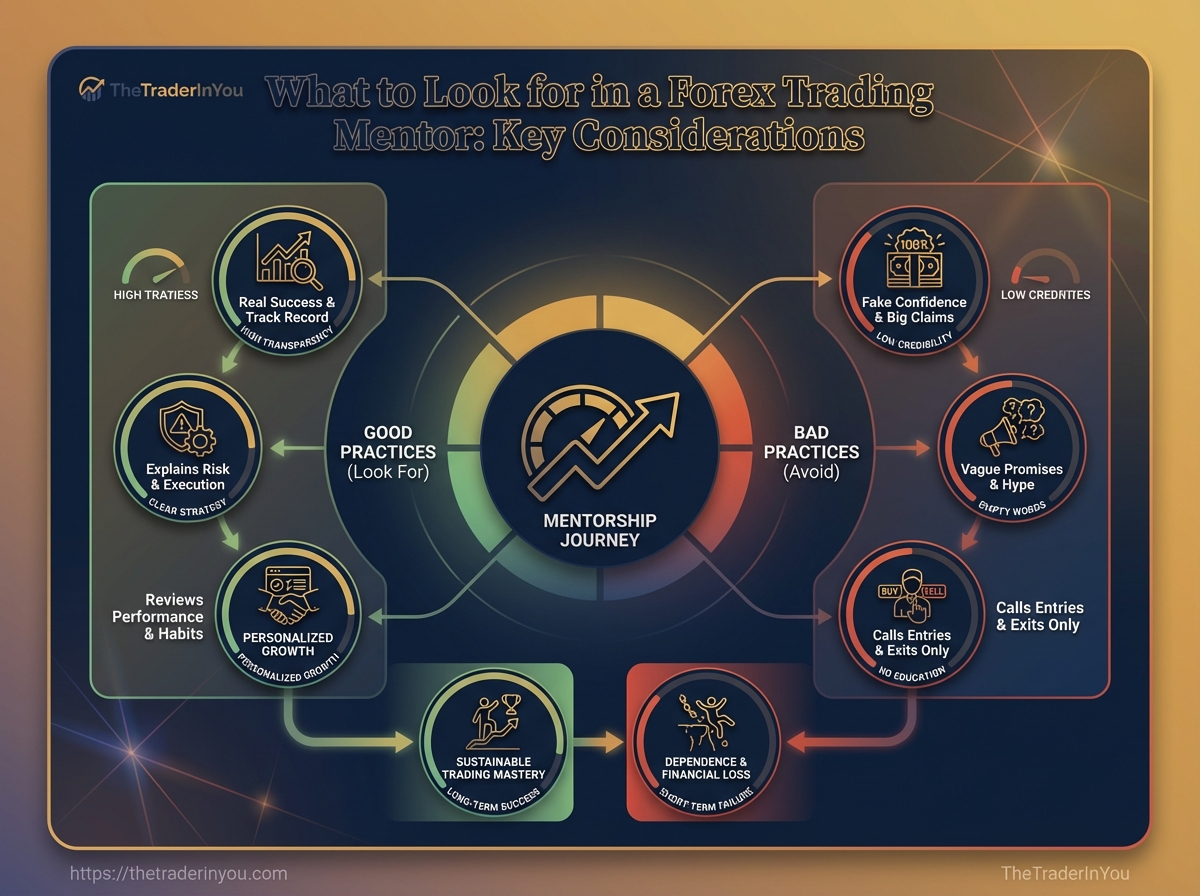
TradeDay puts it bluntly: a mentor needs real success, a track record, years of experience, and relevant experience that a student can follow and respect.
The money matters too—but not because there’s one ‘correct’ price. The real question is whether you’re buying measurable feedback, not an ongoing stream of generic advice.
A solid mentor should also do more than call entries and exits; they should review performance, address emotional habits, and help you build discipline around risk.
That is where most people get caught.
They want a shortcut, but what they really need is a guide who fits their current level, their learning style, and the way they actually trade.
Quick Answer: Choose a forex trading mentor who can back up claims with verifiable proof (not just screenshots) and who runs a structured feedback loop on your trades—so you improve your decisions, not merely hear ideas. On the first call, focus on three things: 1) Evidence: ask what documents or third-party reports they can share to validate their trading record. 2) Feedback mechanics: confirm how trade reviews work (what gets reviewed, how often, and what changes you’re expected to make). 3) Fit and support: clarify access/cadence (office hours vs private calls vs chat) and whether you’ll have practical, time-bound milestones. Price varies by program model, but avoid deals that require “commitment first” before you see a measurable, demo-first improvement path (see Section 8 for how to evaluate costs and contract terms).
A trader on a mentorship call can learn a lot in five minutes.
If the conversation is all hype, vague promises, or pressure to “act fast,” that’s already the answer.
The better test is simpler.
Notice whether the person talks about process, risk, and your specific gaps.
That matters because the relationship should feel like coaching, not active management.
Coaching helps you make better decisions on your own.
Active management starts to look like someone running your account by voice—which is a dangerous habit for a trader building judgment.
Pay close attention to the first discussion about losses.
A serious forex trading mentor will ask about your entries, exits, risk size, and emotional mistakes, then explain how they would review those decisions with you.
- Ask what gets reviewed. Good mentors discuss trade plans, risk management, and execution—not just chart patterns.
- Check for teaching style fit. Mentoring works better when the mentor can explain clearly and adjust to your pace.
- Watch for dependency signals. If every answer becomes “just follow me,” that’s active management in disguise.
- Match the cost to the role. Treat mentorship as an investment: confirm the all-in fees and the specific timeframe/milestones you’ll get (what skills you’ll demonstrate, and how progress is measured).
A useful mentor call should also fit a demo-first workflow and cover execution, leverage, and emotional control—not only trade ideas.
If the call sharpens your thinking and leaves you more independent, that’s money well spent.
The best choosing-a-mentor moment feels calm, not thrilling.
A polished certificate can look impressive on a sales page.
It still tells you almost nothing about whether a forex trading mentor can survive drawdowns, explain decisions, or teach under pressure.
Trading is judged by repeatable results and repeatable teaching—so credentials are a doorway, not the finish line.
A good mentor also needs to show how they think: how they size risk, how they handle mistakes, and how they correct behavior over time. That’s why teaching style and trade reviews belong alongside performance history.
The ideal setup includes trade review, real-time feedback, and behavioral correction—not just chart commentary; that fits the practical guidance in Forex market analysis mentorship.
What to ask for before paying
| Item to request | Why it matters | Quick validation step |
|---|---|---|
| Audited account statement | Shows a cleaner record of deposits, withdrawals, and performance | Match the broker name, dates, and balance changes against other documents |
| Broker trade history export | Gives raw trade data instead of edited screenshots | Ask for CSV or platform export and compare it with claimed trades |
| Trade-by-trade log with timestamps | Reveals whether trades were real, timed well, and consistent | Spot-check entries against market sessions and platform history |
| Third-party verification like Myfxbook or FX Blue | Reduces the chance of self-edited performance claims | Confirm the account is connected and the history hasn’t been reset |
| Drawdown and max adverse excursion details | Shows how much pain the strategy takes before it works | Compare worst-case losses with the mentor’s risk claims |
The cleanest records usually come from broker exports, Myfxbook, FX Blue, or broker-issued statements.
If someone avoids those and only offers screenshots, the story is doing too much work.
That scrutiny matters because mentorship/coaching is usually an ongoing commitment; at that level, the proof should be stronger than personality.
A mentor who can prove live performance, explain the numbers, and show their risk habits is worth a serious look.
Everything else is just noise with a nice logo.
Teaching approach and compatibility
A forex trading mentor can be excellent and still be the wrong fit.
A trader who needs live feedback will not learn the same way as someone who prefers structured lessons and quiet repetition.
That is why teaching style matters as much as experience.
Tradewiththepros describes mentorship formats that range from one-on-one coaching to group classes, online sessions, and in-person work, which tells you the real choice is not “mentor or no mentor,” but which format fits your learning habits (Forex Market Analysis Mentorship).
A good match also needs curriculum alignment.
TradeDay says the person teaching should have a track record, years of experience, and relevant experience, but the lesson plan still has to line up with your current stage and your time horizon (How to find a good trading mentor and the 5 places where not to look for help with your trading).
Format fit
Workshops: Best for traders who want concentrated learning, live examples, and a clear structure.
They work well when you need to see a full process, not just hear theory.
One-on-one coaching: Best for traders with specific problems, especially repeated mistakes or poor execution.
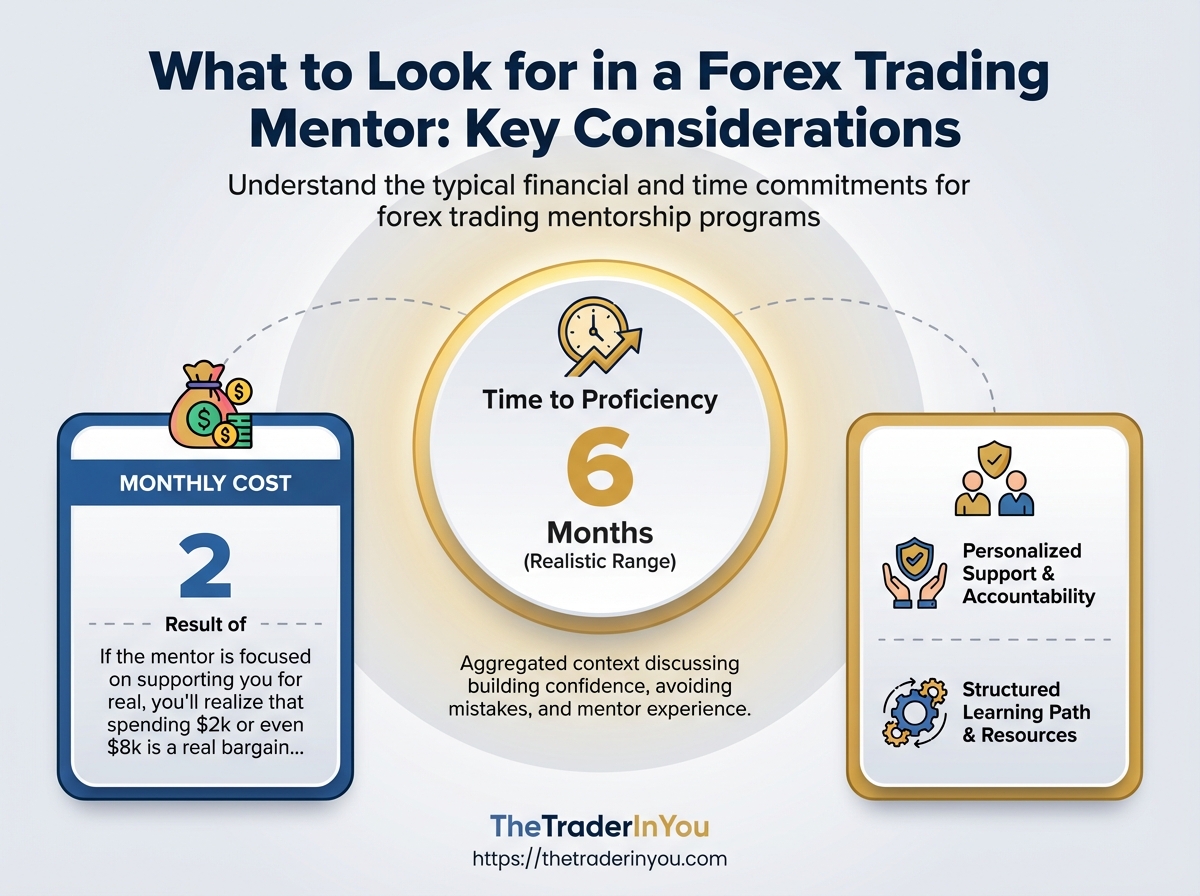
Our own education review places mentorship/coaching at $200–$2,000+/month in 2025, with a 3–12 month path to proficiency, which is a serious commitment (Forex trading educational resources reviewed).
Group classes: Best for traders who want accountability and lower cost.
They can be useful if the mentor still gives room for direct questions instead of running a pure lecture.
Curriculum fit
Strategy match: Ask which setups are taught and whether they match your market style.
A mentor teaching breakout systems to someone who wants mean reversion is a bad fit, even if the mentor is talented.
Hands-on drills: Good programs include demo practice, trade journaling, and review exercises.
That matters because we already advise traders to start with a demo account and short course work before adding deeper mentorship (Structure Your Trader Education).
Time to competence: The timeline should be realistic.
If a program promises mastery in a few weeks, the calendar is doing more talking than the mentor.
Risk and trade lifecycle
A strong mentor covers the whole trade, not just the entry.
That means position sizing, stop-loss placement, trade management, exit rules, and post-trade review.
They should also teach emotional control.
Fear, greed, and overconfidence can wreck a decent setup, which is why a mentor who skips the psychology side is teaching half a lesson.
- Risk rules: Ask how losses are capped and reviewed.
- Trade planning: Ask how entries, exits, and invalidation are defined.
- Execution habits: Ask how the mentor checks slippage, spreads, and broker conditions.
- Behavioral review: Ask how mistakes are tracked and corrected over time.
The best trading mentorship programs feel practical, not theatrical.
That is the standard we use when we judge fit for our own education resources.
Program structure, pricing, and commitments
Why does one mentorship offer look cheap and still cost more than the premium option? The answer is usually in the structure, not the headline price.
A forex trading mentor can be sold by the hour, by the month, or by a fixed program.
The price only makes sense when it matches the amount of feedback, review, and access included.
The Trader In You’s 2025 education review puts mentorship/coaching at $200–$2,000+/month with 3–12 months to proficiency, which is a useful anchor when a sales page avoids clear numbers (forex trading educational resources reviewed).
TradeDay also argues that a mentor should have real track record, years of experience, and relevant experience, not just good marketing copy (how to find a good trading mentor).
Common program models and what they usually mean
That matters because the format changes the kind of progress you can expect.
Hidden costs usually show up as platform subscriptions, recorded-call libraries, charting tools, mandatory software, or extra review sessions.
A fair contract should also spell out trial length, refund rules, renewal terms, and measurable milestones such as journal quality, execution discipline, and stop-loss consistency.
- Ask for the full bill: tuition is only part of the cost.
- Check renewal terms: some programs roll over quietly after the intro period.
- Tie milestones to behavior: profit targets are weaker than execution rules and risk control.
- Read the risk language: the FCA requires standardized warnings for CFD distribution to retail clients, which is a reminder that leverage needs blunt wording, not sales gloss (COBS 22.5).
Choosing a mentor gets easier once the program is measured against a real learning path.
If the structure, price, and commitments do not fit how you study and trade, the offer is already too expensive.
A five-star review is cheap.
A forex trading mentor can buy praise, bury criticism, or surround themselves with affiliate noise that looks like endorsement.
The better question is whether outside proof, reference checks, and outcome samples point in the same direction.
What “good third-party validation” looks like
If every testimonial reads like a sales page, and nobody can explain the sample period, the account type, or the risk cap, treat it as marketing first and evidence second.
A mentor who brushes off risk disclosures is also worth side-eyeing—serious markets don’t run on hype.
A clean reference check usually starts with one simple test: ask for the same outcome in two forms.
A written testimonial is fine, but a broker statement, verified trade log, or time-stamped performance sample carries more weight.
A simple way to record claimed outcomes
| Student sample | Reported result timeframe | Risk parameters used | How it’s verified (what you can check) |
|---|---|---|---|
| Student A (mentor-provided) | e.g., 6 months / specific date range | e.g., % risk per trade, max daily loss | e.g., Myfxbook/FX Blue link OR broker export + timestamps |
| Student B (mentor-provided) | e.g., 10 weeks / specific date range | e.g., fixed SL methodology + max drawdown | e.g., trade-by-trade log matched to platform history |
| Student C (reference call) | e.g., after onboard period | e.g., consistent risk cap + journaling rules | e.g., verified screenshots tied to account statements |
If a forex trading mentor can’t show context around the result, the claim is too soft to trust.
One last rule helps a lot: ask whether the sample reflects a demo-first learning path (or at least a staged progression), not just a lucky screenshot.
A good choosing-a-mentor process should reveal how the program handles execution, psychology, and risk before it ever talks about profits.
Interaction dynamics: access, feedback frequency, and community
A forex trading mentor can look great on paper and still be a poor fit if the communication rhythm is messy.
The real test is simple: can you get help when a trade is fresh, or do you have to wait until the lesson is stale?
That matters because mentorship works best when it includes structured guidance, real-time feedback, and trade review, not just theory sessions after the fact.
Trade guidance that adapts to the trader’s questions, strengths, and gaps is exactly the kind of setup described in Forex Market Analysis Mentorship.
A strong program usually has three access layers.
Office hours handle common questions, private calls handle deeper mistakes, and Slack or Discord handles quick checks without turning the mentor into a 24/7 help desk.
The cadence should match the stage of the trader.
Beginners need frequent review of entries, exits, risk, and journaling habits, while more advanced traders often need sharper feedback on execution and discipline.
A mentor’s feedback should leave a paper trail.
Trade reviews, journal notes, and performance reports make it easier to spot repeat errors like moving stops, chasing entries, or overtrading after a loss.
- Office hours: Look for fixed windows and a clear topic scope, so support feels predictable instead of random.
- Chat access: Ask whether replies come within hours or days, and whether screenshots and trade logs are fair game.
- Private calls: Good calls end with action items, not vague encouragement.
- Journals and reports: The best mentors review habits, not just winners and losers.
- Community critique: Moderated peer feedback should sharpen judgment, not turn into a noisy chatroom.
Community matters because trading can get isolated fast.
Group sessions, shared trade replay discussions, and moderated critique create accountability, and structured group formats are common across mentorship models, including the ones described by Forex Market Analysis Mentorship.
If the access is fuzzy, the feedback is irregular, and the community is mostly noise, the mentorship is probably selling comfort rather than growth.
A good forex trading mentor makes interaction feel disciplined, specific, and useful.
What should I look for in a forex trading mentor before paying?
Prioritize what you can verify and how you’ll be coached. Use the “what to ask for” evidence checklist (Section 5) and the first-call decision cues (Section 3) to confirm the mentor will review your actual decisions—not just discuss generic trading ideas.How do I verify a forex mentor’s track record and credibility?
Don’t rely on polished certificates or isolated screenshots. Request the record types listed in Section 5 (audited/broker exports/trade logs) and assess testimonials using the context/verification logic in Section 9 (sample period, account type, risk caps, and how the result was validated).What mentorship format (one-on-one, group, online, in-person) is best for my learning style?
Choose the format based on feedback needs and how you learn, not on prestige. Match your situation to the teaching/compatibility framework in Section 6, then sanity-check the communication rhythm and deliverables described in Section 11.How much does forex trading mentorship or coaching typically cost?
Expect pricing to vary by model (hourly vs cohort vs subscription vs performance-based) and by the amount of access and review you actually receive (Section 8). Rather than chasing a “cheap” number, pay for measurable feedback and clear terms (trial, refunds/renewals, milestones, and hidden costs).Should I use a demo account before working with a mentor?
Yes—at least at the start. Confirm the mentor supports a demo-first or staged learning path (Section 3 and Section 9), and use that period to see whether they improve your execution decisions through structured review (deliverables and cadence in Section 11). Only move to real capital once the process is consistently working.The real test of a forex trading mentor is whether you can evaluate them on evidence, execution, and fit—before you commit.
When you’re deciding, run a quick pass in this order: (1) evidence (what real records they can share and how you can validate them), (2) coaching mechanics (how often they review your trades and what deliverables you receive), and (3) terms (trial length, refunds/renewals, milestone structure, and any hidden access costs).
If the mentor can’t explain their decision rules and risk behavior clearly—or they won’t provide credible documentation you can verify—step back. Time and capital are both too valuable to treat mentorship like a marketing pitch.
Follow Joshua for daily forex tips on X: @thetraderinyou or connect with him on LinkedIn: Joshua Okapes.
Source link