Will Nations Fight Bitcoin With Competing PoW? Game Theory Explained
In a discussion on X, Jason Lowery debated the viability and future of Reusable Proof-of-Work (RPoW) networks—particularly whether nations might attempt to create competing proof-of-work systems. The conversation was sparked by an inquiry from Rabbit Hole Investor (@rabbitholeinvst) directed at Lowery, an astronautical engineer, Major in the US Space Force, and author of the “Softwar” thesis. Lowery’s thesis emphasizes Bitcoin’s strategic importance for US national security.
Can Nation-States Fight Bitcoin With Their Own PoW Network?
Rabbit Hole Investor asked Lowery, “Do you see a future where other reusable proof of work networks are created for other applications?” Lowery responded by referencing questions he previously received from the White House Office of Science & Technology Policy.
He stated that while he cannot predict the future with absolute certainty, he believes there will be a dominant RPoW network that gains universal acceptance in much the same way that TCP/IP became the global standard for data transport: “This was one of the questions I received from the White House Office of Science & Technology Policy. […] My intuition is that a single dominant Reusable Proof-of-Work (RPoW) network will emerge as the primary standard—much like how TCP/IP became the universal protocol for data transport […] In RPoW, network size directly translates to security. […] This consolidation of all RPOW applications into one RPOW network […] is a strategic necessity.”
He elaborated on how RPoW’s security scales with computational power and energy expenditure, creating a “reinforcing cycle” that naturally incentivizes participants to migrate to the largest and most secure network. Lowery pointed to what he calls “Mutually Assured Preservation,” where even adversarial nation-states (e.g., NATO and BRICS) would effectively become “frenemies” on the same RPoW network. According to his assessment: “The cost of attacking either side increases to such an extent that they become ‘frenemies,’ each strengthening the security of the other’s interests on the same network.”
Lowery’s stance leans strongly toward Bitcoin as the dominant RPoW protocol. While he does not label himself a “Bitcoin Maximalist,” he makes it clear that Bitcoin is the de facto global PoW standard due to market forces and network effects.
Thomas Young, Managing Partner at RUMJog Enterprises, further probed Lowery’s thesis by asking about individual Bitcoin ownership and the monetization potential for BTC in a world where nation-states treat the network as “The Standard”: “Will it be practical for individuals to own privately held BTC? … Specifically, would interested nation states ‘rent’ privately held BTC to misattribute or create diversification or will they simply want to own their own BTC?”
Lowery replied: “I’m a subscriber to the belief that if Bitcoin becomes a global unit of account, its purchasing power will naturally increase as humanity grows more productive. This makes the need to chase yield obsolete—unnecessary, even. Bitcoin itself is the yield.”
He then shared a cautionary perspective on the promises of yield in a future where governments might adopt executive orders to seize custodial BTC. According to Lowery: “If I were a nefarious president or nation, I’d lure people into giving up self-custody of their BTC by dangling the promise of yield… Then, with a simple executive order, I’d nationalize NYDIG, Coinbase, and MSTR’s Bitcoin… This is why I don’t own MSTR. MSTR’s Bitcoin is a future president’s honeypot… When the next EO6102 inevitably comes, it will be widely supported.”
Another user asked Lowery whether sovereign entities might create their own networks—for instance, sidechains or drivechains pegged into the main Bitcoin network—under their sovereign control. Lowery responded by contrasting PoW and Proof of Stake (PoS) in terms of centralization: “If the goal is sovereign control over a network, then PoS is a far better design than PoW… A nation (or any entity) could simply pre-mine the tokens, distribute them to itself, and implement a vote-based PoS system… This structure would ensure that control remains centralized… while still maintaining the (false) appearance of a decentralized system.”
He acknowledged that a nation could create an RPoW network with centralized administrative control, but he considers this approach more complex and less efficient compared to a straightforward proof-of-stake system for achieving centralized governance: “PoS offers a more direct and practical way to achieve centralized control over a digital asset network without the computational and energy-intensive requirements of PoW.”
The overarching theme of Lowery’s commentary is that game-theoretic pressures—both among individuals and nation-states—tend to favor consolidation around a single, most secure PoW network. He argues that Bitcoin’s sheer scale and entrenched position give it a near-insurmountable lead. Meanwhile, nations seeking control might experiment with alternative protocols, but ultimately face a steep uphill battle competing against what has already been embraced by “the free and open market.”
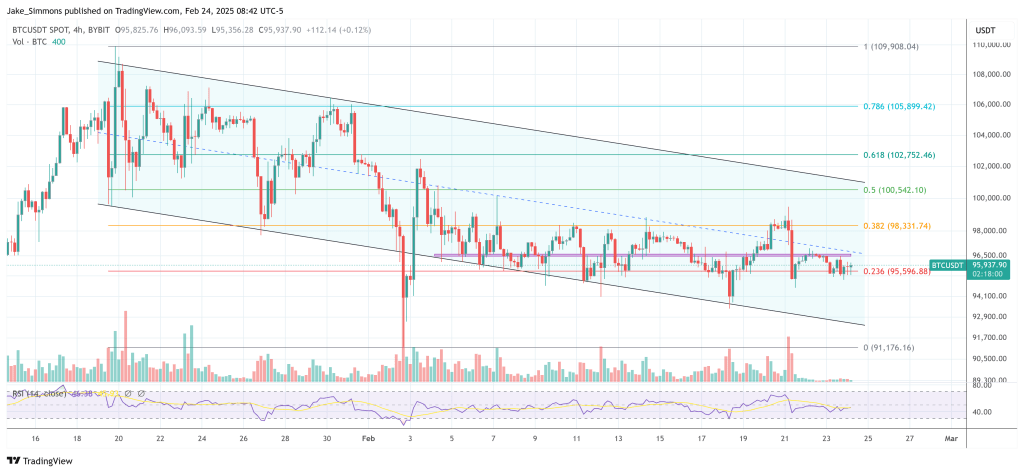
At press time, BTC traded at $95,937.